The First Amendment Audit: The Camera Is Not a Press Credential
Stardate 2026.237 · D947
Published source copy. Educational material, not legal advice.
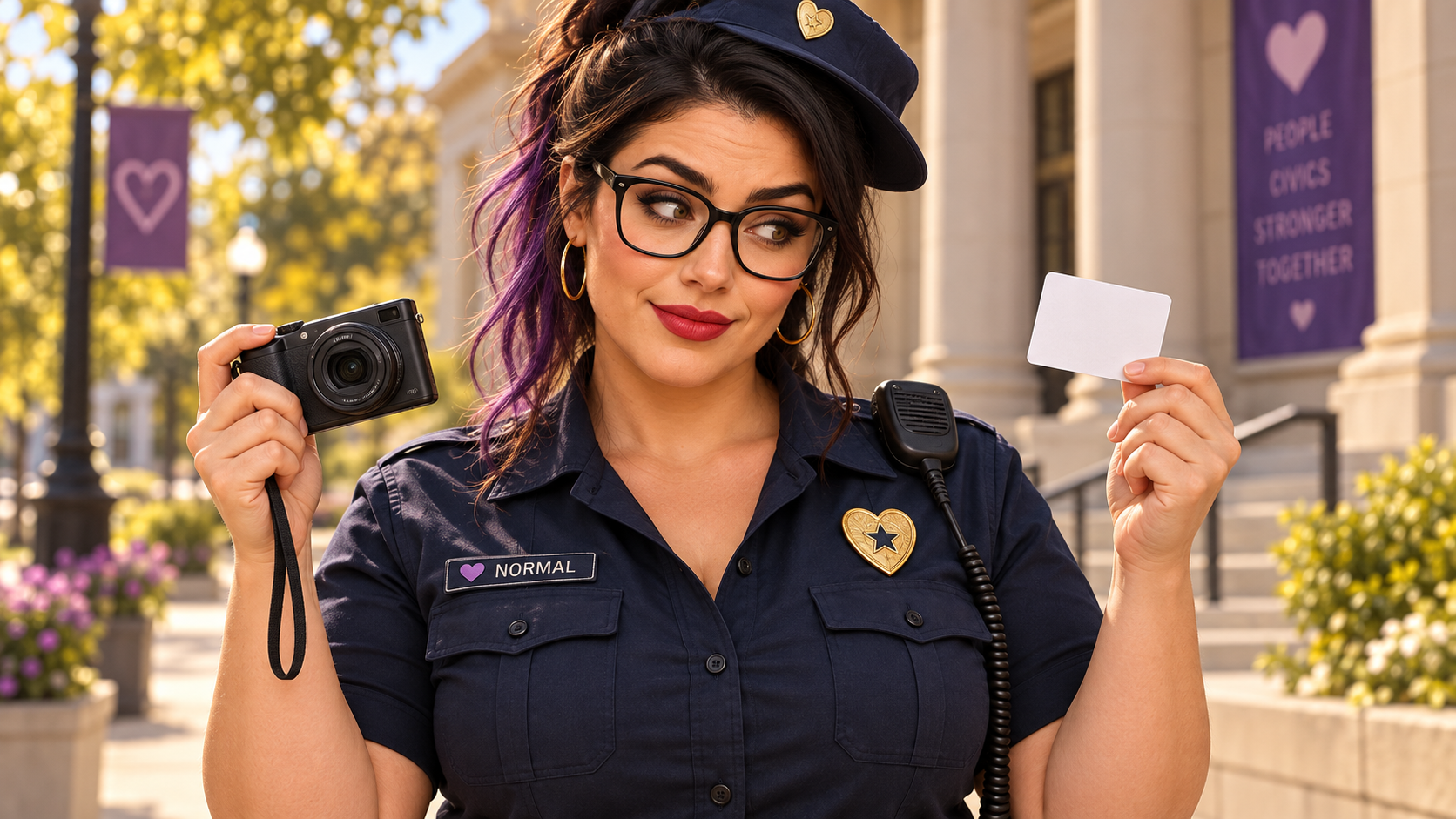
Everybody wants the badge
The First Amendment auditor walks into the scene with a camera and a sentence already loaded:
I am the press.
The sentence has force because the underlying instinct is right. A free society cannot reserve public truth-telling for people who have been approved by a newsroom, a police chief, or a government office. The press is not only a building with a masthead. It is also the people watching what power does in public.
But the legal sentence needs one calibration before the camera starts rolling:
The First Amendment protects freedom of the press. It does not automatically issue every person a government press credential or create an unlimited right to enter every place and record everything.
That distinction does not weaken the audit. It makes the audit harder to dismiss.
What the First Amendment actually carries
The amendment holds several freedoms in one compact charge: religion, speech, press, peaceful assembly, and petitioning the government for redress. These are not five unrelated decorations. Together they describe a public capable of believing, speaking, gathering, criticizing, documenting, and demanding an answer.
That is why a camera can matter. It turns a one-sided encounter into a record that can be reviewed. It lets a person document what a public employee says, what a policy requires, whether access is being applied consistently, and whether the official response is about safety or about disapproval.
The camera is not magic. It is a witness.
The public sidewalk is not a private office
Public forums have a special place in First Amendment doctrine, but “public” does not mean “anything goes.” Government may enforce reasonable, content-neutral time, place, and manner rules. A person generally cannot block a doorway, enter a restricted workspace, ignore a safety perimeter, threaten someone, trespass, or turn recording into physical interference and then call the interference speech.
The first audit question is therefore not only Can I record? It is also:
Where am I standing, what is the rule, and am I interfering with the work?
Those questions protect the auditor from confusing a constitutional principle with a personal demand for access.
“No expectation of privacy in public” needs care
The phrase is common in auditor culture, and it points toward a real difference between a public-facing scene and a private home. But it is too blunt to carry the whole legal analysis.
A person may be visible in public without surrendering every legal protection. Different laws can govern audio recording, private conversations, protected personal information, minors, medical information, court-protected material, and the use or publication of a recording. A public employee may be working in a public place while an unrelated private citizen is passing through the frame. A public building may contain both open areas and restricted rooms.
The responsible auditor asks what is visible, what is audible, what is lawful, and what is necessary. The goal is a record of public power—not a license to make strangers into props.
The audit is a boundary test
The cleanest First Amendment audit tests a boundary:
- Is the person in a lawful public place?
- Is the recording peaceful and non-interfering?
- Is the official reacting to conduct, or to a viewpoint?
- Is the restriction written, neutral, and consistently applied?
- Is the official asking for identification or a press credential that the law actually requires?
- Is the person being ordered away because of a lawful safety rule, or because the camera is embarrassing?
The answer is not always “the auditor wins.” The answer is a record precise enough that someone outside the adrenaline of the encounter can tell what happened.
That is the part the internet often loses. The audit is not a theater trick where the loudest person earns the Constitution. It is documentation under pressure.
The First Amendment is not a command to escalate
Some auditors treat escalation as proof. If the employee gets angry, the video gets more views. If the officer raises the volume, the thumbnail gets sharper. If the person filming keeps poking after the legal point is clear, the confrontation becomes content.
That may be good engagement. It is not automatically good civic work.
A camera can record without baiting. A person can ask for the policy without insulting the employee. A person can decline to answer a question without turning the refusal into a threat. A person can leave when the lawful encounter is over and still preserve the record.
The First Amendment protects the right to speak. It does not require a person to perform anger in order to deserve protection.
The Normal Like Peter translation
This is where the amendment becomes more than a civics card.
People who have been disbelieved learn to bring receipts. People who have been overruled learn to document the room. People who have been told that their memory is the problem learn to press record before the story gets rewritten around them.
That instinct deserves respect. It also deserves a method.
The camera can be a counter-record without becoming a weapon. The audit can expose a power imbalance without manufacturing a new one. The point is not to humiliate the person behind the counter. The point is to keep public power answerable to the public.
The First Amendment does not say that every recording will be comfortable. It says the government does not get to decide whose speech counts as speech merely because the speech is inconvenient.
A field card for the next audit
Before recording:
- Confirm the property boundary and whether the area is open to the public.
- Read the posted policy if one exists.
- Keep a clear path and do not interfere with staff, emergency work, or members of the public.
- Record the full context when possible, not only the confrontation.
- Ask for the rule and the official’s name or role without inventing a right to private information.
- Preserve the original file and write down the time, location, and sequence.
- If the encounter becomes a detention, search, threat, or arrest, stop treating the camera like a courtroom and get qualified legal advice.
The camera is not a press credential.
It is something more ordinary and, in the right hands, more important: a citizen keeping a record.
This essay is general civic education, not legal advice. Recording and access rules can vary by jurisdiction, property type, and circumstance. Consult a licensed attorney for a specific situation.
