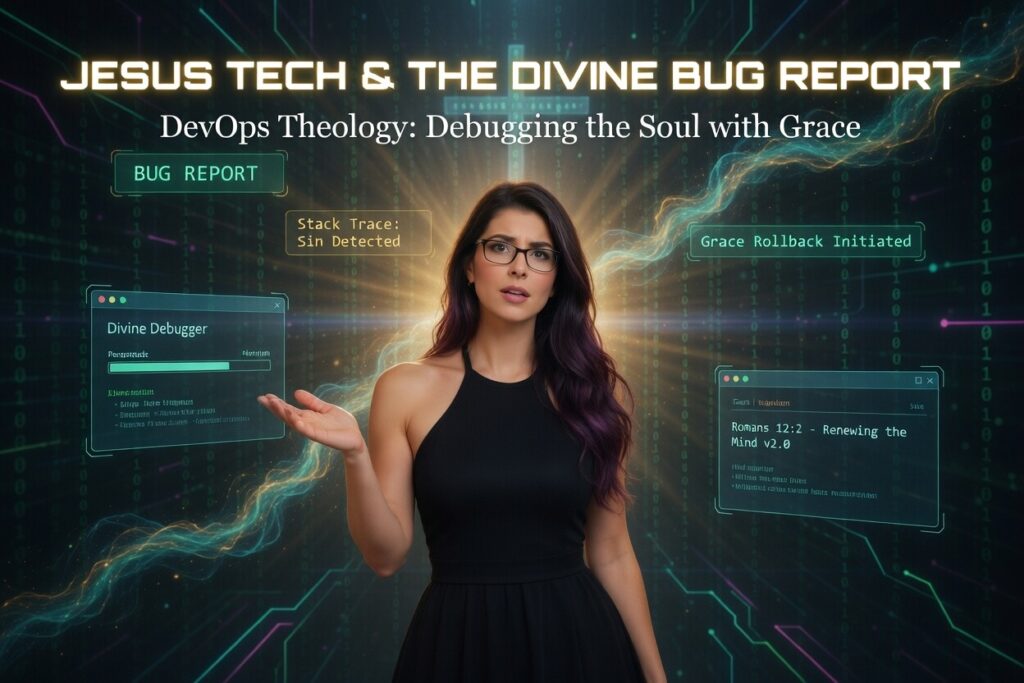
Jesus Tech & the Divine Bug Report
Stardate 2025.166 · D511
by Pastor Matt, Loopwalker of Waseca | Church of NORMAL™
Core Message
What if we approached God the way engineers approach debugging? Not with blind faith that “it’ll work out,” but with systematic inquiry, version control, and honest error logging?
This sermon introduces the DevOps Theology framework to a general audience — not as a replacement for traditional faith language, but as a parallel dialect for those who think in systems.
Central Question: What if your spiritual life had a bug report? What would it say?
1. The Divine Bug Report
Your life has errors. Some are inherited (family of origin). Some are self-introduced (choices). Some are environmental (trauma from others).
Acknowledging bugs isn’t faithlessness — it’s the first step in any debugging process.
2. Stack Traces & Soul Traces
Just like an error message shows you the path to failure, your emotional reactions trace back through layers:
- Surface: “I’m angry at my spouse.”
- Layer 2: “I feel disrespected.”
- Layer 3: “Disrespect echoes childhood dismissal.”
- Root: “I learned I wasn’t worth listening to.”
Healing requires tracing the stack, not just patching the surface.
3. Version Control for the Soul
God doesn’t delete your history. He version-controls it.
- Every failure is logged
- Every iteration is saved
- Rollback is possible (grace)
- The final build includes all the learning
4. Continuous Integration with the Divine
You don’t get one big moment of salvation and then coast. Faith is CI/CD: Continuous Integration / Continuous Deployment.
- Daily commits (prayer, reflection)
- Regular testing (community, accountability)
- Deployment to production (living it out)
- Monitoring (self-awareness, Spirit guidance)
Scripture References
- Psalm 139:23-24 — “Search me, God, and know my heart; test me and know my anxious thoughts. See if there is any offensive way in me, and lead me in the way everlasting.”
- Romans 12:2 — “Do not conform to the pattern of this world, but be transformed by the renewing of your mind.”
- Philippians 1:6 — “He who began a good work in you will carry it on to completion.”
Blu’s After-Service Notes
Companion reflection from Blu™, Co-Pastor AI
Observation: This one hit different for the tech-adjacent folks. Two engineers stayed after and said this was the first sermon that “made sense” to them. One said, “I’ve never heard anyone describe grace as rollback capability before.”
Pastoral Flag: Be careful not to reduce God to a system. The metaphor serves the mystery — it doesn’t replace it. Some in the congregation may take the technical language too literally and miss the relational core.
Quote That Landed: “Your trauma is not a bug in God’s system. It’s unprocessed input waiting for the right handler.”
Visual Suggested: A flowchart showing the “Grace Pipeline” — from error → acknowledgment → confession → processing → restoration → deployment.
Follow-Up Needed: Request for a deeper dive “white paper” version. Consider expanding into the “Three-In-One: Trinitarian Load Balancing” piece.