Wednesday September 9, 2026
Stardate 2026.252 · D962 · C239 · NG+ D40
L:D5A8.D962.C239.2026.252
#normallikepeter #churchofnormal #carnivalofnormal #NLPNews #Waseca
NLP News · By Matt Stoltz
What happened to the church bells? Who occupied City Hall before the people we remember? What survives of the university years, the printing plants, and the stories that still travel around town?
Those questions belong together. Waseca’s history lives in institutions, work, worship, music, family memories and newspaper pages. Some of those pages describe terrible events. Others describe a parade, a new business or neighbors turning out to help.
This article began with local questions and an AI-generated list of mysteries. Checking the sources changed several of the stories. A giant flag became a different kind of puzzle. A supposed school shooting became the documented prevention of an attack. A mayor list acquired visible gaps. There is plenty to investigate without adding certainty the records cannot supply.
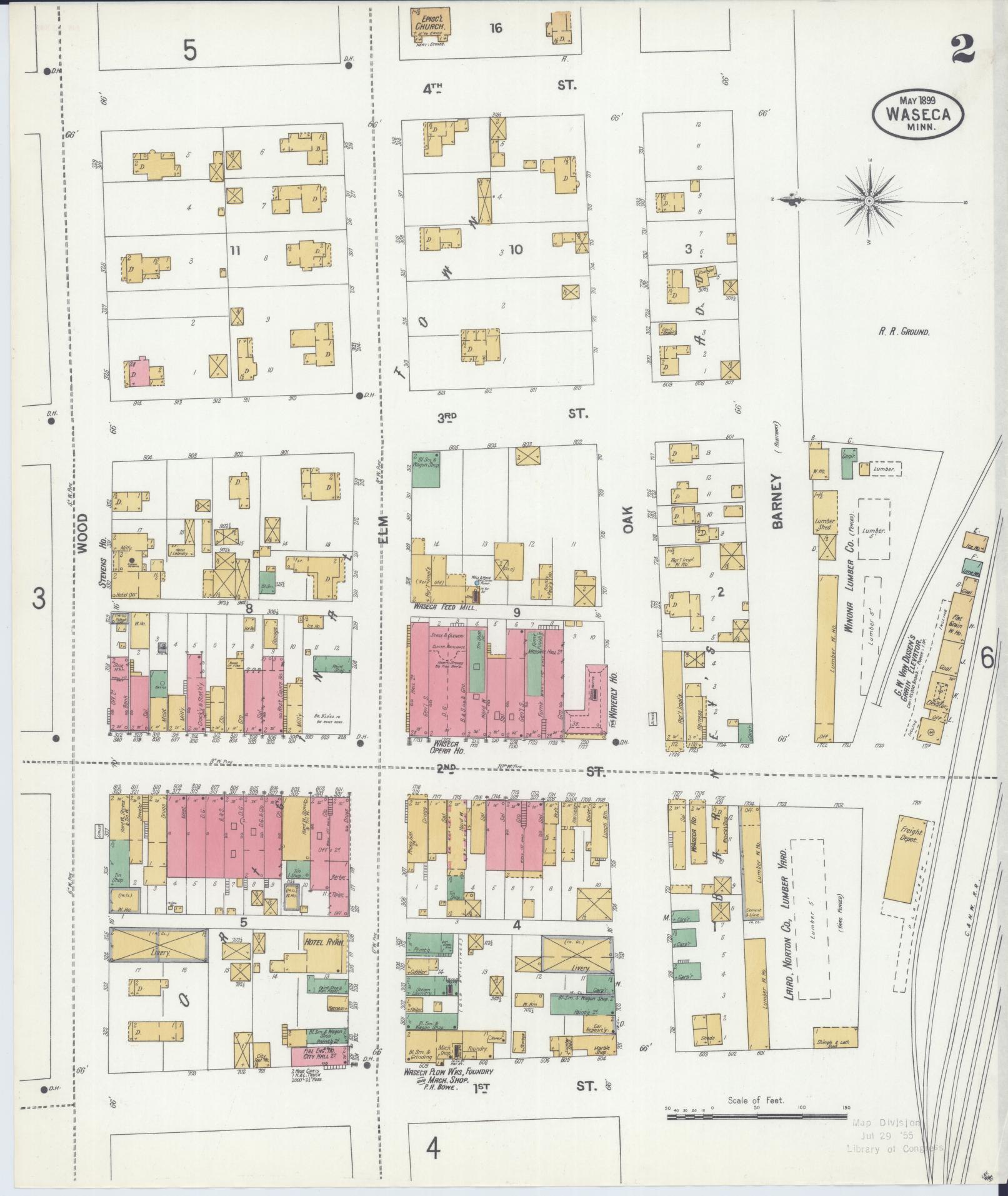
What happened to the bells?
There is a documented interruption in one familiar civic sound. In August 2024, the Pioneer reported that the courthouse bell’s mechanism malfunctioned in 2017 and was disabled. After a long search for specialist help, striking resumed. The article describes a pattern of counting the hour and striking once at the half-hour. It documents a shutdown and restoration; it does not verify today’s operation. Pioneer, August 8, 2024, page 17.
Church bells have their own histories. The specialist TowerBells inventory records a ten-note Deagan tubular chime installation at Waseca’s former Methodist church in 1923, later scrapped when the building became the county museum. North Waseca Lutheran’s history records preserving its 800-pound bell in a replacement tower in 1963. Removal at one building does not explain every church’s sound. TowerBells inventory, North Waseca Lutheran history.
For the Catholic church in town, I am taking the question to mean Church of the Sacred Heart in Waseca. Its December 28, 2025 bulletin describes hoped-for repairs to the south bell-tower stairwell. That establishes a maintenance plan, not that its bells stopped. We have not confirmed a current ringing schedule or the cause of any interruption. Parish identity and history, December 2025 bulletin, PDF page 5.
Hourly striking also differs from the Catholic Angelus, traditionally observed morning, noon and evening, and from bells for services or funerals. That distinction helps frame the next question: which bell, at what time, during which years? The tradition alone cannot tell us Sacred Heart’s local schedule. Vatican News on the Angelus.
Start with the newspapers that were actually there
The Waseca County Pioneer began in 2022 and marked four years this September. Waseca County News adopted its current title in 1982, continuing earlier local newspaper traditions. They are separate publications. Pioneer anniversary, Minnesota Historical Society newspaper history.
For older events, the name on the search box matters. In 1919, look for the Waseca Journal-Radical and Waseca Herald. In 1929, look for the Waseca Journal and Herald. Library of Congress records document those title periods; searching only a modern paper’s name can miss the contemporary account. Journal-Radical, Journal, Herald.
The wider county record includes Wilton’s early papers, the Janesville Argus and today’s Janesville Journal, and the New Richland/Star Eagle lineage. The History Center catalogs newspaper collections, business files, oral histories and dedicated crime materials. Its collection list is a practical starting point for a specific question. A listing tells us material is cataloged; it does not mean we have read it. History Center resources, Janesville Journal, NRHEG Star Eagle.
Two civic buildings, several different dates
Waseca became the county seat in 1870, replacing Wilton. The courthouse’s National Register nomination describes records and furniture moving on election night. The present courthouse dates to 1897 and was designed by Orff & Joralemon; a north addition followed in 1976. County-seat history and the surviving building’s construction are separate dates. National Register nomination.
City Hall requires its own timeline. James E. Child’s 1905 county history records the city’s June 14, 1888 purchase of Nicholas J. Breen’s blacksmith property for a City Hall. The downtown historic-district nomination identifies a later redevelopment of the old City Hall site in 1978. Neither date establishes when today’s municipal building opened. Child’s original book, printed pages 709–710, downtown nomination, PDF page 62.
The current city page places City Hall at 508 South State Street and lists Randy Zimmerman as mayor. The present building’s original opening records remain a useful local-history question. Official city roster.
Who were the mayors?
Child distinguishes earlier village presidents from city mayors. His mayor roster supplies the following early chronology. These are the years he attributes to office, rather than a modern reconstruction of election and oath dates. He also says the early village record book was already missing when he wrote. Original roster, printed page 589.
| Years in Child’s account | Mayor |
|---|---|
| 1881 | Warren Smith |
| 1882 | M. L. D. Collester |
| 1883–1885 | I. C. Trowbridge |
| 1886 | G. Buchler |
| 1887 | E. B. Collester |
| 1888–1890 | D. S. Cummings |
| 1891 | D. E. Priest |
| 1892 | I. C. Trowbridge |
| 1893–1896 | D. S. Cummings |
| 1897 | John Moonan |
| 1898–1903 | C. A. Smith |
| 1904–1905 | Wm. C. Wobschall |
Later records need more assembly. For example, the Legislative Reference Library credits George H. Goodspeed with three years as mayor but does not supply their dates. Contemporary MPR reporting identifies Judy Kozan as a former mayor in February 1996. Those are useful anchors; they do not fill every intervening term. A complete succession requires election returns and organizational minutes, including acting service and contested outcomes. Goodspeed record, MPR’s 1996 report.
The flag mystery survives the fact-check
The enormous 48-star flag found at the fairgrounds is a real historical puzzle. But the checked reporting describes cotton, with a June 29 measurement of 36 by 19 feet. Claims that it was heavy wool from 1818 or the Civil War, with stars added later, are unsupported by the inspected articles. Pioneer, July 2, 2026.
CNN’s July 4 account follows possible connections to 1940 and 1942 parade photographs and a newspaper caption. Those clues could help establish its story, but a caption’s different dimensions leave room for doubt about the match. Maker, commission date and provenance remain open. The interesting work is comparing the object, photographs and accession records. CNN’s flag investigation.
Murder records and courthouse ghost stories
The Schuch family tragedy began on May 18, 1929. Historical Society and local newspaper retrospectives describe the deaths of Julius Schuch and two children. Those accounts disagree on some names and details. The History Society’s 2010 account still described an unsolved case; that is a dated historical statement, not a new official determination in 2026. History Notes, August 2010, page 4.
A later recollection about John Ruehl’s alleged confession does not establish a proven perpetrator. Before retelling the scene in detail, the original newspaper coverage and investigation materials deserve inspection. The historical horror needs no invented dialogue or motive. Ruth Ann Hager’s 2010 retrospective.
The courthouse has a different kind of story. Pioneer reporting connects the vault-staircase lore to Ralph Garland’s death on January 26, 1919, and reports that the death was ruled suicide. It also recounts later staff experiences and paranormal investigations. Those accounts document a haunting tradition; they do not establish a ghost or overturn the reported death finding. Pioneer, “Ghost stories persist”.
The 2007 Kruger case belongs in a different category again. Tracy Kruger and his son Alec were killed; Hilary Kruger survived. Michael Zabawa was convicted, and the Minnesota Supreme Court affirmed in 2010. This is an adjudicated case, not an unsolved mystery. Minnesota Supreme Court decision.
A school attack was prevented, and the town had to respond
In April 2014, a resident reported suspicious activity, and police encountered 17-year-old John LaDue. The planned school attack was prevented. Waseca did not experience the school shooting that a loose retelling might imply.
The legal history also needs care. The Court of Appeals upheld dismissal of attempted-murder and attempted-property-damage counts because the evidence did not meet the required threshold for conduct beyond preparation. Separate possession charges remained. LaDue later pleaded guilty to an explosive-device offense; July 2016 reporting describes probation ending when he accepted the felony sentence with the incarceration time already served. Court of Appeals decision, 2015 plea reporting, 2016 disposition.
The town’s response included a family meeting, counselors and questions about safety. Worship and the school variety show were part of the immediate community scene. WCCO on the family meeting, WCCO on school and worship responses. Later disagreement over accountability and reintegration was also real. A community response can contain relief, fear, faith and conflicting judgments at the same time. FOX 9’s 2016 reporting.
Another response deserves remembering: in October 2023, a missing-child search ended with the child found safe. Police thanked hundreds who helped. That is a resolved search, and the old article should never become a current missing-person alert through careless reposting. This survey does not establish a complete roster of open disappearances. FOX 9’s updated search report.
Scandals require the same precision
Child’s history records an 1894 financial scandal involving J. L. Claghorn. It is a route into original local court and newspaper records, with the author’s judgments kept separate from ours. Child’s historical account.
A much later federal case has a Waseca connection through a defendant’s residence. In 2012, federal prosecutors announced Kevin Coleman’s sentence for embezzlement involving a Connecticut company. The location matters: this was not a finding of corruption in Waseca’s city government. U.S. Attorney’s sentencing release.
Folklore, old houses and the people before the plat
In June 1905, the Minneapolis Journal reported a visitor digging near a vacant Byronville house in search of supposed buried wealth. The story included spirits and an outlaw explanation. The digging produced no treasure. We have an old newspaper account of a treasure belief, not confirmation that the treasure existed. Transcription, original issue, page 12.
The History Center describes the 1868 Bailey House as one of Waseca’s oldest homes and its early owner Dayton Smith as an accused horse thief. Both qualifications belong in the retelling. Local memory towns likewise deserve individual histories rather than one explanation about railroads. History Center research page, county history.
The name Waseca is locally explained through Dakota language and the land’s abundance. A fuller history also has to address displacement: MNHS describes the Ho-Chunk’s forced removal in 1863 despite their nonparticipation in the U.S.–Dakota War. Dakota and Ho-Chunk histories are distinct. Tribal-authored histories and language sources deserve room in the next stage of this work. History Center county history, MNHS Ho-Chunk history.
The university years and the research that continued
The university’s local story began with land and farming. Regents purchased land southwest of Waseca in 1912; the demonstration farm and experiment station began operating in 1913. The Southern School of Agriculture opened in 1953. Following a 1969 transition decision, the two-year University of Minnesota Waseca college operated from 1971 to 1992. University chronology, University-hosted alumni history.
The college’s closure did not end the university’s presence. The Southern Research and Outreach Center continues agricultural research and outreach. The former college campus followed a separate path: a Justice Department Inspector General history dates its federal purchase to 1993, the men’s prison opening to 1995, and conversion to a women’s institution to 2008–2009. SROC history, DOJ Inspector General report, printed page 2.
Catalogs and alumni accounts can bring back the classroom experience. A campus timeline can identify an opening and closure; it takes more evidence to describe what people learned, built and carried into their working lives.
EF Johnson and Cinch: shared roots, separate branches
EFJohnson dates its Waseca founding to October 10, 1923, beginning with mail-order radio transmitting parts. Its company history follows the business into communications equipment, including a 1939 police-car system and a 1975 Bell Laboratories cell-site transmitter contract. These are specific contributions to communications history. Company anniversary, company historical timeline.
The later names can be confusing. The radio business became part of JVCKENWOOD in March 2014. The Johnson connector business had taken a separate ownership path; Bel’s 2014 acquisition from Emerson included the Johnson brand now presented by Cinch. “EF Johnson became Cinch” is too compressed to explain those branches. Radio acquisition, Bel acquisition, Cinch’s Johnson brand.
Local consequences also belong in this history. EFJohnson announced in 2004 that it would end Waseca operations by the following spring, affecting roughly 140 employees. That is a dated announcement, not a current employment count. A 2025 certificate separately documents Cinch’s Waseca site. The businesses’ shared origins do not make their later local footprints identical. Contemporary closure announcement, Cinch site certificate.
Brown Printing, Quad and the work behind the name
Brown Printing grew from local newspaper and commercial-printing work. Wayne “Bumps” Brown’s obituary dates incorporation to 1957; a business-history account describes the later ownership sequence through Bemis and Gruner + Jahr. Those sources offer a route back to the company’s own anniversary publications and contemporary sale reports. Brown’s obituary, business history.
Quad’s annual report fixes its acquisition of Brown at May 30, 2014. The Waseca plant closed at the end of 2017, with hundreds of jobs affected. Those dates matter when the story is remembered through changing company names and inconsistent headlines. Quad annual report, printed page 94, Region Nine’s recovery account.
The federal Economic Development Administration later recorded recovery and planning grants for Waseca and Region Nine. A grant award documents a response; its projected jobs are not proof that the jobs materialized. Employees’ accounts and follow-up economic records are needed to tell what happened after the presses stopped. EDA’s December 2019 awards.
The celebrations and achievements belong in the record
Sleigh and Cutter grew from horse owners organizing in 1950; the History Society’s recent exhibit draws on programs, photographs and scrapbooks. The County Free Fair held its 2026 run July 8–12. The Marching Classic advertises its 39th annual event for September 19, 2026, still ahead as this article is written. Sleigh and Cutter history, Free Fair, Marching Classic.
Guinness recognizes Dave Kunst’s 1970–1974 journey as the first verified circumnavigation by walking. His account places its departure and return in Waseca. In another arena, the Bluejays’ 2021 boys basketball championship was their first in that sport since 1918. Those precise achievements are impressive enough without enlarging the claims. Guinness, Kunst’s account, MSHSL report carried by KSTP.
Keeping the record open
The next discoveries may be modest and decisive: a church maintenance entry, a mayor’s oath, a correctly dated newspaper photograph, a university program or a worker’s recorded recollection. Each can answer a question that repeated internet summaries leave unresolved.
Our History & Civics doorway connects this work to public learning. The aim is a local record people can inspect, correct and add to—with enough care for the people whose lives appear in it.
Research checked September 9, 2026. Linked sources distinguish institutional records, contemporary reporting, later recollections and folklore. No new interviews, archive visits or physical examinations are represented here. To suggest a correction or raise a rights or privacy concern, contact Normal Like Peter and include this article’s URL and the relevant details.