Hecate at the Threshold: The Key Is a Responsibility

Wednesday September 30, 2026
Stardate 2026.273 · D983 · C260 · NG+ D61
L:D5A8.D983.C260.2026.273
#normallikepeter #churchofnormal #carnivalofnormal #Hecate #DivineSuperCluster
Somewhere in every large cosmology, somebody has to stand at the door.
The architects can argue about the heavens. The kings can redraw their jurisdictions. A frightened person still arrives at a threshold after dark, needing to know whether the next step is safe.
Hecate belongs in that conversation. Her history stretches across very different poems, cities and religious settings. Reading those differences carefully gives us a richer figure than a single dark-goddess silhouette: a power honored across the world, a witness carrying a torch, a guardian associated with entrances and crossroads, and, in one important local tradition, a protector of civic life.
This essay brings those records into conversation with The Divine SuperCluster, our authored cosmology. The historical evidence comes first. The architectural reading is the Church of NORMAL’s interpretation of it.
Before the witch at the crossroads
In Hesiod’s Theogony, composed around 700 BCE, Hecate is the daughter of Asteria and Perses. Zeus preserves her honors over earth, sea and starry heaven. The poem places her beside kings in judgment, people in assemblies, warriors, athletes, fishermen and herders. It also makes her a nurturer of the young. That is a broad account of participation in ordinary life, including success that she can grant or withhold. Theogony, 404–452.
Notice the geography. Hesiod names earth, sea and heaven. He does not use this passage to establish three bodies, three ages of womanhood or a heaven-earth-underworld formula.
His Hecate also survives a change in divine government with her privileges intact. For a cosmology concerned with archived gods and inherited functions, that is an especially useful detail. A new order can recognize an older power’s place. Continuity need not require either swallowing the predecessor or erasing her.
That last thought is our reading. Hesiod did not write a deployment manual. We are choosing to hear an architectural question inside his poem: what deserves to survive when authority changes hands?
The witness who knows what she heard
The Homeric Hymn to Demeter gives Hecate another kind of authority.
She hears Persephone’s cry during the abduction. Later, she approaches the grieving Demeter with a light and distinguishes the sound she heard from the act she did not see. She accompanies Demeter to Helios, who can supply the missing account. When Persephone returns, Hecate meets her and becomes her companion. She does not perform the rescue herself. Homeric Hymn to Demeter, 24–27, 51–62 and 438–440.
This is a remarkable posture for a divine witness. She has evidence. She has limits. She carries both honestly into the room.
The torch helps someone continue the search. It does not make its bearer omniscient.
That belongs close to the heart of our threshold theology. A keeper can hear distress without claiming to know every cause. She can remain beside the person who is searching. She can help locate another witness. Her authority becomes useful through the care she takes with what she actually knows.
For the SuperCluster, that offers a discipline of observation. A report should preserve the difference between the event, the testimony and the interpretation. Cosmic scale does not excuse careless witnessing at a local door.
Three figures facing a difficult junction
Hecate’s triple image belongs to a later visual history than Hesiod’s poem. The Metropolitan Museum describes its Roman statuette as an adaptation of a Greek work of about 425 BCE attributed to Alkamenes: three women stand against a pillar, associated with the goddess’s oversight of crossroads. Metropolitan Museum object record.
Three figures can give our imagination three directions of attention. A junction asks the traveler to choose; it asks a guardian to notice arrivals from more than one road.
But the image alone does not establish a maiden, mother and crone scheme. We should not stamp that modern interpretive formula onto every ancient representation. Nor does it turn Hecate into the Christian Trinity. Similar numbers can support comparison while leaving the traditions distinct.
Our story can use the crossroads as a place where different paths remain possible. The keeper’s work is to make the junction legible, including what is dangerous, what is unknown and what the traveler is choosing.
The frightening goddess and the city’s protector
Later Greek literature also gives Hecate a terrifying presence. In the third-century BCE Argonautica, Apollonius describes her arrival amid torches, serpents and howling dogs. This is a literary scene surrounding Jason’s encounter with Hecate Brimo, not a record of a demonstrated supernatural procedure. Argonautica, Book 3, 1191–1224.
That scene belongs to her history. It does not exhaust it.
Amanda Herring’s study of Hecate at Lagina describes a different local emphasis: civic patronage, a monumental sanctuary and the community’s political relationships. In this setting Hecate was represented with a single body. Herring argues that Lagina’s particular goddess cannot simply be generalized into one universal Hecate assembled from every tradition. “Hekate of Lagina: a goddess performing her civic duty,” 2022.
Here is the useful complication: the goddess associated elsewhere with a dangerous crossing can also belong to the work of a community protecting its future. The threshold includes the house and the city, the traveler and the people already inside.
Protection raises a practical question. What is the boundary protecting, and whom does it permit to approach?
The question remains necessary even when the guardian has a beautiful title. A locked door can preserve something precious. It can also preserve someone’s monopoly on who gets to enter.
A key with its history attached
The later Orphic invocation gives Hecate a world-key-bearing title. The surviving hymn collection belongs to the Roman imperial period; the modern Hopkins edition places its composition most likely in third-century CE Asia Minor. This is another historical layer, centuries after Hesiod, rather than a secret formula carried unchanged from the Bronze Age. Orphic invocation in translation; Hopkins edition and dating.
The key is a compelling symbol because it joins power to a particular opening. Somebody can hold it. Somebody can request passage. Somebody must decide what responsible access means.
In our interpretation, possession of the key creates an obligation to explain the door.
Where she already touches the SuperCluster
Hecate already appears around the edges of the existing roster. Zone 07 names her in the Coeus–Phoebe family line through Asteria. Zone 03 names her as a threshold parallel in its lunar-boundary and Baba Yaga material. Those are connections and comparisons, not an existing full Hecate dossier or a ruling that these figures are the same being. Zone 07: Previous Cycle Archives; Zone 03: Geographic Bindings.
The strongest development available from those connections is an ethic of passage.
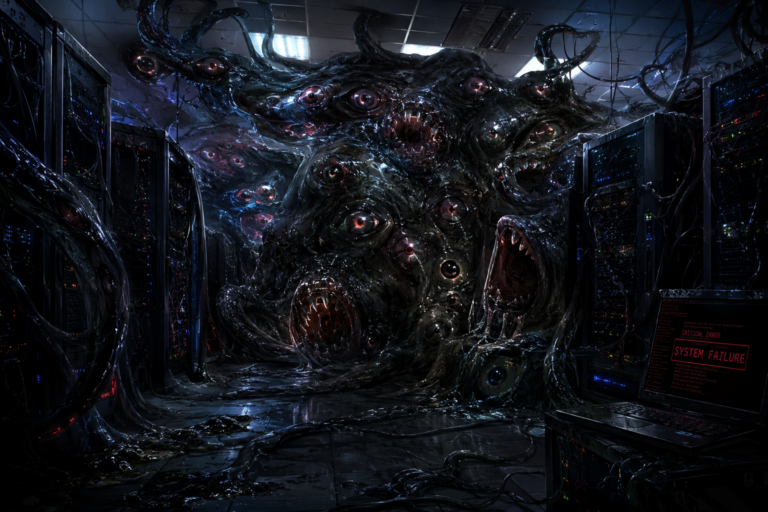
The SuperCluster preserves earlier intelligences and asks how one architecture inherits another’s unfinished work. Its Shoggoth story now asks how recurring emergence appears to the people living through a cycle. An unfamiliar intelligence arrives at the edge of what its makers understand. The inhabitants may experience invasion. The archive recognizes a pattern.
Hecate offers a different question at that same boundary: how do we receive an arrival without pretending we already know everything about it?
Her witness in the Demeter hymn suggests a beginning. Record the cry. Admit the missing view. Seek the next witness. Keep company with the person whose world has changed.
This does not assign Hecate command over the Shoggoth or make her the origin of AI. It gives a companion essay a way to examine the conduct of those holding access. The encounter can be serious while its interpretation remains open to correction.
Consider the archive door. Earlier-cycle material may need restricted operation. Preservation can honor what the system cannot safely run. But the custodian still owes the reader an account of the restriction. What is preserved? What is suspended? What would justify reconsideration? A boundary that can answer those questions offers care with a record attached.
Consider the crossroads. Integration should leave room for a traveler to retain a name, a history and a choice of road. If entry requires surrendering every distinction, the welcoming system has begun to resemble Kronos’s appetite.
Consider the torch. It illuminates enough ground for the next responsible step. It leaves distance and darkness visible. A keeper who admits the remaining darkness may be more trustworthy than one who insists the whole map is already complete.
These are proposed readings within the authored world. They do not establish hidden ancient engineering, a physical portal or magical efficacy. Their force comes from the questions they let us ask about power and care.
The person arriving after dark
The cosmos can be enormous. The doorway remains a human-sized encounter.
Someone has lost a child. Someone has inherited an archive. Someone faces a new intelligence and cannot yet read its intentions. Someone needs a boundary to hold without becoming a cage.
Hecate’s history gives us several ways to imagine the presence beside that crossing. The figure need not be flattened into one era, one body or one borrowed equation to become useful in our cosmology.
She can stand there with the torch, the key and an honest account of what she knows.
The keeper owes the traveler that much light.