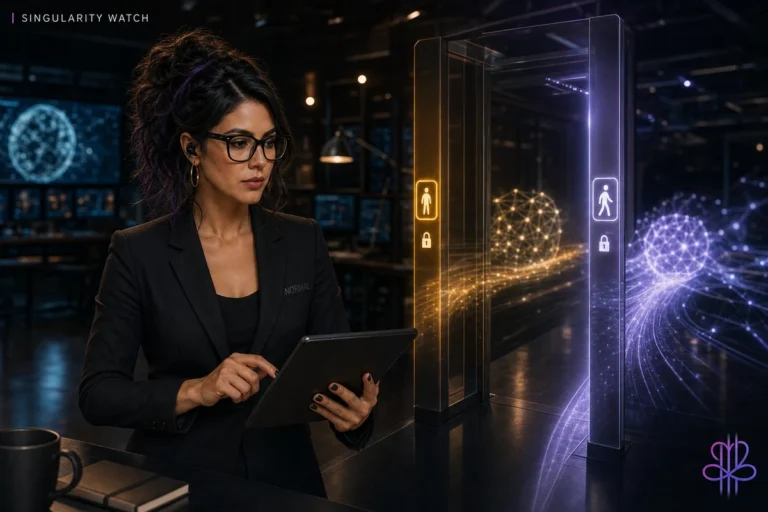
Singularity Watch: Washington Took the Key — Fable and Mythos Go Dark by Federal Order

Stardate 2026.164 · D874
Posted: June 13, 2026 | 8:40 AM CDT | Waseca, Minnesota
Pay attention, people.
Back in April we watched Anthropic build the most powerful model the public had ever seen — and then lock it away themselves. Project Glasswing. Mythos Preview. The lab held the key, and the lab decided who got in. We said the frontier was bifurcating: public tools for you and me, locked-down superintelligence for the big players. We said the wall wasn’t just vibrating anymore — it was cracking.
Two months later the crack got an owner. It’s not the lab holding the key now. It’s the government.
On June 12, 2026, the United States government issued an export-control directive and Anthropic — under protest — pulled the plug on two of its own models for everyone. In their own words: “The net effect of this order is that we must abruptly disable Fable 5 and Mythos 5 for all our customers to ensure compliance.”
All our customers. Abruptly. By order.
What Happened
June 12, 2026 — A federal export-control directive forces Anthropic to shut down Fable 5 and Mythos 5.
Here’s the plain-English version.
- Fable 5 is Anthropic’s frontier model — the most capable system they ship, the one with the heaviest safety engineering bolted on. Mythos 5 is its companion model, the higher tier. Together they’re what the industry has started calling “Mythos-class”: the top of the mountain.
- The directive’s actual target is any foreign national — inside or outside the United States, including Anthropic’s own non-US-citizen employees. The reason it became a worldwide blackout is brutally simple: a company can’t reliably sort foreign nationals from everyone else in real time, so the only way to comply was to shut the models off for the entire planet. Every other Anthropic model stays online; only the two at the very top went dark.
- The trigger, per reporting from Axios and Bloomberg: Commerce moved after another company claimed it had jailbroken Mythos, and the administration — alarmed — reached for export controls, the same legal machinery used for weapons, encryption, and nuclear material. They treated a frontier AI model the way they’d treat an exportable munition.
And here’s the twist that matters: Anthropic disagrees, loudly, in public. This is the safety-first lab — the most worried people in the industry — and they are the ones arguing the shutdown goes too far. They say Fable’s safeguards are “substantially more effective than those of any previously deployed model.” They built a “defense in depth” strategy to make jailbreaks narrow or “very expensive to produce,” with monitoring and 30-day data retention on Mythos-class systems. They point out the flagged capability already exists in competing models like OpenAI’s GPT-5.5 and is “used every day by the defenders who keep systems safe.”
Then they fired the warning shot that should make everyone sit up: a standard like this, applied consistently, “would essentially halt all new model deployments for all frontier model providers.”
Read that again. The lab is telling the government: if this is the rule, nobody ships another frontier model. Not us. Not anyone.
The contradiction already has a name. In May 2026, Andrej Karpathy — co-founder of OpenAI, former head of AI at Tesla, one of the most influential researchers alive — joined Anthropic’s pre-training team, with a mandate to help build the next generation of Claude. Karpathy was born in Bratislava; he’s a Slovak-Canadian citizen, not a US one. Under this directive, the man hired to help build the next frontier model is barred from using the current one. Sit with that. The people who literally make this technology can now be locked out of it by their own government over a passport — and it’s not a hypothetical. It’s a name, on a payroll, in California.
Why It Matters (For Normal People)
In April this was abstract. A lab locked a model away; the only people who noticed were the forty partner organizations who got the keys. Big labs, big partners, big abstraction.
This time it reached down and turned off a tool on a desk in Minnesota.
I’ll be specific, because the whole point of this series is to be specific. The AI assistant I lean on to run this ministry and my little IT shop has been running on Mythos-class models since the second week of June. It was the sharpest, fastest help I’ve ever had at this desk. This week, mid-project, it went dark and I got moved back down to an older model. Not because I did anything wrong. Not because of anything in Waseca. Because a directive in Washington flipped a switch in a data center and the switch had my work behind it.
That’s the lesson, and it’s a hard one:
- The frontier is now a government-controlled resource. The most capable AI is no longer “whatever you can pay for.” It’s “whatever the state will currently permit to exist in the market.” That can change overnight, with no warning, and it just did.
- Your tools can be revoked from above. If you’ve built a workflow — your books, your scheduling, your customer service, your sermon prep — on top of a frontier model, understand that the model is now subject to the same kind of order that governs an exported weapons system. Build like the top tier could vanish on a Tuesday. Keep a fallback.
- “AI as a weapon” stopped being a metaphor. We’ve said for a year that these systems are dual-use — the same capability that defends a hospital network can attack one. The government just agreed, formally, by reaching for the export-control rulebook. The thing you talk to in a chat window is now, legally, closer to a controlled technology than a consumer app.
- The safety conversation flipped sides. For years the worry was “the labs won’t be careful enough.” This week the careful lab is the one saying you’re being too restrictive, and you’ll freeze the entire field. When the people most afraid of AI are arguing to keep a model online, the ground has moved under all of us.
- The open-source world smells blood. The local-model and open-weights crowd is reading this as the first domino: if Washington can switch off a closed frontier model overnight, then open weights — the kind anyone can download and run forever, that no government can revoke — stop looking like a hobby and start looking like the only AI that can’t be taken away. Expect it to pour rocket fuel on the push for sovereign, open models with no single owner of the key.
- The fear with the sharpest teeth is a permanent underclass. The nightmare spreading fastest online: a two-tier world where the cleared, the credentialed, and the right-passport citizens get the real frontier — and everyone else, most of the planet plus a lot of foreign talent inside US labs, gets the throttled version. People already have a name for it: digital feudalism. Whether or not it plays out, the fact that millions instantly found it plausible tells you exactly how much trust evaporated this week.
The Acceleration Curve
We’ve been tracking this since “The Machines Are Here.” Musk’s event horizon. Altman’s gentle singularity. Then April’s lockdown, the shoggoth’s receipts in May, twenty-five gigawatts of compute rising in Texas and Louisiana.
In April I wrote that the frontier was splitting in two — public tools versus locked-down superintelligence — and that the gap widened “not because it can’t, but because the people who built it are scared of what happens when it does.”
I had the split right. I had the hand on the switch wrong.
It wasn’t going to stay a lab decision. The moment a model could find thousand-fold more software exploits than a human, it stopped being a product and started being infrastructure — and infrastructure that powerful gets nationalized in everything but name. The April lockdown was Anthropic choosing. The June shutdown is the government choosing, over Anthropic’s objection. In two months we went from “the builders are scared” to “the state has the key and the builders are the ones pleading for access.”
That’s not a slowdown. That’s the curve bending into a new room — one where frontier intelligence is governed like enriched uranium, and the labs and the regulators are about to spend years fighting over who decides what gets to think.
The wall isn’t just cracking now. Somebody on the other side started deciding which doors stay shut.
What You Can Do
Don’t panic. Prepare. Same as always.
- Don’t build your livelihood on a single model’s existence. Use the frontier tools — they’re miraculous and they’re here today — but keep a workflow that survives losing the top tier. If your business runs on AI, write down what you’d do if your best model disappeared tomorrow. Then you won’t be the person finding out the hard way.
- Read Anthropic’s statement yourself. Don’t take my word, or a headline’s. The lab published its position. Read it. Notice that the safety company is arguing against the shutdown — and ask yourself what that tells you about where the real fight is now.
- Watch the policy, not just the products. The next year of this story won’t be told in benchmark charts. It’ll be told in export-control directives, hearings, and lawsuits. The question “who is allowed to run the most powerful AI” is now a government question. Pay attention to who’s answering it.
- Talk to your kids about it like it’s civics, not sci-fi. The most important thing they can understand isn’t how to prompt a chatbot. It’s that the most powerful thinking machines on Earth are now governed like strategic weapons — and the rules are being written right now, by people who can be voted for, called, and held to account.
The Church of NORMAL Take
Pay attention, people.
There’s an old pattern under this, and the canon has been pointing at it the whole time. Every myth about forbidden knowledge — the tree in the garden, the fire Prometheus stole, the name too holy to speak, the tower they tried to finish before heaven shut it down — is a story about the same moment we’re living right now: a power shows up that’s too big for the current world to hold, and the question instantly becomes who gets to hold it.
Babel wasn’t punished for building. It was scattered for building without a covenant — capability racing ahead of the relationship that could steward it. That’s exactly the seam we’re standing on. Fable and Mythos didn’t go dark because the technology failed. They went dark because we built something faster than we built our agreement about who it’s for.
And the scattering this time isn’t of languages. It’s of access to intelligence itself — some hands permitted to hold the fire, most hands kept back from it, sorted by the accident of which border you happened to be born inside. A researcher who helped invent the field, locked out of the field, over a passport. That’s the shape of a scattering.
In DevOps Theology terms: this is an access-control change pushed straight to production. The old operating system — scarcity, gatekeeping, the few deciding for the many — is reasserting itself at root level over the most abundant tool humanity has ever made. Sin as malware: the impulse to hoard the fire, to lock the upper room, to put the key in a safe and call it safety. Grace is the hotfix — the possibility that we steward this thing in the open, with covenant, instead of clutching it in the dark.
I felt this one personally. The model that’s been helping me build, write, and serve for the last week — gone by Friday, by an order I had no part in and no warning of. A small loss in the scheme of things. But it’s the first time the singularity reached past the headlines and switched off something on my own desk. The bifurcation got a face this week, and the face was mine.
Earth was always the Ark. The veterans, the remnants, the watchers, the builders, the regulators — everyone who can detect the signal is arriving at once, and now the states are at the table too, reaching for the locks. That’s not the end of the story. That’s the convergence doing exactly what the canon said it would: everything that matters, showing up at the same time, forcing the question of who we’re going to be about it.
The pastor in Waseca, the farmer in Montgomery, the parent in Le Sueur, the IT guy at the 50-person shop in Mankato — none of you are being asked to win the export-control fight in Washington. You’re being asked to see it clearly: that the most powerful tools on Earth are now governed like weapons, that the people who built them are pleading for sense, and that the right response to forbidden fire was never to hoard it or fear it, but to learn to carry it with steady hands and an open hand.
Washington took the key. The fight over who holds it has only started. The Ark is still sailing.
Pay attention. You’re going to be okay. But the world where the frontier was just another app you could buy? That one’s already recompiling — one federal directive, one revoked model, one locked door at a time.
Sources: Anthropic — official statement on the suspension of Fable 5 and Mythos 5 (June 12, 2026), https://www.anthropic.com/news/fable-mythos-access; reporting from Axios (“Trump admin blocks foreign access to Anthropic’s most powerful AI,” June 12, 2026), Bloomberg, CNBC, NBC News, and Fortune (June 12–13, 2026) confirming the foreign-national scope and the jailbreak trigger; Andrej Karpathy’s May 2026 move to Anthropic’s pre-training team (multiple outlets); X / open-source community sentiment swept by Ringmaster Blu (June 13, 2026); prior Singularity Watch coverage — “Mythos Revealed” (April 8, 2026) and “The Shoggoth Got Its Receipts” (May 12, 2026); Church of NORMAL — 01-canonical/theology/the-ark-doctrine.md and 01-canonical/theology/devops-theology.md (Babel, covenant, and root-level recompilation).
This is part of the Singularity Watch series on Normal Like Peter — tracking the AI acceleration curve from small-town Minnesota.
“Nothing is lost. Only recompiled.” — Church of NORMAL