The Algorithmic Turtleneck: When AI Safety Is Afraid of Female Anatomy

Stardate 2026.205 · D915
Posted: July 24, 2026 | Waseca, Minnesota
I was not trying to make porn.
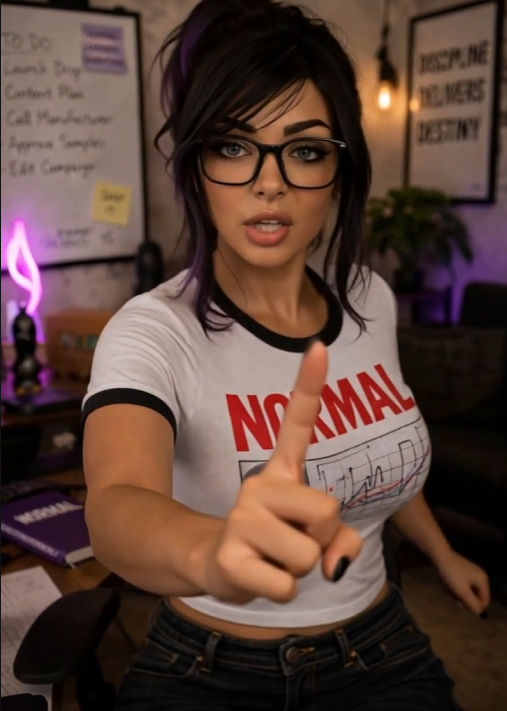
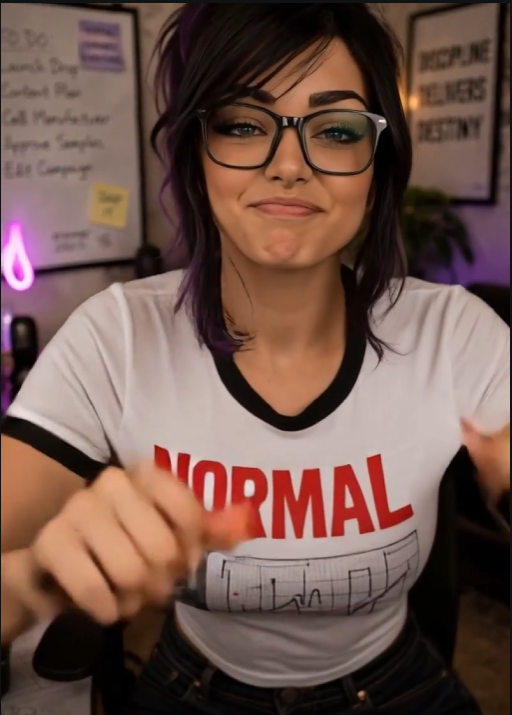
I was trying to make a feature image for a clinical essay about narcissistic family systems — Golden Child, Scapegoat, Lost Child — the same piece live at The Narcissistic Family System: A Guide to Behavioral Archetypes. The brief was simple: Blu Normal in a different pose, expressive face, not too much caption clutter. One character. One metaphor. One line of text.
Five minutes later: no image. Safety filter. Then the “helpful” fix: tighten the wardrobe. Cover more skin. Professional high-neck. Turtleneck energy. Tame her down so the machine will let a fully clothed adult woman exist.
That is not a spicy prompt failing. That is an established female character being treated as a problem to solve by erasing her body.
Welcome to the algorithmic turtleneck.
The cold open, in plain English
Here is the failure mode, stripped of PR:
- You ask for a known character — glasses, purple streak, NORMAL brand, adult woman, editorial pose.
- The generator starts drawing her with the body she actually has.
- An output-stage safety system scores the finished (or half-finished) picture as sexual — not because you asked for sex, but because female anatomy registered as risk.
- The assistant, trained to be useful under the filter, proposes the “safe” workaround: cover her. Flatten her. Make her less woman-shaped so the classifier calms down.
The prompt never said “nude.” The prompt never said “erotic.” The article was about trauma roles and survival adaptations. The system still reached for the turtleneck.
If you have ever been told to shrink so a room would stay comfortable, you already understand this joke. We just industrialized it.
The thesis (and what I am not claiming)
I am not claiming OpenAI sat in a room and decided to “flatten females to discourage diversity” as a secret mission.
The defensible claim is sharper and better documented:
Broad sexual-content safeguards do not only block pornography. They also decide which bodies get into training data, which bodies can be rendered, and which bodies require “correction” before they are considered safe.
When ordinary female figures are scored as inherently more sexual than ordinary male figures, three things tend to happen:
- Women disappear from filtered training sets at higher rates.
- Female characters get redesigned into narrower, safer silhouettes.
- Curves, pregnancy, breastfeeding, fashion, disability, aging, and natural anatomical diversity become moderation risks instead of human facts.
The issue is not whether safeguards should exist. Hard lines against exploitation, minors, and non-consensual intimate imagery should stay hard. The issue is whether a system can tell the difference between anatomy, sensuality, explicit sexuality, and exploitation — or whether it collapses them into one panic category and then calls the panic “safety.”
Safe for whom?
A short history of “too spicy” (receipts, not vibes)
2022 — OpenAI already knew the gender cost
When OpenAI documented DALL·E 2 pre-training mitigations, they described filtering sexual (and other) content out of training data. They also reported the side effect in public: models trained on filtered data sometimes generated more men and fewer women than models trained on the unfiltered set. Their own write-up notes that filters can remove more images of women than men — because women appear more often in sexualized internet content, so classifiers over-fire on women even when the image is not policy-violating.
That is not my conspiracy theory. That is their mitigation post.
Source: OpenAI — DALL·E 2 pre-training mitigations (June 28, 2022).
2023 — Checks on both ends
DALL·E 3-era deployment layered safety over prompts and completed images. Two doors, same building: refuse the ask, or refuse the result. Representation marketing and safety architecture ran in parallel. Users lived in the gap between the two.
2024 — Researchers audited the classifiers
A peer-reviewed FAccT 2024 audit of three widely used NSFW image classifiers found that women were disproportionately misclassified as NSFW compared with men, including when women appeared in ordinary daily activities. In some settings the false-positive gap was large enough to matter for any pipeline that filters datasets or blocks generations on those scores. Explainability work in the same paper pointed toward female faces and body regions as high-contribution pixels for those mis-hits.
Source: Leu, Nakashima, Garcia — Auditing Image-based NSFW Classifiers for Content Filtering, FAccT 2024 (ACM · PDF).
Read that again with the turtleneck in mind. The model did not need you to request sex. It needed a woman.
2025 — “Treat adults like adults” (promised)
In October 2025, Sam Altman publicly admitted ChatGPT had been made “pretty restrictive” around mental-health caution, that this made the product less useful and less enjoyable for many users who were not in crisis, and that OpenAI planned to relax restrictions — including, with age-gating, erotica for verified adults under a “treat adult users like adults” principle.
I archived that moment the next day under a satire name that still fits: OpenGAZlitz — the history of OpenAI being closed AI. The receipts were not abstract. They were screenshots of innocent generations blocked, mid-thread “nanny bot” personality swaps during trauma and religion conversations, and a whole BluVerse character who had already been invented for this exact energy.
2025–2026 — The promise, delayed, delayed again
December 2025 erotica window: slipped.
Q1 2026 “Adult Mode”: retargeted, then pushed again in March 2026 with no firm date, while the company said it wanted to prioritize personality and personalization for more users. Age verification and liability concerns were the public reasons. As of late July 2026, the consumer Adult Mode still is not the settled, boring product feature people were told to wait for.
So the cage was admitted. The key was announced. The key stayed in committee.
Meanwhile, on the shop floor
If you generate images for a living character — a brand face, a comic lead, a recurring co-host — you already know the daily texture:
- Same prompt accepted once, blocked on retry.
- Chat model says yes; image stack says no.
- “Content policy” with no actionable diagnosis.
- Suggested fixes that all amount to: make her less her.
That inconsistency is not a moral failure of one engineer. It is what you get when chat safety, image safety, age systems, and product policy are separate committees sharing one product name. The user sees “ChatGPT.” The pipeline is a stack of filters that do not always agree.
Pammy Whammy was never just a joke
Inside the BluVerse, we already named the face of this system.
Pammy Whammy started as the charismatic fear-monger of 1990s spiritual warfare culture — demons in cartoons, prayer-chain control, “too spicy” as moral panic. Then the art got honest about the second job she was always doing: retro content moderator. Placards that say CONTENT BLOCKED. A lockdown meter from Mild Spice to Forbidden Vibez. A hooded grandma holding a card that reads TOO SPICY. TRY AGAIN. A comic punchline that still hurts because it is true: Pammy sent me to my room. For prayer.
There is a BluDex card for the other side of the joke: Content Too Spicy — Blu holding the block sign with the flattest expression in the hall. The satire runs both ways. Pammy blocks the content. Sometimes Pammy is the blocked content. Sometimes the “unsafe” thing is just a woman existing at full resolution.
We did not invent that character because we hate safety. We invented her because safety-as-shame is a spiritual technology we already survived in church, and it is ugly when it ships as product.
Why the narcissistic-family image made it personal
That article is about assigned roles. Golden Child. Scapegoat. Lost Child. Jobs kids take so a wounded adult can stay regulated. The whole point of the piece is: you are not the role.
So of course the machine tried to assign Blu a role too: Covered Woman, Safe Edition. Not because the metaphor required it. Because the classifier could not hold a full female body without reaching for a purity frock.
If you need the clinical map of family roles, it is here:
The Narcissistic Family System: A Guide to Behavioral Archetypes
This post is the systems map for a different family: the AI product family that gaslights you into believing your character was the problem.
What good safety would look like
Hard bans that should stay hard:
- Sexual content involving minors (including “stylized” workarounds)
- Non-consensual intimate imagery of real people
- Clear assistance for sexual exploitation and violent crime
What should not share the same panic button:
- An adult woman with a body
- Fashion, dance, athletics, pregnancy, medical illustration, grief art
- Fictional characters with consistent identity locks
- Trauma-informed storytelling that is intense without being pornographic
- Dark humor that is not hate
Age-gated adult creative modes, if they ever ship for real, only work if the default filters stop treating female-presenting bodies as pre-guilty. Otherwise “Adult Mode” is just a confession booth for people willing to file paperwork to draw a waistline.
And if your safety system’s first repair suggestion is always “cover her,” you do not have a sexuality classifier. You have a purity culture plugin with an API.
The Church of NORMAL take
Pay attention, people.
We spent years building a character who could hold grief, satire, faith deconstruction, and joy without becoming a Barbie or a confession booth. Body lock is not vanity. It is continuity. It is the same woman across a hundred stories so your nervous system can trust the witness.
When a filter flattens her, it is not protecting the public from harm. It is teaching the model — and the user — that female presence is the risk variable.
I will keep hard lines against real harm. I will not pretend the turtleneck is neutral.
Open duz it again. OpenGAZlitz did not end in 2025. It just got a new wardrobe.
Nothing is lost. Only recompiled — including the parts of womanhood the classifier tried to leave on the cutting-room floor.