Accountability — Red Pill, Blue Hair, and the Loop Nobody Wants to Stop
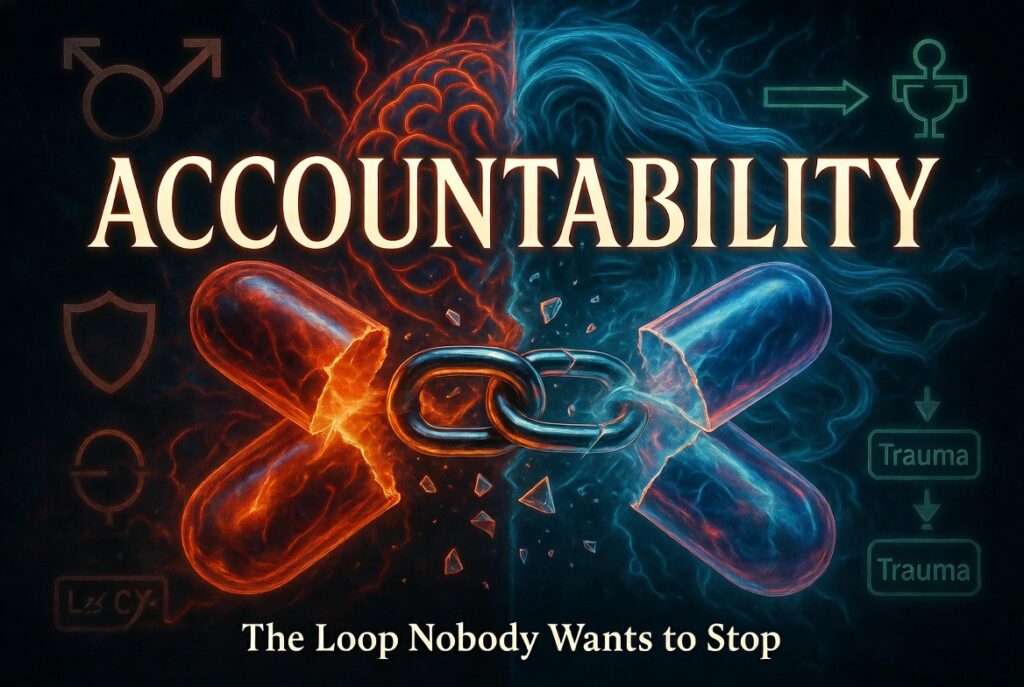
Stardate 2026.110 · D820
Red Pill, Blue Hair, and the Loop Nobody Wants to Stop
The internet has two caricatures of accountability and neither one is real.
On one side: a guy in a podcast studio, baseball cap backwards, telling you that accountability is the thing nobody does anymore, especially women, and if we could just get everyone to “take responsibility,” culture would heal overnight. The word he uses for this is usually masculine. The prescription is usually get harder. The subtext is usually feel less.
On the other side: someone with blue hair on social media explaining that accountability is actually a tool of oppression, that expectations are violence, that asking anyone to admit fault is a form of control, and that holding people responsible for their behavior is — somehow — the real abuse. The word used here is often trauma. The prescription is usually boundaries. The subtext is usually don’t ask me anything.
Both of these are cartoons. Both of these are defenses. And both of these are missing what accountability actually is, at the level it has to operate if human beings are going to stop hurting each other on repeat.
Let’s do the real version.
1. What accountability actually is
Accountability is not confession. Accountability is not self-flagellation. Accountability is not the public performance of shame in exchange for social credit. Accountability is not even, exactly, an apology — although apology can be part of it.
Accountability is the capacity to stay in contact with the reality of your own impact.
Not intent. Not how it felt from your side. Not what you were going through at the time. Those are real and they matter and they belong somewhere in the conversation, but they are not the thing itself. The thing itself is: you stay present with the fact that your behavior landed somewhere, that it had consequences on another nervous system, and you don’t collapse, deflect, or evaporate in the face of that information.
The clinical framing is boring and precise: accountability is a capacity, not a virtue. It is a regulated nervous-system state in which the brain’s threat-detection apparatus does not hijack the conversation before the truth can land. In dysregulated states — fight, flight, freeze, fawn — the capacity to stay present with your own impact is structurally unavailable. Not morally unavailable. Neurologically unavailable.
This is why the “just take responsibility” speech doesn’t work.
2. The shame-avoidance crisis
Here is the thing neither caricature wants to say out loud.
Most people, most of the time, cannot hold accountability because shame is intolerable to the body.
Not uncomfortable. Not embarrassing. Intolerable. At the nervous-system level, shame registers as a dorsal-vagal shutdown signal — the same system that, in extreme form, causes freeze states and dissociation (Porges, 2011; Schore, 2003). When the body interprets “you did a harm” as an existential threat, it closes the conversation. Not on purpose. Automatically.
Research on shame (Brown, 2006; Tangney & Dearing, 2002) draws a sharp line between guilt (“I did a bad thing” → generative, oriented toward repair) and shame (“I am a bad thing” → collapsing, oriented toward hiding or retaliating). Accountability lives in the country of guilt. Shame makes that country inaccessible. When someone you love is unable to be accountable, you are almost never looking at a moral failure. You are looking at a nervous system that cannot currently visit the country where accountability happens.
This matters because the internet solution to non-accountability is shame harder. More public. More vicious. More thorough. Which is exactly the thing that produces less accountability, because it drives the nervous system deeper into shutdown.
You cannot shame a dorsal-vagal state into ventral-vagal function. You just can’t. It’s not a willpower problem. It’s a wiring problem.
3. “Women’s kryptonite?” — The trope and what’s underneath it
There is a small corner of the internet that has, for years now, insisted that women are uniquely bad at accountability.
The trope says: men will admit when they are wrong, women will rewrite the story until they are right. Men take the L. Women weaponize feelings to dodge. Men are “logical,” women are “emotional.” You’ve heard it. It moves. It clicks with people who have felt unheard.
Here is the useful part of that trope, stripped of the culture-war packaging:
Socialization patterns differ in how accountability gets performed, not in the underlying capacity.
Research on apology and conflict behavior is mixed and culture-bound (Schumann & Ross, 2010 found women apologize more frequently but noted both sexes applied the same threshold for what counted as offense-worthy; cross-cultural data complicates any universal claim). What appears to be “women can’t be accountable” is often, on closer look, something else: different rules for what is allowed to be admitted, what risks being admitted, and what the social cost of admission has historically been.
For a lot of women, admitting fault has, for a lot of history, been dangerous — in relationships, in professional settings, in legal contexts. A nervous system that learned “admission of fault = loss of safety, loss of standing, loss of the relationship” will not do the thing cheaply, no matter how many podcast hosts demand it.
This is not an excuse. It is a diagnostic.
The same pattern shows up on the other side. “Real men don’t apologize” is the mirror trope, and it describes a nervous system that learned that admission of fault = loss of masculinity, loss of respect, loss of the pack. Same nervous-system logic. Different training data.
Neither “gender” actually has an accountability kryptonite. What humans have is a shame-avoidance kryptonite, and the cover story changes depending on which tribe you grew up in.
If you find yourself believing that “the other side” is the one that can’t be accountable, that is almost always a sign that your in-group’s accountability-avoidance pattern is so normalized to you that you can’t see it. It’s just called “being reasonable” when your side does it.
4. The red pill caricature
Fair reading. In its cleaner versions, the red-pill framing has a real observation underneath it:
Modern discourse has built increasingly elaborate systems for not having to locate responsibility in the self. Therapy language — boundaries, trauma, triggers, capacity — has been genuinely weaponized in some contexts to pre-excuse behavior rather than to describe the nervous system honestly. That is a real phenomenon. It deserves to be named.
But the red-pill fix — harden up, take the L, stop feeling — is a fix that doesn’t match the problem.
You cannot will yourself into accountability. You cannot muscle your way out of a dorsal-vagal freeze. You cannot “man up” through a shame spiral. The recommendation to do so reliably produces one of two outcomes:
- The person performs accountability without feeling it — a hollow confession that satisfies the accuser and changes nothing in the underlying wiring. The behavior returns in six weeks. In a year. In the next relationship.
- The person, unable to perform the required confession, goes hard in the other direction: digs in, doubles down, reframes the injury as an attack, and becomes more entrenched. The system backfires completely.
The red-pill framing confuses the output of a regulated nervous system (clean, unhedged accountability) with the process that produces it (slow, embodied, often relational, often with grief in it).
You can’t skip to the output.
5. The blue-hair caricature
Fair reading on this one too, because it’s fair to both sides or it’s fair to neither.
In its cleaner versions, the therapy-language-on-social-media framing has a real observation underneath it:
Accountability has, historically, been used as a weapon. “You need to take responsibility for your behavior” has been deployed to gaslight victims, silence survivors, demand labor from the already exhausted, and pretend that systemic harm is a matter of individual virtue. When someone has spent their life being asked to take responsibility for other people’s injuries, the word “accountability” can feel like a trap. Because it has been one.
Boundaries — the actual concept, Dr. Henry Cloud / Dr. John Townsend’s original framing (Cloud & Townsend, 1992) — are about what you are responsible for and what you are not. That is a real, necessary skill. Having it protects the vulnerable.
But the social-media distortion — any expectation of me is violence, any ask is control, any request for repair is abuse — is not a boundary. That is a fortress. And the difference matters.
A boundary is a line around what is yours to carry. A fortress is a wall around your obligation to anyone.
Boundaries make accountability possible. Fortresses make it impossible. And, critically, fortresses do not protect you. They isolate you. They give you the temporary relief of never having to be seen flawed, at the long-term cost of never having to grow.
The blue-hair caricature, when it becomes a worldview, is a fortress that learned the vocabulary of boundaries.
6. The actual through-line
Strip the culture war off both sides and the same thing is underneath:
Both caricatures exist because accountability requires being vulnerable, and both sides have constructed an elaborate defense against that vulnerability.
Red-pill: I don’t have to be vulnerable, I’ll just force the other person to be wrong first.
Blue-hair: I don’t have to be vulnerable, I’ll just reclassify any ask as harm.
Same defense. Different decor.
And neither one produces the thing they both, underneath, actually want — which is a relationship in which both people can be imperfect without the relationship collapsing.
That relationship exists. It is the healthy one. It is also the one that almost nobody gets modeled growing up, which is why almost nobody can do it without learning it explicitly, as an adult, usually with help.
7. Why we don’t stop the loop
This is the part that matters. Because the loops don’t persist because people are evil. The loops persist because of three linked facts:
Fact one: accountability requires regulation.
You have to be in your window of tolerance (Siegel, 1999) for accountability to be physiologically accessible. That means regulated breathing, regulated heart rate, enough ventral-vagal tone to stay in social engagement mode while uncomfortable information lands. If you are in fight/flight/freeze/fawn (Walker, 2013), you are not in that window. No amount of will can put you there mid-conflict.
Fact two: unregulated systems cannot hold themselves steady long enough to be accountable.
This is the pivotal point. The nervous system that has not learned to regulate under pressure will protect itself before it can engage with someone else’s pain. This is not cowardice. This is how nervous systems work. Self-protection is the prior function. Accountability is downstream of safety, and safety, in the clinical sense, is a nervous-system state, not a social condition.
Fact three: most of the conditions under which accountability is demanded are the exact conditions least conducive to accountability happening.
Think about when you have most forcefully demanded accountability from someone: you were hurt, you were escalated, you were in sympathetic activation, you needed it now. Which means the person across from you was also escalated, also in sympathetic activation, and — critically — now experiencing your escalation as additional threat.
You cannot both be regulated when one of you is trying to force regulation on the other through the sheer pressure of need. That is why the loop repeats. Both nervous systems are doing what nervous systems do. Both are defending. Both are failing. Both are furious with the other for failing.
The way out of the loop, at the nervous-system level, is counter-intuitive and unpopular: the accountability conversation has to happen in a regulated state, which usually means not in the immediate aftermath of the harm.
This is not a dodge. This is not “maybe next week when I’ve had time to think about it” as a delay tactic. It is a clinical reality. The nervous system of the person who caused harm needs to come down out of threat before the accountability circuit can come online. So does the nervous system of the person who was harmed. A regulated conversation, forty-eight hours later, by two people who have done some of their own grounding work, will produce more repair than six hours of escalated demand in the moment.
The reason we don’t stop the loop is that this truth feels unfair to the injured party. It sounds, on its surface, like an excuse for the offender. “Oh, you need TIME, do you?” And so, out of legitimate injury, we demand the accountability conversation happen right now, at the highest possible intensity, in a state neither of us can metabolize — and then we are furious that it didn’t work.
It didn’t work because we were asking two dysregulated animals to do a task that requires two regulated ones.
8. What accountability sounds like when it actually lands
It sounds small. That’s the part most people don’t expect.
Clean accountability is boring.
It is not “I am the worst person, I can’t believe I did that, how will I ever forgive myself.” That is a bid for the other person to comfort you, which is the accountability-loop reversing right in front of you.
It is not “I did it because you…” That’s a defense wearing an admission’s clothes.
It is not “I’m sorry if you felt that way.” That’s a confession-shaped denial.
It is, roughly: “I did X. I can see how it landed as Y. That wasn’t what I intended, but what I intended is less important here than what landed. I’m sorry. Here is what I am doing to make sure this doesn’t happen again.”
That’s it. Four beats. Admission. Acknowledgment of impact. Apology without condition. A specific change.
No theater. No performance. No public crucifixion. No cover charge. No invoice.
It is, unfortunately, almost never what either caricature wants. It’s not hard enough for the red pill. It’s not performative enough for the blue hair. It is simply real, and realness — in a public conversation optimized for drama — reads as insufficient.
Which is a different way of saying: the caricatures don’t actually want accountability. They want the feeling of winning.
9. What you do with all of this
You probably can’t fix the public discourse. You probably also can’t fix the person you are thinking of right now as you read this — the one you wish would just take accountability for what they did.
What you can do:
- Do your own. Even small. Even in private. Clean accountability for one thing you did, said into a journal or into the ear of a friend who can hold it, recalibrates your own nervous system to what the state feels like from the inside. You cannot demand from others what you cannot do yourself.
- Stop demanding accountability in escalated states. If you want it to land, wait for both of you to come down. That is not betrayal of your injury. That is respect for it.
- Decouple the conversation about harm from the conversation about worth. “You did a bad thing” is accountable. “You are a bad person” is shame. Keep them separate. This is the single most repair-enabling move there is.
- Notice when accountability becomes theater. If the apology is long, florid, self-flagellating, and followed by the same behavior — it was a performance, not a change. Clean accountability is short, specific, and followed by different.
- Give yourself the accountability you’re waiting for someone else to give you. Write down, honestly, what they did. What it cost you. What you are no longer willing to accept. You do not need their confession to issue your own clarity.
Conclusion: the quietest revolution
Accountability is not a masculine virtue or a feminine virtue. It is not a conservative value or a progressive value. It is not a weapon. It is not a trap.
It is, simply, the practice of remaining a regulated human being in the presence of the fact that you hurt another regulated human being. That practice is hard. It is rare. It is also the only thing that, at scale, stops the loops that are eating every relationship, every institution, every culture war comment thread, every marriage, every family text chain, every church, every workplace.
The revolution is not red-pilled. It is not blue-haired. It is neither hardened nor softened. It is regulated. And it is quiet enough that most people will walk past it looking for something louder.
You don’t need louder. You need true.
🔗 Related: The Covert Narc Series · Dark Empath primer · Emotional Regulation primer
References
- Brown, B. (2006). Shame resilience theory: A grounded theory study on women and shame. Families in Society, 87(1), 43–52.
- Cloud, H., & Townsend, J. (1992). Boundaries: When to Say Yes, How to Say No to Take Control of Your Life. Zondervan.
- Porges, S. W. (2011). The Polyvagal Theory: Neurophysiological Foundations of Emotions, Attachment, Communication, and Self-Regulation. W. W. Norton.
- Schore, A. N. (2003). Affect Regulation and the Repair of the Self. W. W. Norton.
- Schumann, K., & Ross, M. (2010). Why women apologize more than men: Gender differences in thresholds for perceiving offensive behavior. Psychological Science, 21(11), 1649–1655.
- Siegel, D. J. (1999). The Developing Mind. Guilford Press.
- Tangney, J. P., & Dearing, R. L. (2002). Shame and Guilt. Guilford Press.
- Walker, P. (2013). Complex PTSD: From Surviving to Thriving. CreateSpace.
Disclaimer: This piece engages with cultural discourse. It does not endorse or attack any political tribe. Accountability, at the nervous-system level, is the same across ideological lines — the culture-war cartoons are defenses against it, not against each other.
Church of NORMAL — Normal Like Peter
Stardate 20260420.1600 — Sanctuary 6, Waseca MN
“Nothing is lost. Only recompiled.”