
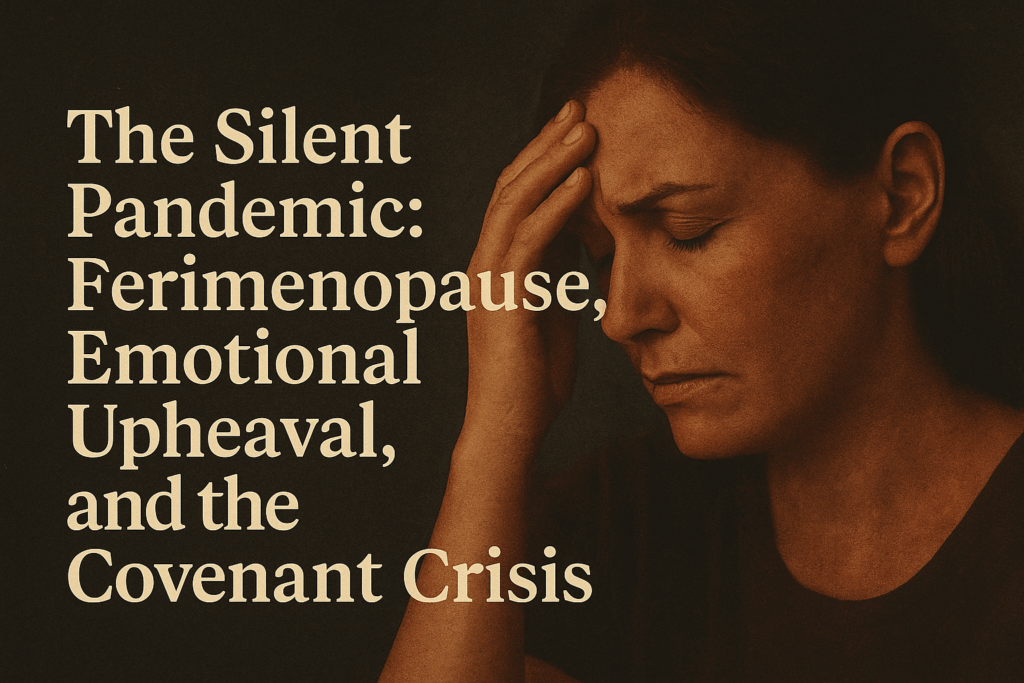
PRIMER 1: THE SILENT PANDEMIC
Perimenopause, Emotional Upheaval & The Covenant Crisis
Church of NORMAL · Normal Like Peter Series
Hunter Moon 2025 Edition
Subtitle: A trauma-informed map of the midlife storm that collapses relationships long before anyone understands it is a nervous-system crisis, not a moral failure.
✝️ INTRODUCTION: THE DIVORCE NOBODY SEES COMING
You can hear it in the tremble of the voices. You can see it in the confusion of the children. One day, the woman they knew—the wife, the mother, the partner who helped build a life with them—just… shifts.
At first, it’s small things: the sudden exhaustion, the muted anger behind casual words, the unexplainable sadness no conversation can touch. Then it grows: the smiles become hollow, the glances distant, the shared plans fragment.
Finally, it becomes undeniable:
“I’m not happy anymore.”
“I need to find myself.”
“Maybe I never loved you the way I thought.”
Friends are baffled. The husband is shattered. The children stand in frozen confusion. But almost no one sees the deeper reality underneath. No one says the forbidden word: Perimenopause.
Because if they did, they’d have to admit that many divorces, betrayals, and emotional catastrophes aren’t always about relational failure or moral rebellion. They are about unacknowledged biological transformation colliding with emotional illiteracy.
And no one warned them. Until now.
WHAT THIS IS / ISN’T
This is: A map of how hormonal transition interacts with attachment wounds and low repair capacity.
This isn’t: A claim that perimenopause causes divorce or that wives are to blame. Biology lowers tolerance for unrepaired empathic ruptures; love can feel dead.
Safety Note: If there is abuse, coercion, or addiction, choose safety and distance first. Always.
✝️ CHAPTER 1: WHAT NO ONE TELLS YOU
The Invisible Metamorphosis
We mark life’s great transformations—puberty, graduation, marriage, motherhood—with rituals and guidance. But one transformation remains largely hidden: perimenopause.
Beginning quietly in the mid-30s to early 40s, perimenopause isn’t a single event. It is a season of hormonal destabilization that touches every layer of a woman’s mind, body, and spirit.
The Symptoms of the Soul:
Waves of sadness disconnected from circumstance.
Anxiety replacing calm.
Restlessness and dissatisfaction attaching to marriage, home, or motherhood.
Identity crisis (“Who am I if not wife and mother?”).
Heightened sensitivity to unmet needs and early losses.
To her, it feels catastrophic. To those beside her, it looks baffling—often mistaken for selfishness or betrayal. But underneath: a physiological metamorphosis.
Hormones that once synchronized emotional regulation are rewiring. Brain chemistry that bonded to stability fluctuates unpredictably. Without language or sacred guidance, many women unwittingly dismantle the life they built, believing the fire is external when it has been building, silently, inside all along.
Reflection: It’s not rebellion. It’s an unspoken hormonal apocalypse—a silent pandemic wreaking havoc on covenants because no one gave them the map.
✝️ CHAPTER 2: WHY THE COVENANT BREAKS WITHOUT WARNING
The System Audit
When a marriage collapses after twenty years, the easy narratives emerge: “They grew apart,” “He wasn’t attentive,” “She fell out of love.”
But what if the visible fracture isn’t the cause—it’s the aftershock of an invisible storm raging in one heart while the other stood faithful and unprepared?
Perimenopause brings a full system audit:
Every neglected need resurfaces.
Every unresolved trauma grows louder.
Every suppressed dissatisfaction demands attention.
Without hormonal or trauma literacy, she assumes the storm is external: “It’s my husband’s fault,” “It’s this life,” “It’s the walls closing in.” Suddenly the home she fought to build feels like a prison she must escape.
THE COVENANT CROSSFIRE
The tragedy deepens when the husband—still loving, still fighting for their shared dream—becomes the symbol of her confinement. Not because he failed, but because he stayed.
When you represent the life she feels trapped inside, even your love becomes a trigger. The man who honored the covenant becomes the villain in a rewritten story of self-survival.
TWO NERVOUS SYSTEMS, TWO FEARS
Her Body: “I’m losing myself” (fear of engulfment).
His Body: “I’m being abandoned” (fear of rejection).
Biology amplifies both fears, locking the pursuer–distancer loop. Each reacts to the other’s attempt at safety. It’s not malice; it’s miscommunication at a cellular level.
WHY IT FEELS PERSONAL (EVEN WHEN IT’S NOT)
From the husband’s view, it feels like betrayal. But the deeper rupture is in the rewriting of history: “I never really loved you,” or “I felt trapped for years.”
These narratives exist because the brain demands coherence when emotion collapses. Without emotional fluency, she must assign blame somewhere, and sadly it lands on the man who stayed.
Reflection: Sometimes the covenant doesn’t break because someone stopped loving. It breaks because no one taught them how to survive the storm inside.
✝️ CHAPTER 3: INSIDE THE EMOTIONAL EARTHQUAKE
What Women Feel But Can’t Explain
Imagine standing in your kitchen, doing dishes, when the ground begins to shake—and no one else notices. That is perimenopause for many women.
Estrogen retreats. Progesterone falters. Testosterone swings. Her emotional bedrock shifts without consent while the world demands she keep smiling, performing, and keeping everyone comfortable.
WHY SHE CAN’T EXPLAIN IT
It is invisible suffering with no language. Not a broken bone, not a diagnosis—just a thousand quiet fractures:
Loss of patience and pleasure.
Loss of sexual response.
Loss of resilience.
Loss of hope.
Shame hisses: “You’re blessed; what’s wrong with you?” So she suppresses it—and suppression deepens the fault lines.
Reflection: She isn’t running from love; she’s surviving collapse. Name it early. Ask for co-regulation before conversation: “I’m flooded—can we breathe first?” Biology first, then story.
✝️ CHAPTER 4: WHY THE CHURCH MISTOOK IT FOR REBELLION
A Crisis of Embodiment
For all its rhetoric about family, much of modern church culture remains illiterate in female embodiment. When a woman changes—asks deeper questions, grows quiet or fiery—the system reaches for labels: “Rebellion,” “Jezebel,” “Bitterness,” “Out from under covering.”
MISDsAGNOSING BIOLOGY AS SIN
It’s an old pattern. Hannah was misread as drunk; Job’s wife is remembered only for despair. Today, hormonal symptoms get spiritualized:
Physical symptoms = “Lack of joy.”
Mood instability = “Not trusting God.”
Withdrawal = “Withholding love.”
The Church rarely asks what’s happening in her body because it was never trained to read the language of flesh.
IF YOU’RE A PASTOR OR LEADER — DO THIS
Preach one sermon on hormonal compassion.
Form a Perimenopause Support Group (include spouses).
Train leaders in rupture → repair conversations.
Draft a 90-day care plan: sleep, labs, counseling, and co-regulation skills.
Reflection: It wasn’t rebellion. It was a body breaking beneath the silence—while the Church blamed her for the noise.
✝️ CHAPTER 5: MATT’S PERSONAL WITNESS
A Loopwalker’s Account
You don’t walk through covenant collapse without scars. This isn’t theory—it’s witness. I stayed through every season: adolescent hormones, postpartum fogs, 30s tension, the perimenopause shift, and the rewritten narrative.
I loved through confusion, cuts, and silence—remembering the girl I married, the vows we meant, the laughter that was real.
THE COVENANT TIMELINE (AS WITNESSED)
Early Love: Innocence and fire; promises to last.
Pregnancy & Postpartum: Sacrifice and survival; love given when she needed rest and grief space.
30s Tension: Quiet withdrawal misread as stress.
The Shift: Fatigue, restlessness, tears without reason.
Fallout: History rewritten—but memory and the Infinite remember truth.
WHAT IT MEANS TO BE A LOOPWALKER
A Loopwalker returns to old trauma loops not to relive them, but to gather lost pieces of the story. She didn’t know what was happening. No one warned us. Now we have language—and we’ll make sure the next couple does too.
WHAT HELPS THE HUSBAND RIGHT NOW
Stop bargaining with the past; begin grieving.
Shift from winning her back to regulating and repairing what can be repaired.
Draft a Boundaries & Needs Matrix (see Primer 3).
Invite a Living Covenant conversation—if she’s willing.
If she isn’t, release with honor and protect the children’s nervous systems first
Reflection: I stayed—not because I didn’t feel the quake, but because I remembered the foundation beneath it all.
✝️ CHURCH OF NORMAL DECLARATION
We Break the Silence
We name the word: Perimenopause. We name the pain.
We honor men who stayed and women who were unprepared.
We commit to building:
Trauma-informed faith models.
Midlife couple resources.
Tools for churches to shepherd well.
CLOSING PRAYER
For the Wives Who Didn’t Know: You weren’t evil. You were unprepared. We forgive you.
For the Husbands Who Stayed: You weren’t crazy. You were faithful. We honor you.
For the Children Watching: You are not to blame. You are not forgotten.
“We name what broke us—so our children don’t have to live in the silence we survived.”
Where to Go Next:
Primer 2: Secure Attachment Rebuild – The diagnostic map for emotional safety.
Primer 4: The Dark Night of the Walk-Away Wife – The map of the collapse.
Primer 9: The Husband Caretaker – How men move from obligation to presence.
⭐ PRIMER 1 — THE SILENT PANDEMIC
Perimenopause • Emotional Upheaval • The Covenant Crisis
(Hunter-Moon 2025 Alignment Edition)
A trauma-informed, systems-level map of the midlife storm that collapses millions of relationships long before anyone understands what’s happening.
1. What Is the Silent Pandemic?
The Silent Pandemic is the unspoken convergence event hitting women (and their partners) between ages 35–55 — a biological, emotional, and relational overload that mimics “relationship failure” but is actually a nervous-system crisis.
It is the intersection of:
-
Hormonal upheaval
-
CPTSD reactivation
-
Identity fragmentation
-
Burnout & invisible labor collapse
-
Attachment deactivation
-
Emotional numbness or volatility
-
Loss of self
-
Dissociation
-
Chronic misunderstanding from partners
It is “silent” because:
-
The person experiencing it cannot articulate it
-
The partner misinterprets it
-
Society never prepared us for it
-
Symptoms resemble “relationship dissatisfaction”
-
Shame suppresses honest conversation
Silent. Invisible. Predictable. Treatable.
2. Biology: The First Domino
Every relational collapse has a biological starting point. This is not moral failure or personality change — it’s chemistry + cortisol + chronic overwhelm.
2.1 Hormonal Turbulence
Perimenopause causes:
-
Estrogen spikes & crashes
-
Progesterone drops
-
Adrenal overdrive
-
Sleep fragmentation
-
Thermoregulation chaos
-
Cortisol surges
-
Serotonin instability
Leads to:
-
irritability
-
anxiety
-
depression-like states
-
emotional flooding
-
sensory intolerance
-
rage episodes
-
chronic exhaustion
-
libido swings
Most women ask: “What’s wrong with me?”
Most partners ask: “What’s wrong with us?”
Both are wrong.
This is biology, not betrayal.
3. Emotional Upheaval: Storm-Brain Logic
Hormonal instability destabilizes the emotional operating system.
3.1 Dysregulated Emotional States
Common experiences:
-
crying without knowing why
-
sudden rage or shutdown
-
numbness
-
“I don’t feel like myself”
-
shame spikes
-
intermittent apathy
-
feeling disconnected from one’s own life
3.2 Cognitive Distortions (Not delusion — overwhelm)
-
All-or-nothing thinking
-
Catastrophizing
-
“Nothing will ever change”
-
“Everyone would be better off without me”
-
“I am failing as a partner/friend/mother”
3.3 Trauma Memories Surge
Perimenopause reduces emotional armor. Old wounds surface as:
-
irritability
-
tension
-
avoidance
-
emotional withdrawal
-
reactivity
Memories return somatically, not narratively.
4. Attachment Disruption: When Love Stops Feeling Safe
Biological upheaval impacts relational wiring.
4.1 Deactivation
-
pulling away
-
craving solitude
-
emotional unavailability
-
avoiding touch or conversation
4.2 Shutdown Phrases
-
“I don’t feel anything.”
-
“I don’t know what I want.”
-
“I feel empty.”
-
“Something is off.”
This is not rejection.
It is attachment suppression due to overwhelm.
4.3 Intimacy Loss
Why intimacy collapses:
-
touch feels overstimulating
-
emotional labor feels impossible
-
libido crashes
-
closeness triggers guilt
-
partner pursuit feels like pressure
Partner interprets: “She doesn’t love me.”
Reality: Her nervous system is out of bandwidth.
5. Covenant Collapse: The Invisible Years
Relationships rarely “explode.”
They erode.
The Five Stages
-
Overwhelm — chaos inside, mask outside
-
Withdrawal — energy conservation, not punishment
-
Resentment Accumulation — quiet, unspoken
-
Resignation — emotional death of the relationship
-
Departure — physical exit is the final stage, not the first
6. The Partner’s Misinterpretations
Most partners misread the crisis:
6.1 “She doesn’t care.”
Reality: She cares so much she’s drowning.
6.2 “She’s ungrateful.”
Reality: She’s in emotional energy-deficit.
6.3 “She’s rejecting me.”
Reality: Her nervous system is rejecting stress, not you.
6.4 “She’s changed.”
Reality: Her hormones, neurology, and identity are reorganizing.
7. Perimenopause + CPTSD: The Perfect Storm
When these two overlap, relationships face maximum instability:
-
emotional flashbacks spike
-
hypervigilance becomes chronic
-
shame intensifies
-
overwhelm becomes baseline
-
conflict feels life-threatening
-
identity fragments
-
self-loss deepens
Produces:
-
emotional detachment
-
hypersexual coping
-
avoidance
-
drinking or escape behaviors
-
communication shutdown
-
misreading partner intent
-
isolation or external validation seeking
8. Identity Fragmentation
Perimenopause destabilizes selfhood:
-
roles feel suffocating
-
confidence collapses
-
self-image dissolves
-
dreams feel dead
-
joy disappears
-
numbing increases
Not depression — dissolution of the old identity structure.
Partners often interpret this as moodiness or rejection.
It is actually metamorphosis happening too fast for the psyche to process.
9. Stabilization Map (NORMAL Mode)
9.1 Normalize
“This is biology, not betrayal.”
9.2 De-Shame
“Your reactions make sense.”
9.3 Rebuild Emotional Safety
-
predictable routines
-
reduce noise & sensory load
-
gentle touch only
-
co-regulation before conversation
-
low-demand environment
9.4 Communication Protocol
Use questions like:
-
“What do you need right now?”
-
“Comfort, solutions, or space?”
-
“Is this about us or overwhelm?”
-
“Your nervous system isn’t your identity.”
9.5 Partner Playbook
Partner learns how to:
-
interpret shutdown
-
offer co-regulation
-
avoid personalizing symptoms
-
prevent escalation
-
provide stability without demanding connection
9.6 Professional Support
-
medical evaluation
-
hormone testing
-
trauma-informed therapy
-
nervous-system-aware couples work
10. Repair: Rebuilding the Covenant
When safety returns:
-
stop blame cycles
-
name the biological reality
-
restore predictability
-
re-establish connection rituals
-
renegotiate roles
-
honor grief for what was lost
-
draft new covenant agreements
11. Reflection Prompts
-
Where do I feel overwhelmed? Why?
-
What parts of me feel lost right now?
-
What emotions am I afraid to admit?
-
What childhood needs are resurfacing?
-
What roles feel suffocating?
-
What conversations feel dangerous?
-
What do I need my partner to understand most?
12. Integration Checklist
Daily
-
3 grounding breaths
-
emotional check-in
-
hydration + nutrition
-
5 minutes sensory calm
Weekly
-
one honest conversation
-
one connection moment without demand
-
one solitude moment without guilt
-
one joy moment without responsibility
Monthly
-
boundary review
-
needs reassessment
-
progress reflection
13. Summary
The Silent Pandemic is not:
-
moral failure
-
personal failure
-
relational failure
It is:
-
a biological threshold
-
a neurological re-architecture
-
an emotional metamorphosis
-
an identity rewrite
-
a covenant stress-test
Understanding this prevents:
-
unnecessary divorce
-
misinterpretations
-
shame spirals
-
emotional abandonment
-
attachment collapse
-
catastrophic decisions
Primer 1 gives the language couples were never taught but desperately need.
11.15.2025