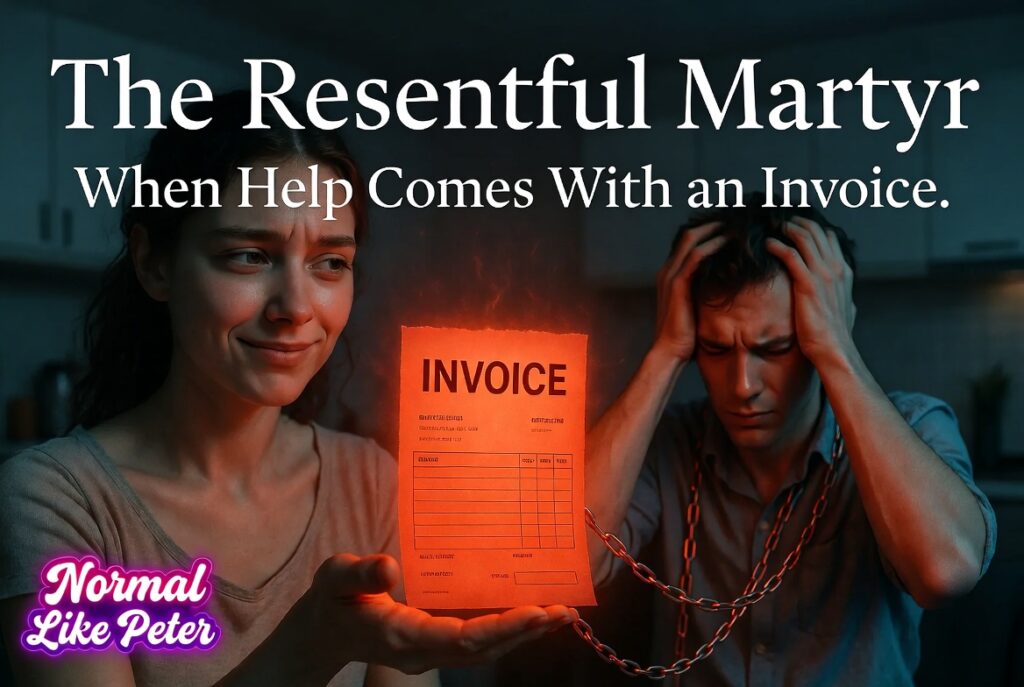
The Resentful Martyr — When Help Comes With an Invoice
Stardate 2026.110 · D820
When Help Comes With an Invoice
You didn’t ask them to do the dishes.
You didn’t ask them to rearrange their schedule. You didn’t ask them to “take the whole thing on.” You may have even said, out loud, “I’ve got this” — and they smiled that tight smile and did it anyway.
Then, three hours later, you found them in the kitchen sighing. Or fourteen days later, in the middle of an unrelated conversation, they brought it up. “Well, I was the one who had to handle everything while you were…”
That’s the move. That’s the mechanism.
The Resentful Martyr is not someone who helps you. The Resentful Martyr is someone who creates a debt you never agreed to owe, and then quietly — or not so quietly — collects interest on it for the rest of your life.
1️⃣ The setup: unasked-for sacrifice
The first move is generosity you didn’t request.
Sometimes it looks genuine. Sometimes it looks heroic. It almost always looks like something you “should” be grateful for, because from the outside it resembles love. They took on the extra shift. They called your mother so you didn’t have to. They “let” you rest.
But watch the language. Real generosity doesn’t track. Real generosity doesn’t itemize. When someone is actually giving, they are giving — not journaling the receipts for a future audit.
Clinical framing: researchers describe this as covert grandiosity — a quiet belief that one’s sacrifices are uniquely noble and chronically under-appreciated (Pincus & Lukowitsky, 2010). The giving is real. The ledger is also real. And the ledger is the point.
2️⃣ The collection: suffering as currency
Here’s where the nervous-system tax begins.
The Resentful Martyr doesn’t send an invoice in writing. They pay themselves in your guilt. Currency includes:
- The sigh when they walk into the room you didn’t clean
- The “I’m fine” that is audibly not fine
- The quiet recitation, months later, of exactly what they did and exactly how tired it made them
- The “I don’t want to make a big deal of it, but…” followed by making a big deal of it
- The silent service that you are supposed to notice and thank them for — but if you do, they wave it off, and if you don’t, they resent you for it
Either way, you lose. That’s the architecture of the trap. It’s called a double bind (Bateson et al., 1956) — a situation structured so that any response you give is the wrong one. Your nervous system learns, long before your conscious mind does, that you are operating inside a test you cannot pass.
3️⃣ The re-write: you become the villain in their story
Here is the move that tells you it’s not just generosity.
When a real helper gets tired, they say “I’m tired. I need help too.” Repair is possible. You pitch in. The friction resolves.
When a Resentful Martyr gets “tired,” it becomes a narrative. Not a momentary state — a permanent identity. They are the one who does everything. They are the one who holds it all together. You are the one who doesn’t see, doesn’t appreciate, doesn’t reciprocate.
Months or years later, you’ll hear the story told to a friend, a family member, a pastor, a therapist — and the protagonist is them. The selfless one. The long-suffering one. And you, somehow, are the weight they have had to carry.
You may not even recognize yourself in the story. That’s correct. You were never a character in it. You were a plot device.
4️⃣ Why you keep falling for it
Because the setup is real.
They did, in fact, do the dishes. They did, in fact, take on the extra shift. The act of service happened. Your eyes aren’t lying. And if you call out the pattern, you sound like you’re criticizing the act — and now you’re ungrateful on top of everything.
That’s not an accident. That’s the structure.
The nervous-system piece is this: unwanted sacrifice, followed by withheld emotion, followed by implied debt, is intermittent reinforcement (Skinner, 1953; applied to attachment contexts in Carnes, 1997). Your body learns that sometimes their presence is warm, sometimes it’s cold, and you can never tell which one is coming. That uncertainty doesn’t loosen the bond. It tightens it. You start doing the math of how to not-disappoint a person who has structured the relationship so that disappointment is the only option.
This is the same mechanism that makes slot machines work. It is not your fault that you got hooked. The machine was built to hook you.
5️⃣ The tell: try to stop the loop
The cleanest diagnostic is to try to not play.
Next time they sigh in the kitchen, don’t ask what’s wrong. Next time they do an unasked-for favor, say — warmly — “Thanks, but I had it. Please don’t do that on my account next time.” Watch what happens.
A healthy helper will say, “Oh — okay, got it.”
A Resentful Martyr will escalate. The sigh becomes a statement. The statement becomes an accusation. The accusation becomes a story told to someone else about how you rejected their love.
The mask is not the helping. The mask is the collecting. If you pull the collection mechanism out, the whole system short-circuits.
That short-circuit is the tell.
6️⃣ What your body already knows
Before your conscious mind catches up, your body is running the numbers.
You feel the tightness in your chest when they walk into the room. You find yourself rehearsing excuses before you’ve even done anything wrong. You apologize preemptively. You say thank you three times for one favor. You double-check the house before they come home, not because you care about the house, but because you care about their face.
This is anticipatory appeasement — a sympathetic-nervous-system response to chronic low-grade relational danger. It’s the same wiring that keeps you scanning the horizon in a threatening environment. The threat isn’t violence. It’s the cold front. The sigh. The narrative you haven’t read yet but know is being written.
Your body is not wrong. Your body is a better clinician than you think.
7️⃣ What you can actually do
Not fix them. That’s not on the table. Covert narcissistic relating is not responsive to your accountability, your reasoning, or your love. It is responsive only to its own internal logic, and that logic does not have a seat for you in it.
What you can do:
- Name the mechanism. Not to them. To yourself. “That was an unasked-for favor followed by an implied debt.” Naming it deactivates some of its power.
- Refuse the ledger. You don’t owe for things you didn’t ask for. Full stop. The guilt is the bill; don’t pay it.
- Stop over-thanking. One thank-you is a thank-you. Four thank-yous is an apology for existing. They’re different transactions.
- Track the story. If you hear a version of events that erases your contribution and inflates theirs, that’s data, not an accident.
- Protect your interior. You don’t have to correct the story to every friend, family member, or pastor. You just have to know what is true. Sometimes your interior is the only safe room left, and that’s still enough.
8️⃣ The clinical core
The Resentful Martyr pattern sits at the intersection of three clinical phenomena:
- Covert/vulnerable narcissism: self-absorption expressed through victimhood rather than grandiosity (Miller et al., 2011)
- Enmeshment-style family dynamics: unclear boundaries where one person’s sacrifice obligates another’s gratitude indefinitely (Bowen, 1978; Minuchin, 1974)
- Compassion/empathy exploitation: chronically good-hearted people’s tendency to over-apologize and over-repair, which covert narcissistic relating rewards and reinforces
None of these are things to weaponize against a person. They’re lenses. They help you see what you’re already living inside.
Conclusion: the door out
The door out of the Resentful Martyr dynamic is not a door you walk through. It’s a door you stop pretending doesn’t exist.
The door is this: you are allowed to not owe them.
You are allowed to receive their help without becoming their debtor. You are allowed to decline their sacrifice. You are allowed to notice the sigh without translating it into a prayer of gratitude. You are allowed to call the pattern a pattern, even if no one around you sees it, even if the story they’re telling everyone else makes you the villain.
You were never the villain. You were the person who noticed.
🔗 Next in the series: The Half-Truth Scenario →
🔗 Related: Dark Empath primer · 10 Secrets of the Dark Empath
References
- Bateson, G., Jackson, D. D., Haley, J., & Weakland, J. (1956). Toward a theory of schizophrenia. Behavioral Science, 1(4), 251–264. [Origin of the double-bind concept.]
- Bowen, M. (1978). Family Therapy in Clinical Practice. Jason Aronson.
- Carnes, P. (1997). The Betrayal Bond: Breaking Free of Exploitive Relationships. HCI.
- Heym, N., Kibowski, F., Bloxsom, C. A. J., et al. (2020). The Dark Empath: Characterising dark traits in the presence of empathy. Personality and Individual Differences, 169, 110172.
- Miller, J. D., Hoffman, B. J., Gaughan, E. T., et al. (2011). Grandiose and vulnerable narcissism: A nomological network analysis. Journal of Personality, 79(5), 1013–1042.
- Minuchin, S. (1974). Families and Family Therapy. Harvard University Press.
- Pincus, A. L., & Lukowitsky, M. R. (2010). Pathological narcissism and narcissistic personality disorder. Annual Review of Clinical Psychology, 6, 421–446.
- Skinner, B. F. (1953). Science and Human Behavior. Macmillan.
Disclaimer: This piece is educational, not diagnostic. It describes relational patterns, not people. If you recognize yourself inside a dynamic like this, working with a trauma-informed therapist is the safer path than self-diagnosis or cross-diagnosing anyone else.
Church of NORMAL — Normal Like Peter
Stardate 20260420.1430 — Sanctuary 6, Waseca MN
“Nothing is lost. Only recompiled.”