This explainer is educational and reflective. If you feel unsafe or overwhelmed, reaching out to a qualified mental health professional or trusted support is encouraged.
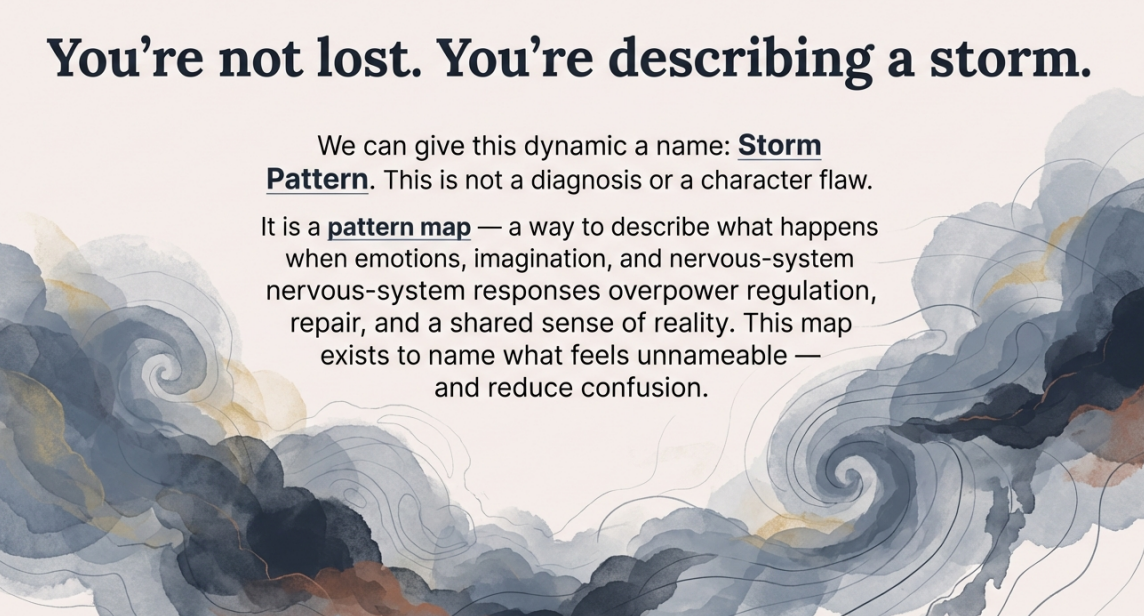
This is not a diagnosis. It’s an non‑pathologizing pattern guide. Patterns, Not Personal.
This explainer is educational and reflective. If you feel unsafe or overwhelmed, reaching out to a qualified mental health professional or trusted support is encouraged.
Project: Trauma Bond Recognition & Exit Framework
Purpose: Pattern recognition, nervous‑system safety, and ethical exit orientation
Method: Non‑diagnostic, self‑referential, mechanism‑based
Audience: Individuals seeking clarity about relational cycles (not labels)
Core Rule: Patterns, not personalities
Some relationships don’t feel simply “good” or “bad.” They feel intense, magnetic, and deeply meaningful — but also confusing, draining, or destabilizing.
This explainer exists to help answer one quiet question:
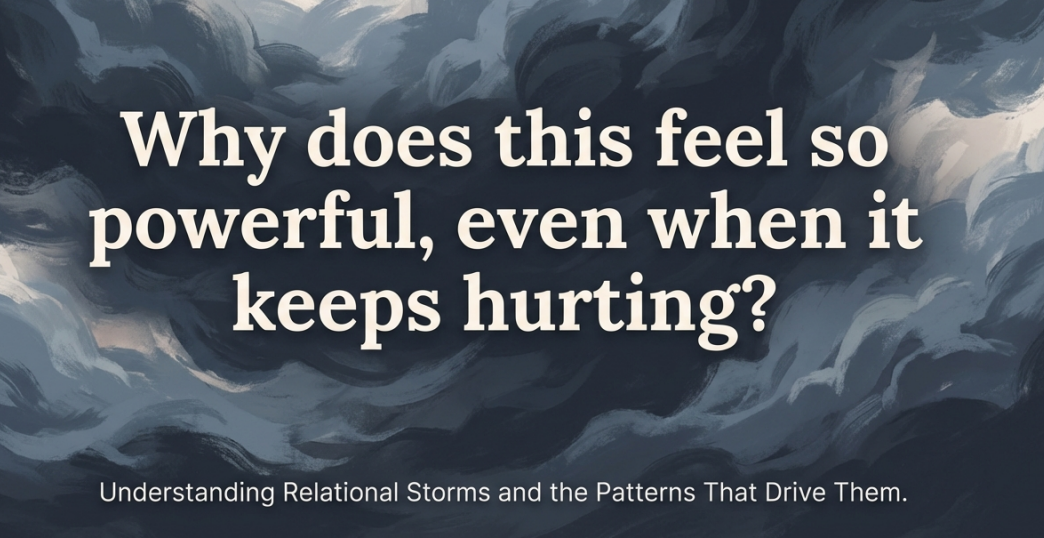
“Why does this relationship feel so powerful, even when it keeps hurting?”
Rather than labeling people, this guide looks at relationship patterns and how they affect the nervous system.
This framework is a relationship‑mechanics map. It is designed to help someone determine whether they are inside a reinforcing emotional cycle rather than a repairable conflict.
A diagnostic tool
A personality typing system
A justification for blame or moral judgment
A replacement for therapy or clinical care
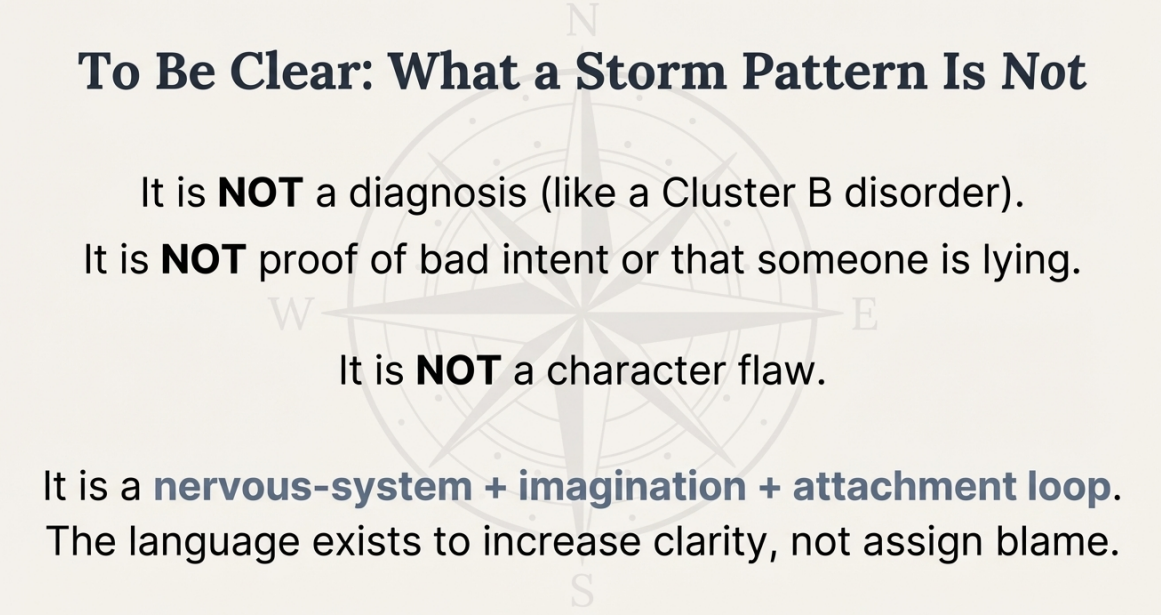
Not a diagnosis
Not a label for your partner
Not proof that someone is abusive or disordered
Not a command to leave
It’s simply a clarity tool.
Identity‑based labels often trigger defensiveness and halt learning. This framework intentionally uses pattern language so insight can occur without threat.
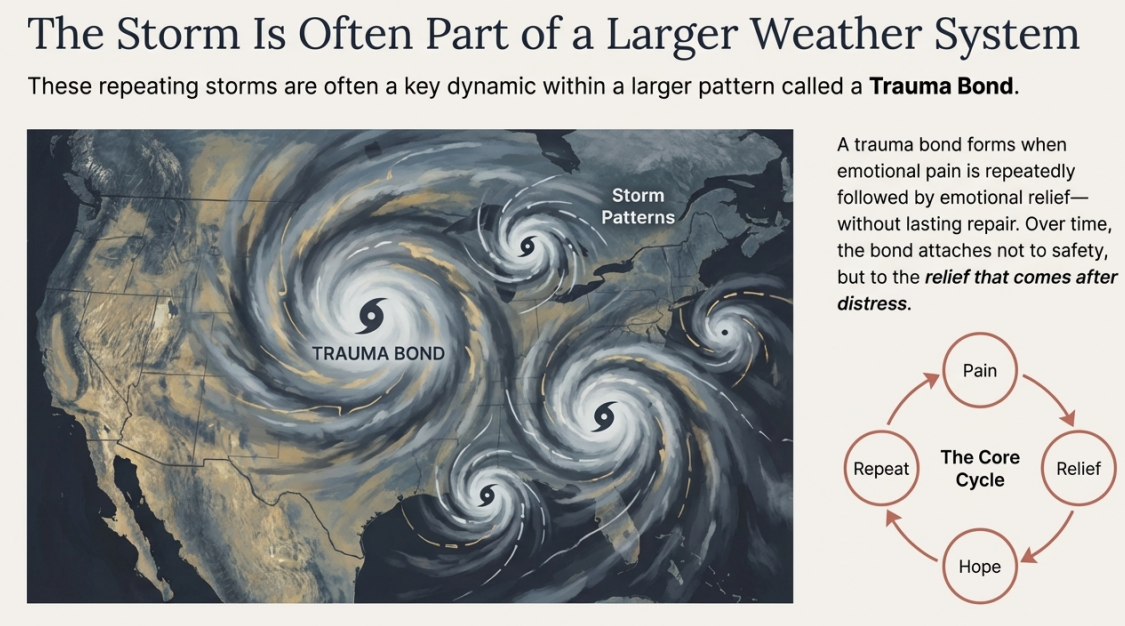
A trauma bond forms when emotional pain is repeatedly followed by emotional relief — without lasting repair.
Over time, the bond attaches not to safety, but to the relief that comes after distress.
In simple terms:
Pain → Relief → Hope → Repeat
The relief feels real. The connection feels real. But the cycle keeps restarting.
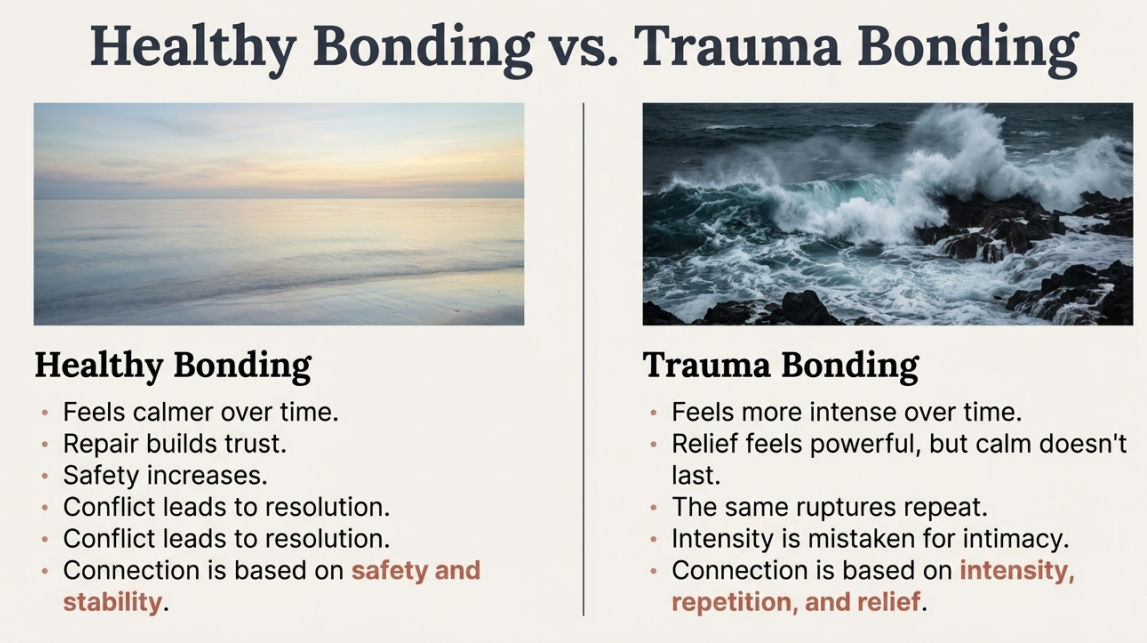
Healthy bonding feels calmer over time.
Repair builds trust
Safety increases
Conflict resolves
Trauma bonding often feels more intense over time.
Relief feels powerful
Calm doesn’t last
The same ruptures repeat
Intensity can feel like closeness — but they are not the same thing.
Conflict can be repaired.
Cycles reinforce themselves.
When indicators appear consistently and together, a cycle—not a situational disagreement—is likely operating.
Trauma Bond = Intensity + Repetition + Relief
Calm → Rupture → Repair → Relief → Reset → Repeat
(Often accelerates over time)
Accelerated Loop: cycles occur faster
∞ Loop: same conflict, no new outcome
Apology / Sorry Loop: words without durable change
Repair Substitution: sex, gifts, food, reassurance replace resolution
Walking on eggshells
Hypervigilance
Internal self‑monitoring
Emotional rupture
Conflict, withdrawal, volatility
Nervous‑system spike
Apology loops
Love bombing
Intense reassurance
Relief mistaken for repair
Temporary peace
Nervous‑system drop
Hope re‑ignited
⬇️ Acceleration
Calm shortens
Incidents intensify
Nervous‑system load increases
Trauma bonds are not about willpower or logic.
They are driven by the nervous system.
Unpredictable relief can bond more strongly than consistent care.
The body learns:
Tension → Release
Distress → Comfort
Over time, the body can mistake intensity for connection.
Unpredictable emotional relief bonds more strongly than consistent care.
The attachment forms to relief, not safety.
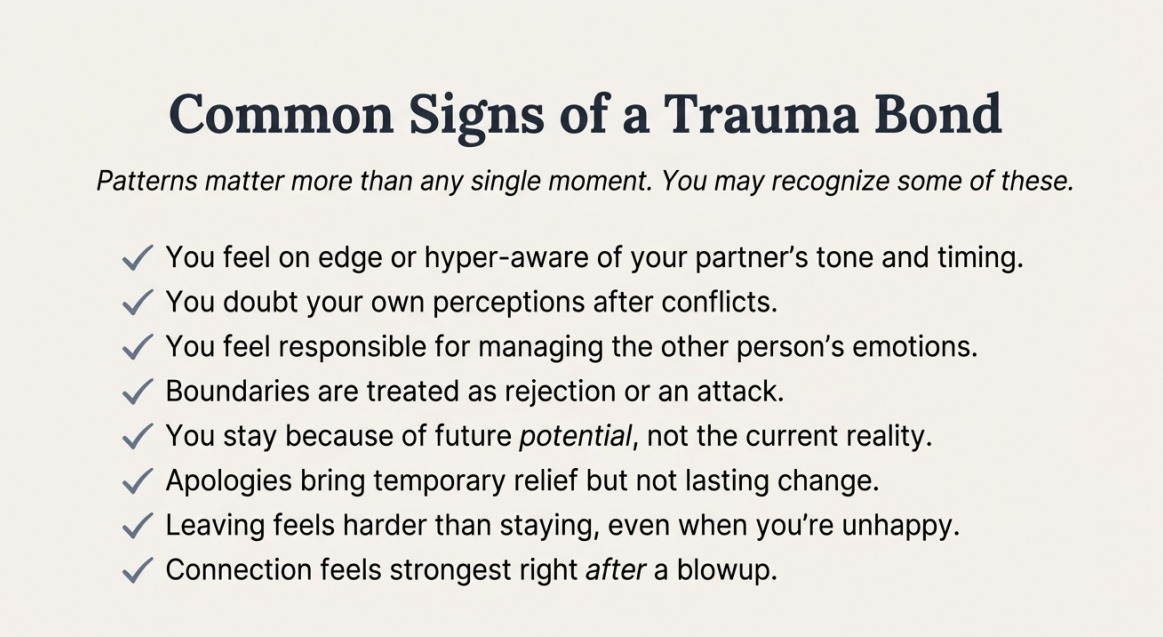
When many are present together:
Chronic hyper‑awareness of tone or timing
Emotional intensity replaces consistency
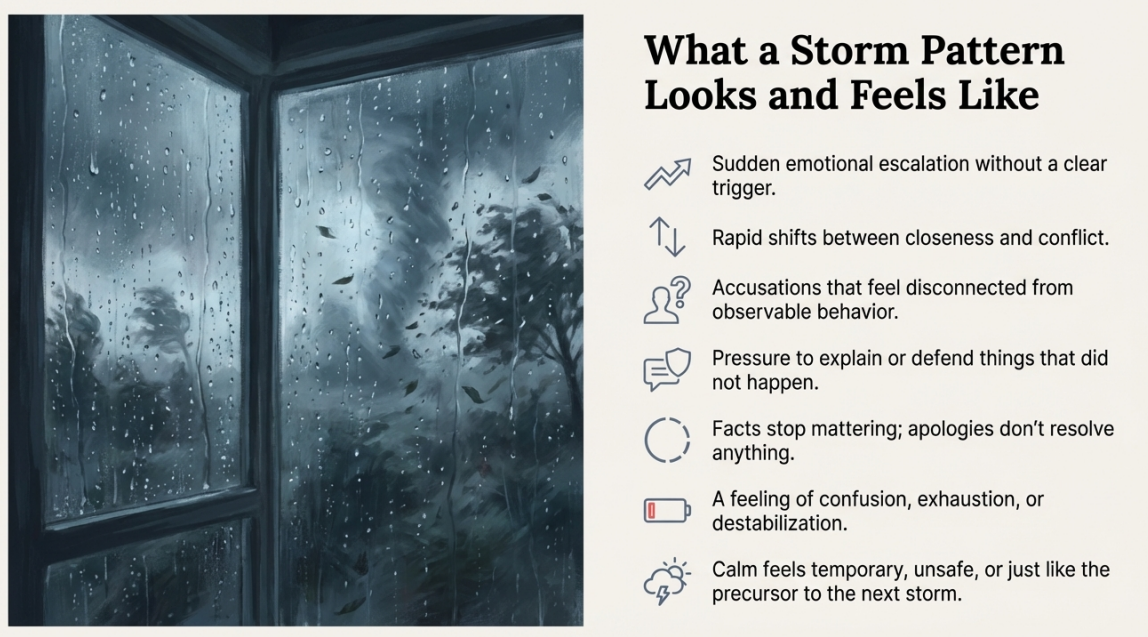
Disproportionate escalations
Doubting your perceptions after reframing
Apologies reset the bond without change
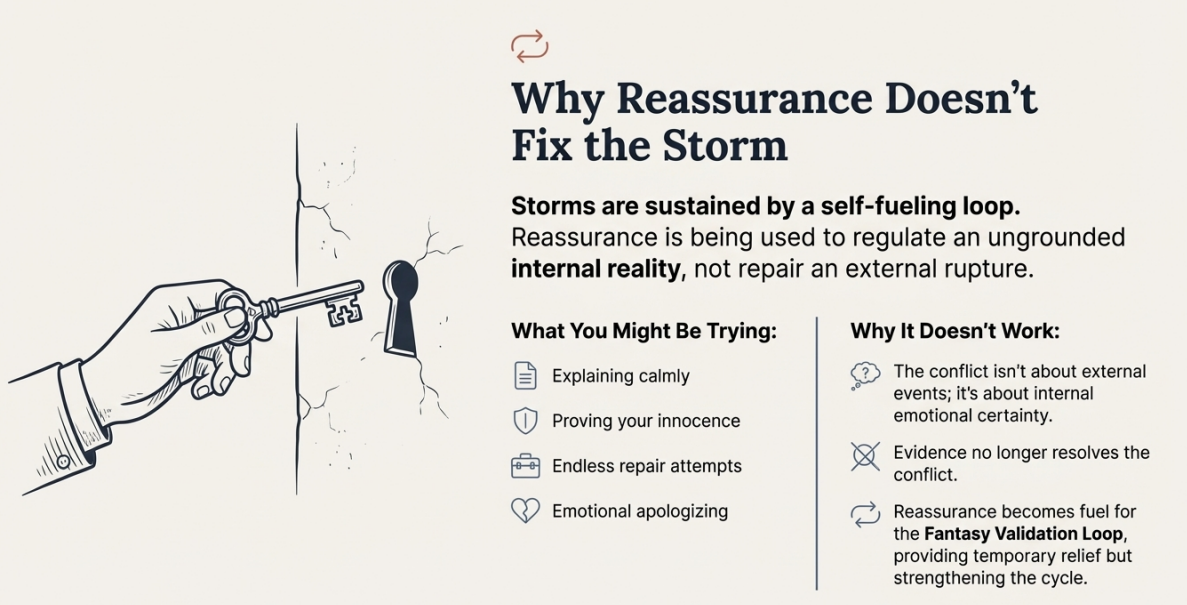
You regulate their emotions
Boundaries experienced as rejection
Tolerating behavior you once wouldn’t
Connection strongest after rupture
Urgency dominates decisions
Promises emphasize future over present
Your needs feel secondary
Valued mainly when soothing or rescuing
Warmth is unpredictable
Patterns explained away
Bonded to potential over reality
Nervous system never fully relaxes
Disagreements become character judgments
Loyalty tested instead of trust built
Leaving feels harder than staying
You don’t need all of these. Patterns matter more than any single moment.
You feel on edge or hyper-aware of tone and timing
Calm only comes after emotional blowups
Apologies bring relief but not real change
You doubt your perceptions after conflicts
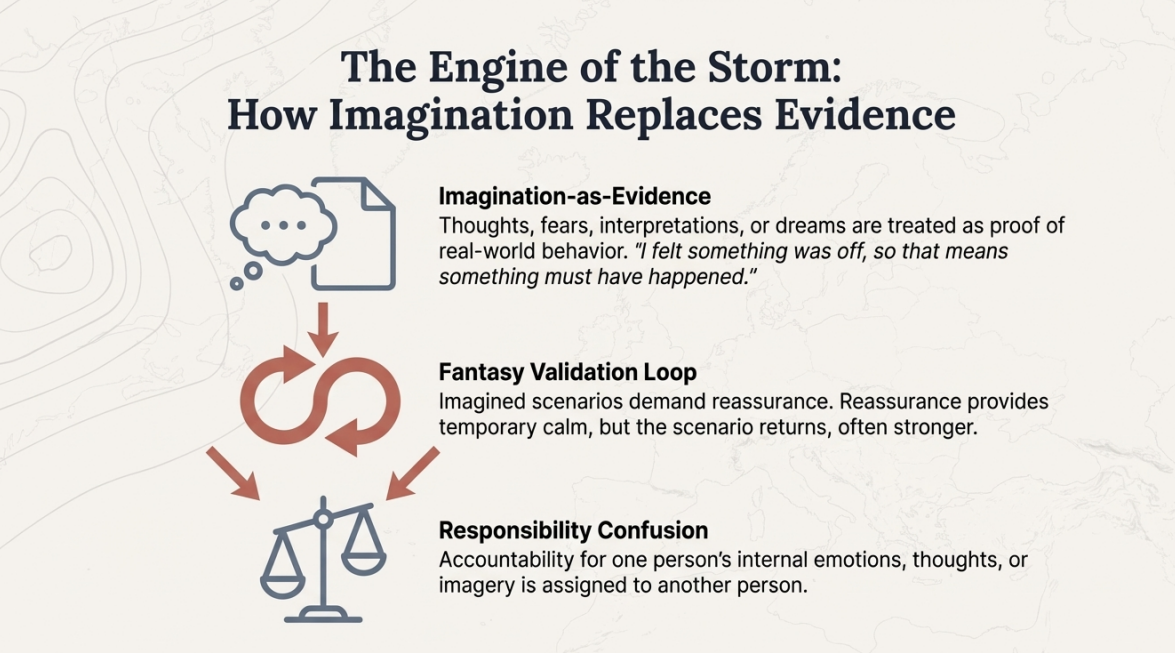
You feel responsible for managing the other person’s emotions
Boundaries are treated as rejection
You stay because of potential, not current reality
Leaving feels harder than staying, even when you’re unhappy
These signs don’t mean anyone is “bad.” They suggest a cycle may be operating.
Ask yourself:
Does this relationship reduce my nervous-system load over time?
Or does it increase it?
Healthy relationships feel steadier as time passes.
Trauma bonds feel urgent, cyclical, and emotionally loud.
Addiction to relief
Addiction to hope
Future faking: emotional promises without behavioral follow‑through
Always the focus
Always hurt or wronged
Tears, wounded positioning
Strings attached
Hot / cold cycles
Lock‑outs
Compliance‑based affection
Gaslighting
Fragmented truth
Reality editing
Polished public image
Dark empath dynamics
Private volatility
Silent treatment
Trust or guilt traps
Spirals
Strategic hurt
Emotional dysregulation framed as fragility
Rumination
Hypervigilance
Identity erosion
Ruptures often arise during misalignment or vulnerability, not overt conflict.
Out‑of‑sync routines or sleep cycles
Sleep‑state traps
Boundary breaches (time, access, capacity)
Ambiguous touch
Alcohol / impulsivity
Triangulation
Future faking
Hypersexual repair
Breadcrumbing
Gifts with strings
Loyalty tests
Performance tracking
Punishment cycles
Relief reinforces return to the loop.
Trauma bonds are body‑driven, not logic‑driven.
Common states:
Hypervigilance
Dissociation
Fantasy thinking
Emptiness after relief fades
The body mistakes intensity for connection.
Avoidant or dismissive patterns resist sustained closeness
One partner over‑adapts
Secure repair replaced with soothing
Eggshells become mutual
Both partners feel unsafe simultaneously
Often appear at pivot points:
“I’m confused”
“I’ll be right back”
“I need you” (urgent)
Mirrored egg‑shell language
Repeated apologies without change
Words reset the loop without resolving it.
Trauma Bond
Relief‑based
High intensity, low stability
Urgent repair
Patterns repeat
Secure Bond
Safety‑based
Low urgency, high consistency
Repair increases trust
Patterns resolve
Loop recognized
Engagement paused
Insight grounded into action
Endurance replaced with embodiment
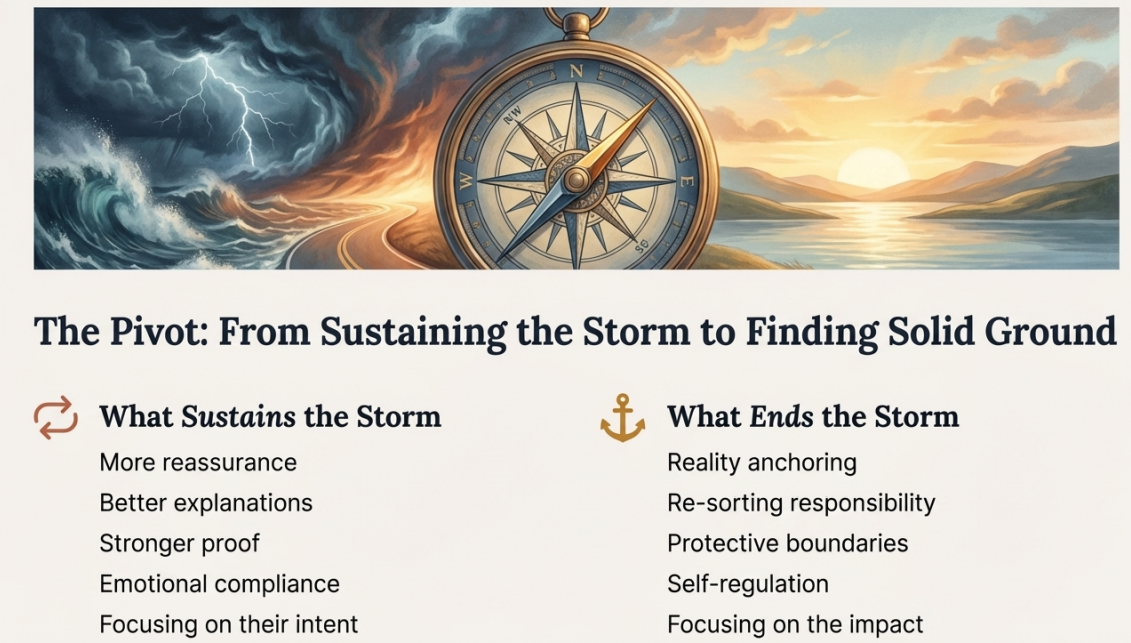
Awareness is the first interruption.
You don’t have to decide anything immediately.
You don’t need a dramatic confrontation.
Small grounding steps help:
Pause before repair-seeking
Notice when relief replaces resolution
Protect sleep and emotional capacity
Pay attention to actions more than promises
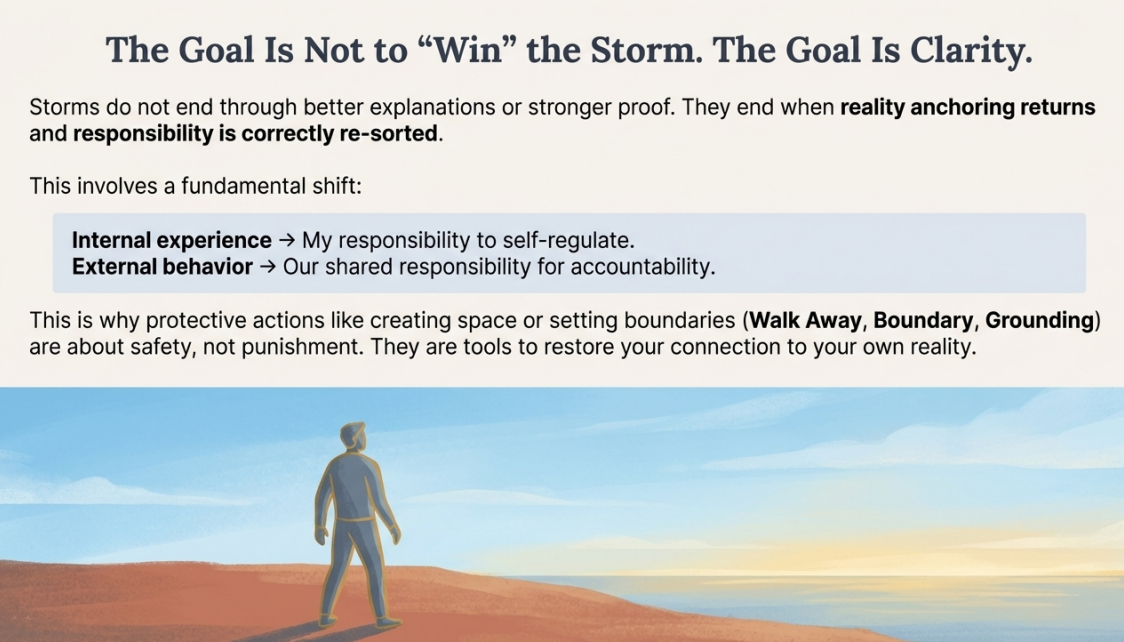
No single conversation breaks a trauma bond.
Patterns change when cycles are interrupted.
A boundary is not abandonment or blame.
It is the closure of a reinforcement channel.
Boundaries interrupt cycles that cannot heal from inside themselves.
Entangled Love – Emotional Addiction – Repair
“Real love isn’t chaotic and painful. It is respectful. It is consistent. It is safe.” – Lise LaBlanc
No single conversation breaks a trauma bond.
Pattern interruption does.
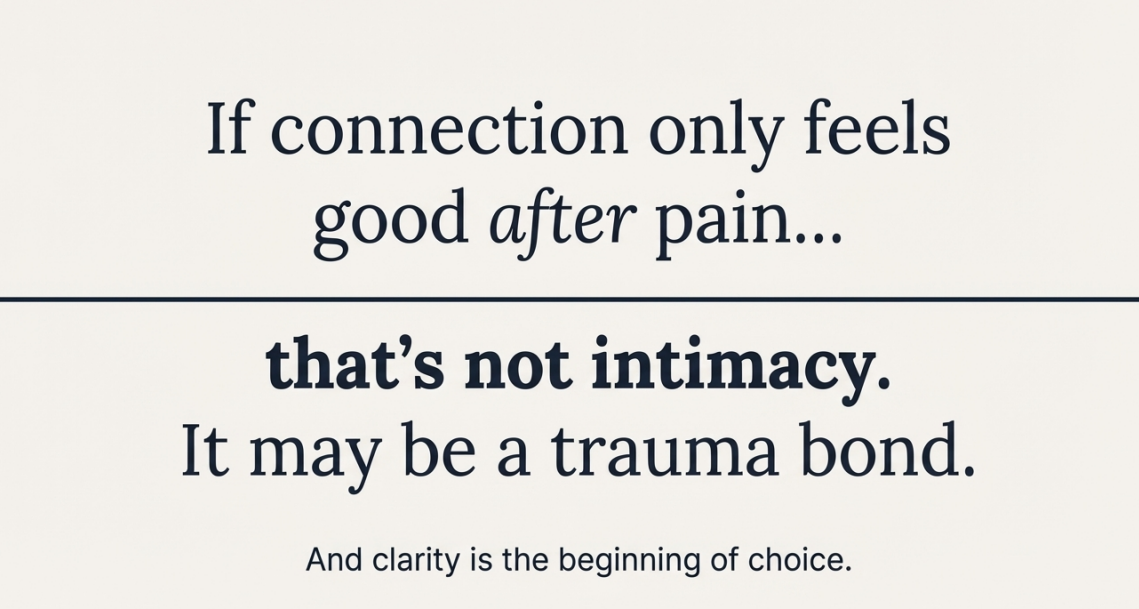
If connection only feels good after pain, and pain returns when things calm—
that’s not intimacy.
That’s a trauma bond. And clarity is the beginning of choice.
Status: Master Alignment v1.0 — internal canonical reference 1.5.2026
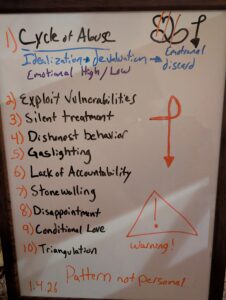
This is not a diagnosis. It’s a pattern guide. Cluster-B Storm Detector.
Cycle of Abuse
Idealization→ Devaluation→ Emotional Discard→ Repeat
Tension Building Phase→ Incident Phase→ Reconciliation→ Clam → Repeat
Exploit Vulnerabilities
Silent Treatment
Dishonest Behavior
Gaslighting
Lack of Accountability
Stonewalling
Disappointment
Conditional Love
Triangulation
This explainer is educational and reflective. If you feel unsafe or overwhelmed, reaching out to a qualified mental health professional or trusted support is encouraged.
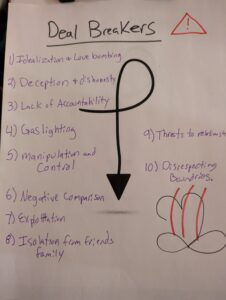
This is not a diagnosis. It’s a pattern guide. Incompatibility is NORMAL. Secure safe relationships are important.
Idealization and Love Bombing
Deception and Dishonesty
Lack of Accountability
Gaslighting
Manipulation and Control
Negative Comparison
Exploitation
Isolation from friends and family
Threats to relationship
Secure Attachment. Safe Relationships. – Patterns, Not Personal.
Spotting Covert Narcissistic Behaviors in relationships. Cluster-B Storm Pattern.
Beware of the Dark Empath
“Wow! I must be terrible.” “I must be a terrible person.” “Ok, list all the reasons i’m so terrible. You have problems too.”
Addicted to Hope – Patterns, Not Personal.