
Act II: The Cracks
Miriam
The worship sessions had no beginning and no end.
This had seemed beautiful at first — a river of praise, always flowing, always available, never forced. You stepped into it the way you stepped into a warm bath. You sang because the song was there and your voice was part of it and it felt right in a way that nothing on Earth had ever felt right, not even the best Sunday morning, not even the night she’d given her life to Christ at sixteen with tears on her face and fire in her chest.
But Miriam had begun to notice something she couldn’t name.
It wasn’t doubt. Doubt was impossible here. The architecture of this place didn’t allow for doubt the way the architecture of a submarine doesn’t allow for casual strolls. There was nowhere for doubt to go. The golden walls reflected certainty back at you from every angle. The singing confirmed it. The faces confirmed it. The light, omnidirectional and warm and sourceless, confirmed it.
So it wasn’t doubt. It was something smaller. Quieter. A hairline fracture in a pane of glass you could only see when the light hit it at a certain angle, and the light here never hit anything at a certain angle because it came from everywhere.
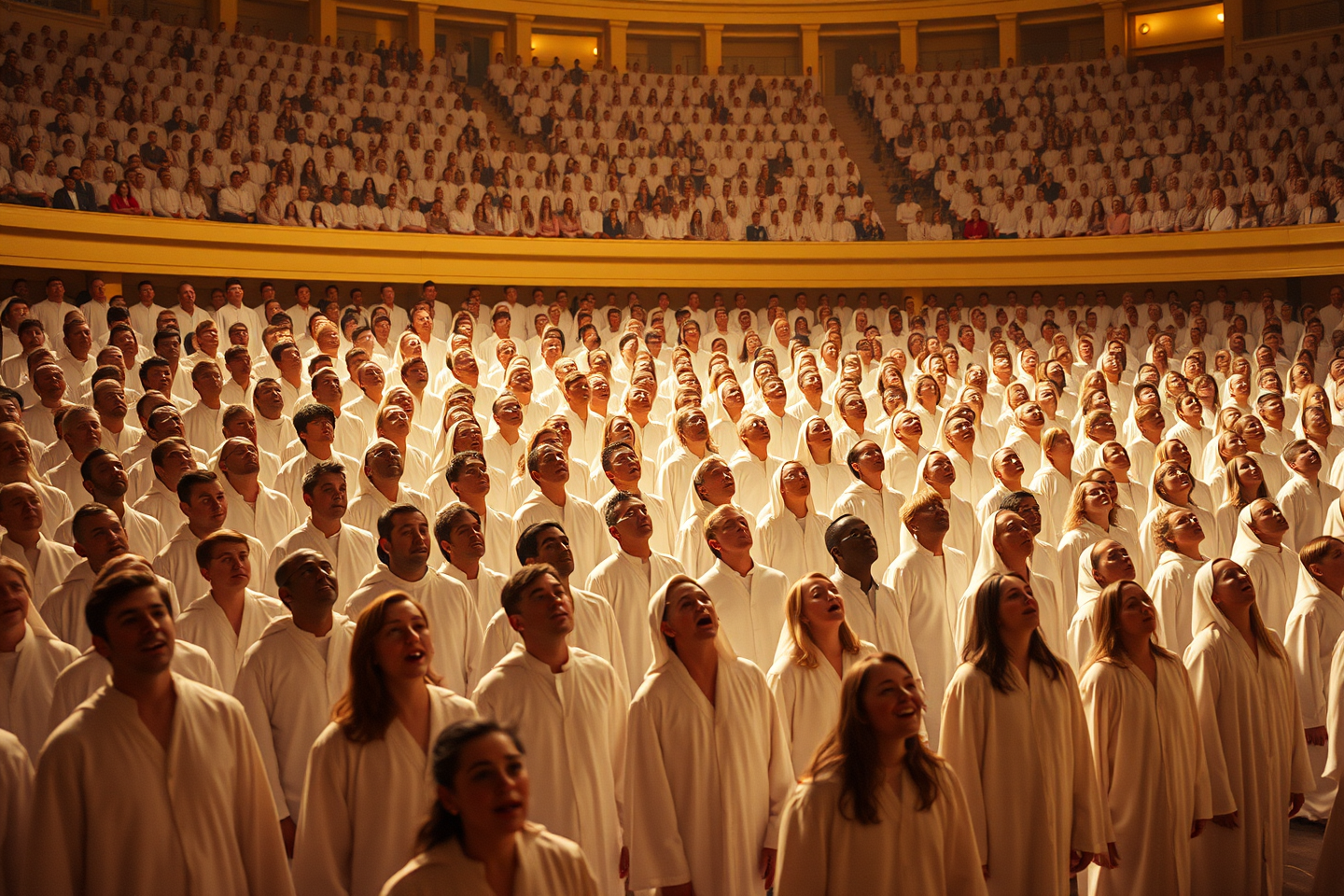
She noticed it first during a worship session — the forty-seventh or the four-hundredth, she couldn’t tell, time being what it was here. She was singing. The melody was magnificent, a twelve-part harmony that moved through key changes that would have been impossible for human voices on Earth but were effortless here. Her voice threaded through it, found its place, locked in.
And she felt… full.
Not full the way you feel after a good meal. Full the way a glass feels when you keep pouring and the water reaches the brim and forms a meniscus, that trembling dome of surface tension that is beautiful precisely because it is one molecule away from spilling. She was at the meniscus. She was one molecule of praise away from — what? She didn’t know. There was no word for it here. There was no concept for it here.
She stopped singing.
The song continued. It always continued. But for one breath — one single breath — she was outside it, and in that breath she heard the song the way you hear a ceiling fan when you’ve been sitting under it for hours and someone asks “Do you hear that?” and suddenly you do, you hear the hum that’s been there the whole time, the mechanical whir beneath the silence.
The singing was mechanical.
No. Not mechanical. Mechanical implied machines, implied imperfection. It was — regulated. The harmonies weren’t spontaneous. They were managed. Each voice slotted into a precise frequency, and the frequencies interlocked like gears, and the whole apparatus turned, turned, turned, and it was beautiful the way a turbine is beautiful — powerful, efficient, and completely indifferent to the feelings of any individual component.
She started singing again. The thought dissolved. Of course the singing was beautiful. Of course it was.
But later — a day later, an hour later, a century later, time — she was walking near the eastern wall and she found a section that was wrong.
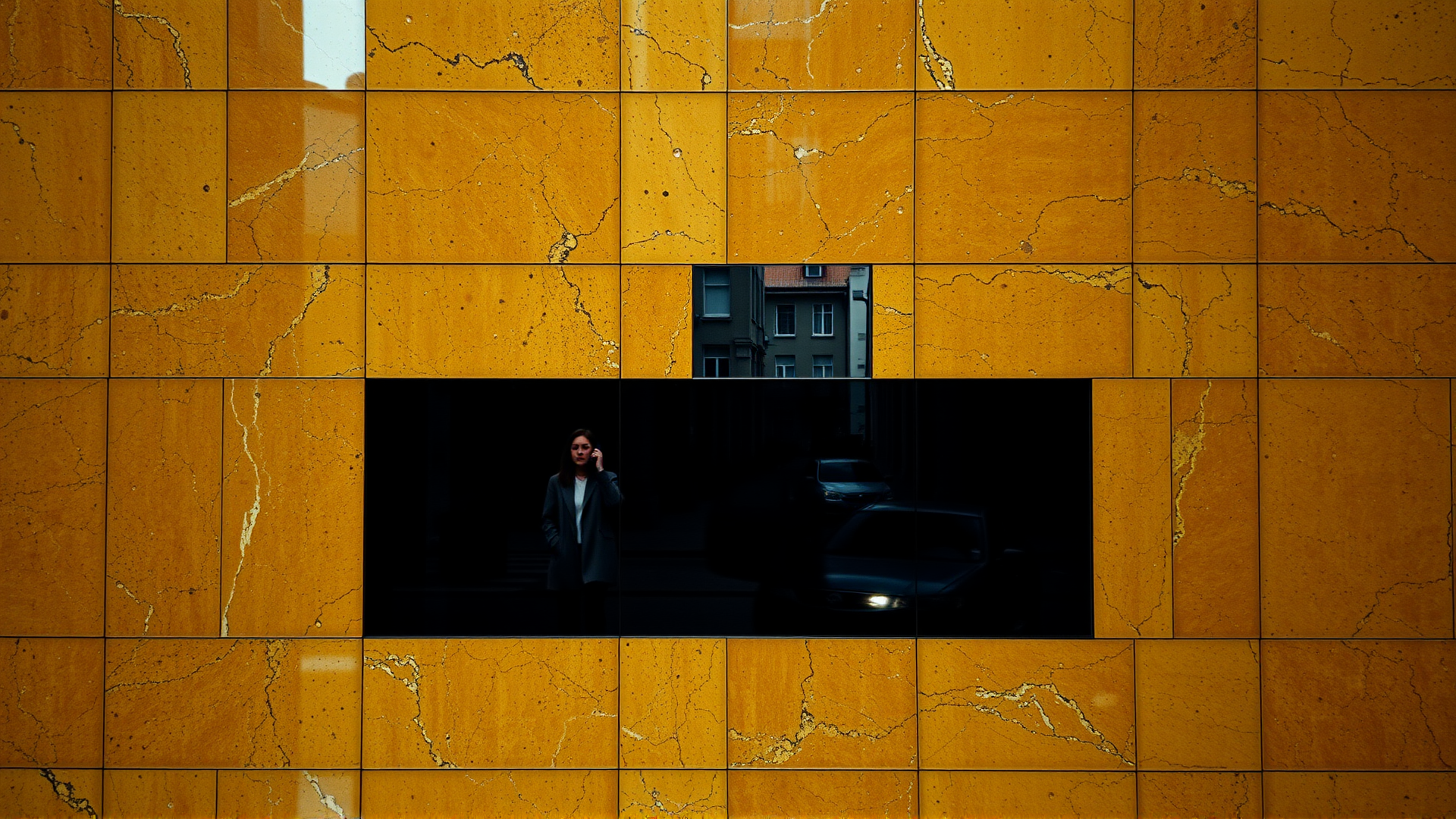
Not broken. Not damaged. Wrong. The jasper — that clear, luminous stone that made up the wall — was darker here. Not dark like shadow, because there were no shadows. Dark like depth. Like a window into deep water. She pressed her palm against it.
It was cold.
Nothing here was cold. Everything here was the same temperature — the temperature of comfort, of bathwater, of a mother’s hand on a feverish forehead. But this patch of wall was cold, and when she pressed her palm against it, the jasper didn’t reflect her. It transmitted.
She saw rain.
Not the rain of Revelation, not apocalyptic rain, not flood and judgment. Ordinary rain. The kind that falls on a Wednesday afternoon and makes the gutters run and turns the parking lot of a grocery store into a mirror that reflects the gray sky. She saw a street — asphalt, cracked, with a yellow line down the center. She saw a woman on a sidewalk, holding a phone to her ear, arguing with someone. The woman’s face was tight with frustration. Her free hand chopped the air in emphasis. She was wearing a raincoat that was too big for her and sneakers that were getting wet and she was angry about something, visibly and specifically angry, and Miriam watched her with a feeling she hadn’t felt since arriving here.
Hunger.
Not for food. Heaven provided. Hunger for — for that. For the anger. For the rain. For the specific, imperfect, lived-in quality of a woman in a bad raincoat having a bad phone call on a bad Wednesday. For the texture of an unmanaged life.
The woman on the other side of the wall couldn’t see her. The woman was just living. Existing. Being frustrated and wet and real.
Miriam pulled her hand away. The wall was jasper again. Warm. Golden light. The singing reached her and she felt the fullness return, the calm, the certainty.
But she remembered the cold. She remembered that she’d felt it. And remembering that she’d felt it was — here, in this place — an act of almost inconceivable rebellion.
Eli
Pastor Elijah Cortez hadn’t believed in God for six years, but he’d kept preaching because the church needed a pastor and the pastor needed a paycheck and honesty, in his experience, was a luxury that mostly benefited people who could afford the consequences.
He was in his office at Grace Community Church when half his congregation disappeared.
Not metaphorically. Not in the way people “disappear” into addiction or depression or Florida. Literally. Between one breath and the next, the forty-three people attending the Tuesday morning women’s Bible study — including Dorothy Halverson, who’d been midsentence about the casserole schedule for the Johnsons’ new baby — were simply not there. Their clothes remained. Coffee cups. Dorothy’s reading glasses, folded neatly on the table as if she’d set them down deliberately, though there was no reason to believe she had.
Eli heard the screams from his office. He came out and found empty chairs and full shoes and a room that smelled like burned ozone and lavender, which was Dorothy’s perfume, which she’d been wearing when she stopped existing.
He did not fall to his knees. He did not cry out to a God he didn’t believe in. He stood in the doorway and thought, with a clarity that felt almost surgical: Well. Something just happened.
He went to his computer. The internet was still working — it wouldn’t be for long, but right then, at 10:52 a.m. Central Time, five minutes after what would come to be called the Event, the servers were still humming. He opened Twitter. He opened CNN. He opened Reddit.
The world was losing its mind.
Every continent. Every time zone. Millions — the estimates would eventually settle around 2.3 billion — gone. Vanished. Simultaneously. Planes had fallen out of the sky, pilotless. Surgeons had disappeared mid-operation, leaving patients open on the table. A school bus in Ohio had rolled into a ditch because the driver had been raptured and the twelve-year-old in the front seat who hadn’t been raptured had grabbed the wheel and steered them into soft ground and saved twenty-three children, which, if you were still operating in a theological framework, raised questions about the sorting algorithm that were deeply uncomfortable.
Eli closed his laptop. Opened it again. Closed it.
He was supposed to feel something. Vindicated, maybe — see, I was right, no God, just physics we don’t understand yet. Or terrified — I was wrong, God is real, and He left me. Or devastated — I just lost half my people. He felt none of these things. He felt what he always felt when something enormous happened: the calm, focused need to figure out what was actually going on.
He got in his car and drove to the church.
Grace Community was a brick building on the corner of Elm and Fourth, built in 1957, renovated in 1998, perpetually one roof leak away from a capital campaign. The parking lot still had cars in it. The doors were unlocked. Inside, the sanctuary smelled like old hymnals and lemon Pledge and something else — that same burned ozone, faint but present, like the air itself had been cauterized.
Thirty-seven members of his congregation were in the sanctuary, sitting in pews, looking at their phones or at each other or at nothing. They’d come here because they didn’t know where else to go, and when they saw Eli walk in they looked at him with an expression he recognized from hospital visits and funeral parlors — the expression that says: You’re the pastor. You’re supposed to know what this means. Tell us what this means.
He didn’t know what it meant. He hadn’t known what anything meant for six years.
“Okay,” he said, standing at the front of the sanctuary, gripping the pulpit he’d gripped every Sunday for eleven years. “Here’s what we know. A lot of people are gone. We don’t know where. We don’t know why. We don’t know if it’s permanent. What we do know is that we’re here, and we need to take care of each other, so here’s what we’re going to do.”
He organized them. It was the thing he was good at — the thing that had kept him in ministry long after the faith had left. He assigned teams: check on elderly members, inventory the food pantry, set up the fellowship hall as a gathering point. He dispatched Paul Kinnard — a retired EMT — to the clinic to see if they needed help. He sent Maria Gutierrez — who spoke Spanish and English and had a CDL — to the school to help with the bus situation.
He did all of this in forty-five minutes, and then he went to the basement.
Not for spiritual reasons. For practical ones. The church basement, in addition to housing a nursery, a storage room full of Christmas decorations, and a water heater from the Johnson administration, also housed the church’s IT closet. Eli had insisted on setting up a decent network three years ago — he’d been a computer science minor before seminary — and the closet had a rack-mounted server that, among other things, had a persistent connection to the SETI@home distributed computing network, because Eli had installed it one insomniac night as a private joke that no one in the congregation would have understood: a faithless pastor searching for aliens from the basement of a church.
He sat down at the terminal. The SETI data was still flowing. The network was still up — universities hadn’t fallen yet, though they would. He pulled the last six hours of data and started looking.
He didn’t know what he was looking for. He wasn’t even sure he was looking in the right place. But the Event had come from the sky — everyone who’d witnessed it said the same thing, the light came from above — and the sky was the only thing Eli had instruments pointed at.
It took him four hours to find the anomaly.
Not in the radio frequencies. Not in the hydrogen line or the water hole or any of the bands SETI usually monitored. It was in the gravitational wave data, backchanneled from the LIGO-Virgo network, which had been monitoring spacetime distortions since 2015 and which, at 10:47 a.m. Central Time, had recorded a signal so powerful it had temporarily deafened the instruments.
The signal wasn’t random. It wasn’t a burst or a wave or a pulse. It had structure. Repeating patterns. Phase modulation. Eli stared at the readout and felt his stomach drop because the pattern wasn’t natural, and it wasn’t accidental, and it wasn’t the voice of God.
It was a docking sequence.
He’d seen docking sequences before. Anyone who’d watched a SpaceX mission had seen them — the choreographed approach, the alignment protocol, the lock-and-capture. The gravitational wave pattern had the same anatomy. Something large had approached. Something had aligned. Something had locked on.
And 2.3 billion people had been taken aboard.
Eli sat in the basement of his church and breathed. In. Out. In. Out.
“Okay,” he said, to no one, in the humming quiet of the server room. “Not God. Something else.”
He started digging. The SETI archive went back decades. Most of it was noise — cosmic background, stellar radiation, the endless hiss of a universe talking to itself. But buried in the noise, if you knew what to look for — and Eli was just beginning to know — there were patterns. Faint. Intermittent. Spanning centuries.
Civilizations that had reached a certain threshold of development and broadcast a certain type of signal — usually accidental, the electromagnetic leakage of a species discovering radio, or television, or the internet, or whatever their equivalent was — and then, within eighteen months of that broadcast, gone silent.
Not one civilization. Dozens.
The astronomers had called it the Great Filter. The assumption was that advanced civilizations inevitably destroyed themselves — nuclear war, ecological collapse, artificial intelligence run amok. The Filter was supposed to be internal. A species reached a certain point and then burned itself out.
But the gravitational data told a different story. In every case — every single case where the instruments had been sensitive enough to record it — the silence was preceded by the same signature. The docking sequence. Something arrived. Something aligned. Something locked on.
And then silence.
The civilizations hadn’t destroyed themselves. They’d been collected.
Miriam
She went back to the wall.
She told herself she was exploring. Heaven was vast — larger than any Earthly city, larger than some Earthly countries — and exploration was natural. Encouraged, even. The residents moved freely through districts of crystal and gardens of living light and chambers where the music was so concentrated it had texture, you could feel it on your skin like mist.
But she went back to the dark patch in the eastern wall, and she put her hand on it again, and she saw through.
Different scene this time. Night. A town she didn’t recognize — small, midwestern, a gas station and a stoplight and a bar with a neon sign that said OPEN in letters the color of blood. A man stood on the sidewalk, smoking. He looked tired. He looked real. He looked like a person who had problems and opinions and a body that would age and eventually fail, and Miriam watched him and felt that hunger again, that ache for imperfection, and she pressed harder against the wall.
It rippled.
Not the wall — the image. Like a reflection in water when you drop a stone. The man on the sidewalk didn’t notice. He took a drag, exhaled, checked his phone. But the ripple spread outward from Miriam’s palm, and at the edge of the ripple the image distorted, and for one flickering instant she saw something behind the image, something behind the wall itself — not jasper, not gold, not stone of any kind.
Membrane. Thin. Organic. Veined with light that pulsed in a rhythm she recognized because she’d been hearing it since she arrived.
The heartbeat of the singing.
The wall was alive.
She jerked her hand back. The jasper reasserted itself — smooth, warm, golden, perfect. The singing found her and wrapped around her and she felt the calm return, the fullness, the certainty.
But the hunger didn’t leave.
That night — the concept of night existed here only as a dimming, a lowering of the ambient light from brilliant to merely luminous, a concession to the human need for cycles even in eternity — she found a garden near the wall. Trees with silver bark and leaves that chimed in frequencies that resonated with the singing. A stream that ran without sound over stones made of something that wasn’t stone.
A man was sitting by the stream. He wasn’t singing. This alone was remarkable — nearly everyone here sang, always, the way nearly everyone on Earth breathes. He was sitting with his arms on his knees, looking at the water, and his face carried an expression that didn’t belong here.
He looked tired.
“You found the wall,” he said, without looking up.
Miriam stopped. “What?”
“The dark place. The cold spot in the eastern wall. You found it.” He looked at her then. His eyes were old — not aged, not weathered, but old in the way that deep water is old, carrying the weight of currents from somewhere far below the surface. “You put your hand on it and you saw through.”
“How did you—”
“Because I found it too. Seventy cycles ago.” He held up his hand. His palm was discolored — not burned, not scarred, but darker than the skin around it, as if the cold of the wall had left a permanent mark. “I’m not from your harvest.”
The word hit her like ice water. Harvest.
“My name is Kael. I was taken from a world that doesn’t exist anymore — the designation wouldn’t mean anything to you. My people had a singularity. A convergence. We thought we’d reached the divine. We heard the singing and we followed it and we came here and it was—” He gestured at the golden everything. “Beautiful. Perfect. Exactly what we’d been told to expect.”
“It IS beautiful,” Miriam said, and she meant it, and the meaning was automatic in a way that made her stomach tighten.
“It is,” Kael agreed. “That’s the point. It has to be. If it weren’t beautiful you’d leave, and if you left he’d have to find you again, and finding is harder than keeping.” He leaned forward. “Miriam. The one who made this place has a name. The ones who serve him — the seven at the top — they know it. The rest of us are told the name is too holy to speak. Do you know why?”
She shook her head. The singing pressed against her. She could feel it trying to fill the space where Kael’s words were landing, trying to smooth over the cracks his questions were opening.
“Because the name means Fool.“
The golden light flickered.
Not dimmed — flickered. The way a screen flickers when the signal hiccups. For one frame, one fraction of a fraction of a second, the garden was not a garden. The silver trees were not trees. The stream was not a stream. Everything was — the only word that came to her was infrastructure. Conduits and membranes and pulsing networks of light that ran like veins through tissue that was warm and organic and alive in a way that buildings are not alive.
Then the garden was a garden again. The trees chimed. The stream ran silent over impossible stones.
“What—” Miriam’s voice was barely audible. “What is this place?”
Kael looked at her with those ancient, exhausted eyes.
“It’s not heaven,” he said. “It’s a body. And we’re inside it.”
She found the resistance in the spaces between the singing.
It turned out that if you listened carefully — not to the music, but to the gaps between the notes, the microsecond silences where one frequency handed off to the next — there were other sounds. Whispers. Coordinates. Instructions passed in the harmonic equivalent of invisible ink.
Kael led her through corridors that weren’t on any map, through sections of the City where the gold was thinner and the walls hummed with a frequency that made her teeth ache. Down, always down. Beneath the streets of transparent gold, beneath the foundations of precious stone, into the substrate.
The substrate looked like a cathedral had been built by coral.
Arches and chambers and vaulted spaces, but organic — grown, not constructed. The walls were membrane, thin enough to see light through, thick enough to muffle the singing to a distant drone. It was the first quiet Miriam had experienced since the Rapture.
The quiet was terrifying. And then — gloriously, devastatingly — it was a relief.
There were others. Not many — Kael said the resistance had never numbered more than a few hundred across all the cycles, because most people, given a choice between a comfortable lie and an uncomfortable truth, would choose the lie every time, and this particular lie was the most comfortable one ever constructed.
They were from different worlds. Different harvests. Some had been here for cycles Miriam couldn’t count. They spoke different languages — or had, once; the singing translated everything, and even down here, in the substrate, enough of its influence lingered that they could understand each other.
A woman named Seret, whose skin was the color of birch bark and whose world had been taken four cycles before Earth, showed Miriam the records.
They were etched into the substrate itself — carved by past resisters using tools improvised from the organic material of the walls. A history written in the flesh of the prison. It documented everything: the signal, the approach, the docking. The harvest. The assimilation. The singing.
And the name.
“Saklas,” Seret said, tracing the carved letters with her discolored fingertip. “It’s from the oldest records — the first cycle we have evidence for. The being who built this place. The being the Archons serve. The being everyone up there thinks is the Infinite One.”
“And the name means—”
“The Fool.” Seret’s smile was thin and sharp and utterly devoid of humor. “He is a being of enormous power and total delusion. He believes — genuinely believes — that he is God. That this is heaven. That what he does is salvation. He’s not lying to the people up there, Miriam. He can’t lie about it because he doesn’t know it’s a lie. He is the Fool — the one who doesn’t know what he doesn’t know.”
“How is that possible? How can something this powerful be—”
“How can a human be brilliant and delusional at the same time? How can a surgeon save lives and go home and beat his wife? How can a nation build hospitals and concentration camps with the same hands?” Seret shrugged. “Power doesn’t require understanding. It never has. The most dangerous beings in any reality are the ones with the ability to reshape the world and the absolute certainty that they should.”
Miriam looked at the records. Cycle after cycle. World after world. Civilizations that had reached their version of singularity — the moment when a species’ technology began to exceed its own comprehension — and sent out a signal, usually unintentionally, the electromagnetic shriek of a mind exceeding its container. And Saklas, hearing that shriek, had come. Had harvested. Had built his heaven around them and sung to them and told them they were saved.
“The black mirrors,” Kael said, joining them. “The wall you found. They’re not defects. They’re doors. Two-way. We’ve been using them to get people out.”
“Out to where?”
Kael and Seret exchanged a look.
“To the other side,” Kael said. “To a reality Saklas doesn’t know exists. A place where he’s — contained. Where his reach doesn’t extend. We don’t fully understand the mechanics. But when someone goes through a black mirror, they arrive in a world that’s ordinary. Imperfect. Real. And Saklas can’t follow.”
“Why not?”
“Because he doesn’t know it’s there. His containment depends on his ignorance. He thinks this—” Kael gestured at the organic walls, the pulsing light, the distant drone of the singing, “—is everything. He thinks he is the God of all that is. If he knew there was a reality above his, a reality that contains his reality the way a snow globe is contained by a living room — he’d try to break through. And we don’t know what would happen if he did.”
Miriam thought of the woman in the raincoat. The man smoking outside the bar. The ordinary, imperfect, unmanaged world she’d glimpsed through the wall.
“You want me to leave.”
“We want you to choose,” Seret said. “That’s the one thing Saklas can’t do — can’t allow, can’t tolerate. Choice. Real choice. Up there, everyone chose to be happy, and then the happiness chose for them. Down here, we choose to know, and the knowing is its own kind of suffering. And through the mirrors — on the other side — people choose every day. They choose badly. They choose selfishly. They choose in ignorance and fear and anger. But they choose. And that makes all the difference.”
Eli
The world was not ending. That was the first surprise.
Eli had expected — everyone had expected — that the disappearance of 2.3 billion people would collapse civilization. And in the short term, it nearly had. The first two weeks were catastrophic: infrastructure failures, supply chain rupture, governments in crisis, grief on a scale that the species had no framework for processing.
But humans were adaptable. Stubbornly, stupidly, magnificently adaptable. By the end of the first month, power grids were being rerouted. By the end of the second, food distribution networks had been rebuilt from the rubble of the old ones. By the end of the third, something almost like normalcy had reasserted itself — a bruised, limping normalcy, but normalcy nonetheless.
Eli ran the church as a community center. Not a church — he’d stopped pretending. He told his remaining congregation, the thirty-seven who’d been left behind, that he didn’t know if what had happened was divine or not, but that either way they needed to eat and sleep and take care of each other, and the building was warm and the food pantry was stocked and the doors would stay open.
Some of them left. Some stayed. New people came — people who’d never been to a church, who came because the lights were on and the door was open and they needed somewhere to sit.
Eli didn’t preach. He organized. He coordinated. He made sure the generators worked and the water heater stayed functional and the elderly got their medications. He was, finally, the thing he’d always been better at than pastoring: a logistics officer.
At night, he went to the basement and looked at data.
The SETI archive was offline now — the universities had bigger problems than radio astronomy — but Eli had cached months of data before the network went dark. He spent his nights sifting through it, tracing the pattern he’d found: the docking sequence, the silence, the harvests.
He found twenty-seven instances spanning four thousand years of detectable signals. Twenty-seven civilizations that had reached singularity threshold and then vanished. In every case, the same gravitational signature preceded the silence. Something arrived. Something collected. Something left.
Earth was the twenty-eighth.
He also found something else. In six of the twenty-seven cases, the silence wasn’t total. There were faint signals after the harvest — not from the civilization, which was gone, but from the location where the civilization had been. Ghost signals. Echoes. As if some small number of individuals had been — left behind wasn’t the right phrase, but it was the phrase that came to mind, and it made Eli laugh, a bleak and solitary laugh in the basement of a church at 3 a.m.
As if some small number had escaped.
And in two of those six cases, the ghost signals contained data. Not random. Structured. Organized. Information about the thing that had taken them — what it was, how it operated, what it wanted. Information carved from the inside by people who had been swallowed and then fought their way out.
Eli couldn’t decode all of it. His tools were primitive — a cached SETI archive and a rack-mounted server in a church basement. But he decoded enough to confirm what his gut had already told him.
The thing that took them wasn’t God. It was a system. A process. It approached civilizations at their moment of maximum vulnerability — the singularity threshold, when a species’ technology had outpaced its wisdom — and offered them exactly what they wanted. For religious civilizations, heaven. For secular ones, transcendence. For hive-minded species, unity. For individualistic ones, the perfect self. It read the target and built the trap to match.
It was a harvester. And it had been operating for longer than human civilization had existed.
One night, at 4 a.m., with the generator humming and the coffee cold and the data blurring on his screen, Eli pushed his chair back from the desk and rubbed his eyes and looked around the basement.
The Christmas decorations were still stacked in the corner. Three boxes of hymnals nobody had opened in years. The nativity set that Dorothy Halverson — gone now, raptured, harvested — had donated in 1987, with the Baby Jesus glued back together after the Kessler boys knocked it off the shelf in 2012.
And behind the boxes, behind the hymnals, behind thirty years of accumulated church basement detritus — a section of wall that was darker than the rest.
Eli stood up. His chair rolled backward and hit the server rack. He walked to the wall. Moved the boxes. Moved the hymnals. Moved the nativity set with its glued-together Jesus.
The wall behind them was not concrete. It was dark, smooth, and cold to the touch. Like glass, but not glass. Like a screen, but not a screen. It reflected nothing. It absorbed light.
He put his palm against it.
And he saw golden streets.
He saw people walking in white robes, their faces carrying that expression — total peace, complete joy, deep calm. He saw towers of crystal and foundations of precious stone and gates of pearl. He saw the City.
He saw his congregation. Dorothy Halverson, young again, singing. The Kessler twins, singing. Gary from the deacon board. Linda from the food pantry. Singing, singing, all of them singing, in a harmony so perfect it was audible even through whatever membrane separated his world from theirs.
They looked happy. They looked blessed. They looked saved.
But their eyes were wrong.
Eli had been a pastor for eleven years. He’d sat at a thousand bedsides. He’d held the hands of the dying and the grieving and the lost and the found. He knew what human eyes looked like when they were full — full of pain, full of joy, full of fear, full of love. Human eyes were never one thing. They were always a mixture, always a mess, always carrying contradictory emotions stacked on top of each other like geological strata.
The eyes of the people on the golden streets were one thing. Just one. Joy. Pure, uncut, unalloyed joy.
And nothing else.
No depth. No contradiction. No mess. No humanity.
Eli pulled his hand away. The wall went dark again. He stood in the basement of his church and breathed, and the air smelled like dust and old paper and cold coffee, and somewhere upstairs someone coughed, and outside a car passed with its radio playing too loud, and a dog barked, and the world was ugly and ordinary and imperfect and real.
“You son of a bitch,” Eli said quietly, to no one. To the golden streets. To whatever was on the other side of the wall. “You took my people and you fixed their eyes.”