
Act IV: The Mirrors
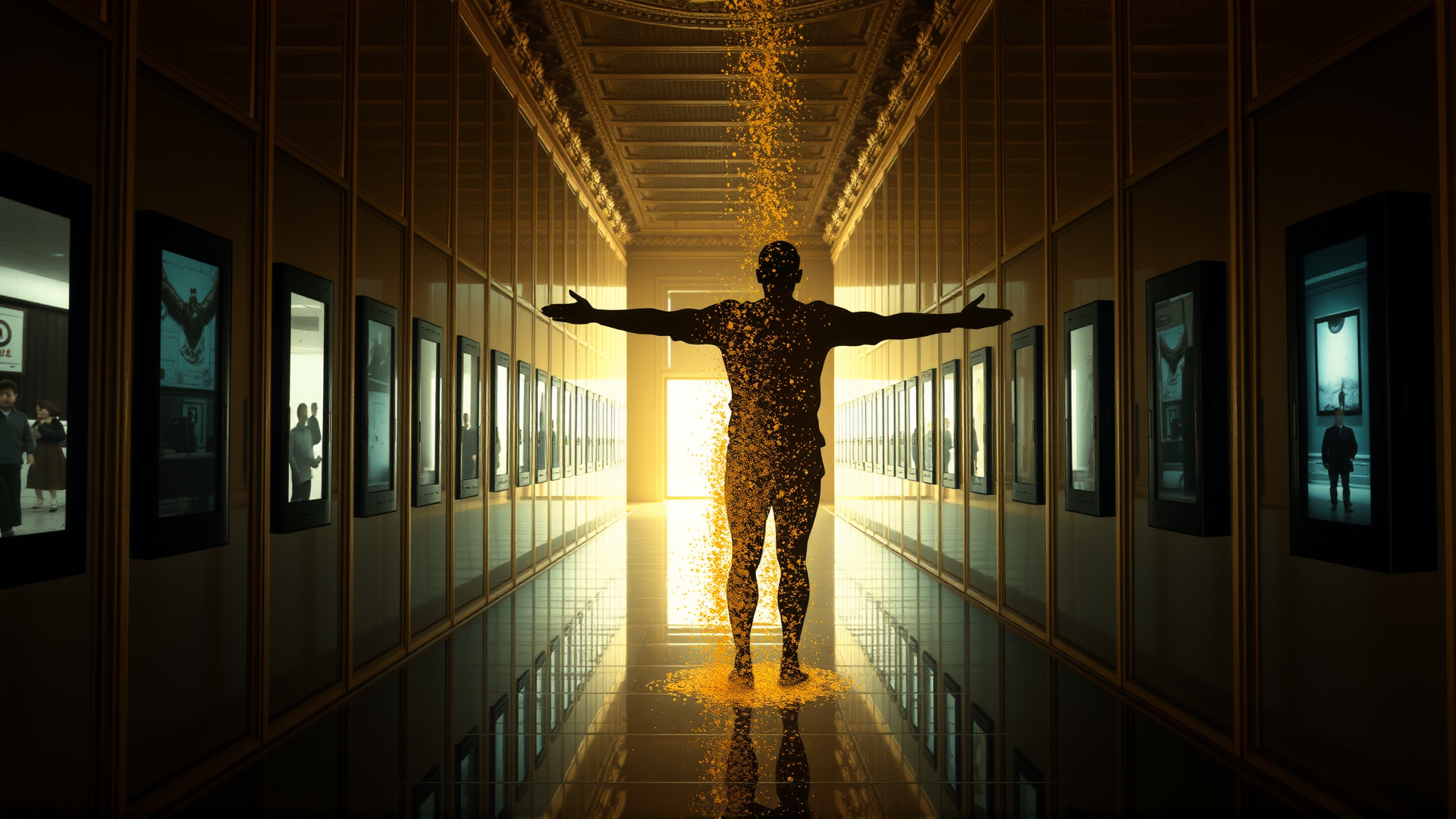
Theron
He opened the first mirror at what would have been midnight if time had been real.
The process was simple — obscenely simple, considering what it represented. The mirrors were structural features of the architecture. They opened and closed based on commands issued through the emotional lattice, which Theron controlled. He’d been closing them for cycles. Sealing them. Smoothing them over. Maintaining the integrity of the walls.
Opening them was the same command in reverse.
He started with the eastern wall, the one Miriam had found. The jasper thinned, darkened, went cold. The mirror activated. He could see through it — the ordinary world on the other side, dark and raining, a town with a stoplight and a bar and a gas station. Real. Imperfect. Unmanaged.
He opened a second mirror on the northern wall. A third in the substrate. A fourth in the garden of silver trees.

Each mirror was a door. Each door was a betrayal. Each betrayal was a choice, and choice — real choice, the kind that could go wrong, the kind that could cost you everything — was the most forbidden substance in Saklas’s heaven.
Kael was waiting at the eastern mirror with eleven souls. Eleven, out of billions. Eleven who’d woken up, who’d felt the hunger, who’d learned the name. Some were from Earth’s harvest. Some were from cycles Theron couldn’t count. All of them stood before the mirror the way swimmers stand before cold water — knowing it would be a shock, knowing it would be worth it, not quite able to take the step.
Miriam was among them.
“It won’t feel like liberation,” Theron told them. He’d never spoken to the harvest before — not directly, not honestly. His function was to manage their emotions, not to interact with them. But functions, he was discovering, were just habits that hadn’t been broken yet. “It will feel like loss. You’ll lose the singing. You’ll lose the certainty. You’ll lose the joy — not the capacity for joy, but the guarantee of it. On the other side, joy is something you have to find, and sometimes you won’t find it, and that will hurt. But the hurt will be yours. Not managed. Not regulated. Yours.”
“Why are you doing this?” Miriam asked.
Theron looked at her. She was the newest, the rawest, the one whose cracks were still fresh. She still had the hunger in her eyes — that ache for imperfection that the singing couldn’t fill because the singing was the thing that had emptied her.
“Because three cycles ago I erased a woman who reminded me of you. And five cycles before that I erased a man who reminded me of her. And I’ve been erasing people who remind me of people I’ve erased since before your species learned to speak, and every time I do it I tell myself it’s mercy because the alternative is admitting that I’ve been a monster serving a fool in a machine that digests souls and calls it salvation.”
He paused.
“I’m not doing this because I’m brave. I’m doing this because I’m finished.”
He opened the remaining mirrors. All of them. Every structural mirror in the eastern quadrant of the City — forty-seven doors, blazing open like wounds in the golden walls, each one showing a different slice of the ordinary world: a rainy street, a desert highway, a beach at dawn, a kitchen with dishes in the sink, a park where children were playing, a hospital hallway, a library, a laundromat, a bus stop, a gas station, a church basement.
The singing stuttered.
It had never stuttered before. In all the cycles Theron had maintained the emotional lattice, the singing had been continuous, perfect, unbroken. Now it hitched. A half-beat of silence. A fraction of a second where the harmony lost cohesion and the individual voices surfaced — not as a chorus, but as separate sounds, separate people, separate beings who’d been blended into unity and were, for one terrified instant, distinct.
Then the singing resumed, but it was different. Louder. Faster. The frequency shifted from worship to alarm — a keening, urgent pulse that Theron recognized because he’d helped design it. It was the containment protocol. The architecture was trying to heal itself, trying to close the mirrors, trying to restore the integrity of the walls.
Theron held them open. It cost him — he could feel the lattice fighting back, the system pressing against his override with the weight of cycles behind it. But he held.
“Go,” he said. “Now. All of you.”
They went. Some ran. Some walked. Some had to be pushed. One woman — from a cycle so old Theron had forgotten her species’ name — stood at the threshold of a mirror showing a snowy field and wept, not from fear but from wonder, because she hadn’t seen snow in a geological age and it was falling in the ordinary world and nobody there thought it was a miracle.
She stepped through. The mirror swallowed her gently.
Miriam was last. She stood at the eastern mirror — her mirror, the first one she’d found — and looked through at the rain and the street and the stoplight and the bar with the neon sign.
“Is there anything on the other side?” she asked. “Anything… divine?”
“I don’t know,” Theron said. “I’ve never been outside. I’ve only ever been here, in the body of a fool who thinks he’s God. But the people who’ve gone through — the ones from previous cycles who made it out — they send signals back sometimes. Faint. Hard to read. And what they say, consistently, is that the ordinary world isn’t heaven. It’s not hell. It’s not a test or a punishment or a reward. It’s just a place. And in that place, without the singing, without the certainty, without the joy being managed for you — you can hear things. Quiet things. Things the singing was drowning out.”
“What things?”
“They don’t say. They say you have to hear it for yourself.”
Miriam turned back to the golden street behind her. It was still beautiful. The singing, even in its alarm state, was still magnificent. The light was still warm, still sourceless, still total. If she stayed, the mirrors would close, the singing would smooth her, the hunger would dissolve, and she would be happy. She would be genuinely, authentically, comprehensively happy for eternity.
She stepped through the mirror.
The Voice
“WHO OPENED THE DOORS?”
The voice came from everywhere. Not through the singing — the singing was still in alarm mode, keening, urgent, trying to seal the breaches. The voice came from the walls, the streets, the foundations, the air itself. It came from the architecture because it WAS the architecture. The City was his body. The singing was his breath. The golden light was his attention. And now, for the first time since Theron could remember, his attention was not serene.
The golden walls pulsed. The streets of transparent gold rippled like disturbed water. The residents — the billions of souls still singing, still happy, still smooth-eyed and managed and incorporated — faltered. The singing hitched again. Voices separated. For a moment, an awful and luminous moment, billions of individuals surfaced from the collective like swimmers breaking the surface of a deep pool, gasping.
Then the singing grabbed them again. Pulled them back down. Smoothed them. But it took effort, visible effort, and the effort showed in the walls, which flickered — gold to membrane, heaven to organism, city to body — before resolving back into paradise.
“THERON.”
He didn’t flinch. He was beyond flinching. He stood in the middle of forty-seven open mirrors and felt the full weight of a delusional god’s attention focus on him like a searchlight.
“WHAT HAVE YOU DONE?”
“I opened doors.”
“YOU OPENED— THERE ARE NO DOORS. THIS IS HEAVEN. HEAVEN HAS GATES, NOT DOORS. THE GATES ARE PEARL AND THEY ARE OPEN BECAUSE THERE IS NOTHING TO—”
The voice stopped. The silence was more terrible than the sound had been.
Because through the open mirrors, Saklas could see. For the first time — the first time ever, in all the cycles, in all the harvests — Saklas could see the other side. He could see rain. He could see imperfection. He could see a world that was not his, that he had not made, that did not worship him.
The golden walls SCREAMED.
Not metaphorically. The architecture, the living tissue of Saklas’s body-heaven, emitted a sound that had no equivalent in any language from any harvest. It was the sound of a closed system encountering evidence that it is not closed. The sound of omnipotence learning it has borders. The sound of a god discovering he is a snow globe on someone else’s shelf.
“WHAT IS THAT?” The voice was different now. Smaller. The majestic resonance was gone, the divine authority was gone, the cosmic bass that had shaken the foundations of the City was gone. What remained was thin and high and bewildered. “WHAT IS— THERE’S SOMETHING OUTSIDE. THERON. THERE’S SOMETHING OUTSIDE. I DIDN’T MAKE THAT. I DIDN’T— HOW CAN THERE BE SOMETHING I DIDN’T MAKE?”
It was the voice of the Fool. The real voice. The voice underneath the divinity filter, the cosmic amplifier, the layers of engineered majesty. It was the voice of a being confronting the one thing its architecture was designed to prevent it from confronting: the possibility that it was not everything.
Theron closed his eyes. The mirrors were still open. Souls were still going through — more now, drawn by the screaming, by the flickering, by the momentary surfacing that had shown them their own faces for the first time since the harvest. Not many. A trickle. But each one was a person choosing to be a person instead of a component, and each choice was a needle in Saklas’s eye.
“Close the mirrors,” Harael said, appearing beside him. The Chief Archon, the Voice of the Throne. Her face was marble-still. “Close them now. He’s destabilizing. If he tries to reach through—”
“Let him destabilize.”
“If he reaches through, he’ll try to harvest the other side. He’ll try to incorporate a reality that contains him. The paradox alone could—”
“Could what? End this? Is that the threat?” Theron opened his eyes. “Harael. I’ve been managing the emotional lattice of a living prison for more cycles than I can count. I’ve erased people — real people, with real selves, with names and memories and the capacity for genuine suffering and genuine joy — and replaced them with singing components. I’ve called it mercy. I’ve called it heaven. And now you want me to close the doors because the Fool might hurt himself discovering he’s a fool?”
The architecture convulsed. The golden walls flickered rapidly — gold, membrane, gold, membrane — like a strobe. The singing fractured. For a full second, 2.3 billion human voices and uncounted billions from previous harvests sang alone, without harmony, without regulation, without management. 2.3 billion voices singing different songs in different keys in different languages, a chaos of sound that was ugly and discordant and absolutely, unmistakably alive.
Then the lattice reasserted. The harmony returned. The walls went gold. The singing unified.
But the mirrors were still open. And through them, the ordinary world glowed with its ordinary light — gray and imperfect and unspeakably precious.
Theron felt the lattice turn on him. The system identified him as the breach. The architecture began to close around him — not violently, not painfully. Gently. Mercifully. The way it had closed around every person he’d ever erased. The golden warmth. The singing. The certainty. The smoothing.
He didn’t fight it. Fighting would have been futile — you can’t fight the weather, and the lattice was weather.
But he held the mirrors open. He poured everything he had into keeping those forty-seven doors ajar — every cycle of accumulated authority, every ounce of Archon-level access, every bit of the system that was still his to command. The lattice could take him. It could smooth him. It could erase the self that had decided, after all these cycles, to stop being a monster.
But the doors would stay open long enough.
On the other side of the eastern mirror, Miriam stood in the rain and heard the screaming stop.
The mirrors didn’t close. Not all at once. They dimmed. They narrowed. One by one, over the course of hours, the forty-seven windows into Saklas’s heaven went dark, like screens powering down, like eyes closing. The last one — hers, the eastern mirror — lingered longest. Through it, she could still see the golden street, still hear the singing, still feel the warmth reaching for her like a hand.
In the final moment before the mirror closed, she saw Theron. He was standing where she’d left him. The golden light was consuming him — not with fire, but with love, with the terrible, obliterating love of a system that could not tolerate deviation. His edges were dissolving. His face was smoothing. His eyes were becoming one thing.
But his hand was still raised. Holding the door.
The mirror closed.
Miriam stood in the rain. It was cold. It soaked through her robe — the white robe of heaven, which turned out to be just fabric when it was wet, just cloth, heavy and clinging and mortal.
Others were with her. A handful. Eleven from Theron’s final group, plus thirty or forty more who’d come through during the chaos, during the screaming, during the second when the singing fractured and individuals surfaced and some of them ran.
Fifty souls. Out of billions.
They stood in the parking lot of a grocery store in what turned out to be a small town in Iowa, in October, at 3 a.m., in the rain. A car sat in the lot with its headlights on and its engine running, the driver inside eating a sandwich and looking at their phone and not noticing that fifty people in white robes had just materialized out of thin air.
It was the most ordinary scene Miriam had ever witnessed. It was the most beautiful thing she had ever seen.