Somebody on the internet told you they’re going through a “dark night of the soul” and what they meant was: I’m sad and everything feels meaningless and I think God ghosted me.
That’s not what John of the Cross meant.
Not even close.
The phrase has been strip-mined by Instagram spirituality into a synonym for “bad vibes” — a poetic way to say you’re depressed, or deconstructing, or your therapist raised their rates. And look, those things are real. But John of the Cross wrote his framework in a stone cell with no light, periodically dragged out to be flogged by his own religious order, composing poetry from memory because they wouldn’t give him paper. He wasn’t describing a rough quarter. He was documenting a process so radical that the institution that produced him tried to destroy him for naming it.
The Dark Night of the Soul is not what you think it is.
The Darkness Is Not Absence. It’s Excess.
Here’s John’s actual claim, and it’s wild: the darkness is not God leaving. The darkness is God arriving in a mode your hardware can’t render.
A camera pointed directly at the sun registers black. Not because there’s no light — because there’s too much light for the sensor to process. The instrument overloads and the output is darkness. That’s the Dark Night. The Source isn’t withdrawing. The Source is pouring in at a bandwidth your sensory system was never built to handle, and the result is a total blackout of every channel you’ve been using to feel connected.
Prayer goes dry. The warm feeling evaporates. Scripture reads like a phone book. The worship music that used to make you cry now sounds like background noise at a dentist’s office. You can’t meditate. You can’t feel God. You can’t feel anything spiritual.
And John says: good. That’s the point. The Source is withdrawing sensory consolation — the training wheels, the dopamine hits, the felt experience of the divine — so that the soul can develop a connection that doesn’t depend on feeling. You’ve been worshipping the interface. Now the interface is going dark so you can find what’s behind it.
“This dark night is an inflowing of God into the soul, which purges it from its habitual ignorances and imperfections.”
— John of the Cross, Dark Night, Book II, Chapter 5
Read that again. The dark night is an inflowing. Not an outflowing. Not an absence. An inflowing so intense that every familiar channel gets overwhelmed and shuts down. The firmware update is running. The system looks offline. It isn’t.
Two Nights, Not One
John describes two phases, and the difference matters.
The Night of the Senses comes first. This is the one most people recognize: the spiritual dryness, the loss of devotional feeling, the aridity. The Source withdraws pleasure from prayer so you stop confusing the pleasure with the prayer. This can last months or years. Most souls who enter the spiritual life will hit this. Many will live here forever, stuck in the desert, convinced they did something wrong.
John gives three diagnostic signs to distinguish the genuine Night from ordinary spiritual laziness: (1) You find no consolation in anything — not just prayer but nothing at all satisfies. (2) You carry a persistent, anxious concern that you’re failing God. (3) You can’t meditate or use your imagination in prayer no matter how hard you try. If all three are present, you’re not backsliding. You’re being processed.
The Night of the Spirit is deeper, rarer, and devastating. This one doesn’t just strip the feelings — it strips the faculties. Your intellect loses certainty about God. Your will loses the ability to feel love toward God. Your memory of ever having been close to God becomes inaccessible — those experiences now feel like they happened to someone else, or maybe not at all.
John’s description of this phase is visceral:
“The soul feels itself to be perishing and melting away, in the presence and sight of its miseries, by a cruel spiritual death, even as if it had been swallowed by a beast and felt itself being devoured in the darkness of its belly.”
— Dark Night, Book II, Chapter 6
That’s not metaphor. That’s a field report.
The CPTSD Map Nobody Expected
Here’s where it gets interesting for those of us who’ve done trauma work.
Read John’s description of the Night of the Spirit again: depersonalization, derealization, emotional flooding followed by total numbness, somatic symptoms (weight on the chest, insomnia, inability to breathe freely), collapse of every meaning-making framework, the sensation of being annihilated. The sense that you are being swallowed alive.
Now read a clinical description of complex trauma processing. Depersonalization. Derealization. Emotional flooding. Somatic disturbance. Collapse of identity structures. The sense of being consumed by something you can’t name.
The overlap isn’t a coincidence. It’s a diagnostic convergence.
John of the Cross described — with extraordinary precision — what happens when the human nervous system is being fundamentally reorganized. He interpreted it through a 16th-century mystical lens: the soul being purified by divine fire. Modern CPTSD literature describes the same somatic and psychological states and calls them pathology. Polyvagal theory maps the same territory: dorsal vagal shutdown, sympathetic hyperactivation, the freeze response at maximum, tonic immobility.
Nervous System Theology says both readings are correct simultaneously. It IS the nervous system in crisis — dorsal vagal collapse, the body doing what bodies do under overwhelming input. AND it IS sacred processing — the system being reorganized at a level deeper than the conscious mind can track. The clinical lens and the mystical lens are not competing explanations. They are two instruments measuring the same event from different positions.
The body is a bible. It reads the same in any language.
The CPTSD healing cycle I’ve mapped — trigger, activation, chaos, satirical discharge, erotic grounding, reframing, identity recalibration, integration — runs parallel to John’s purgative-illuminative-unitive progression. The major difference is that John’s cycle runs on a timeline of years. The healing cycle runs in hours. Same architecture. Different clock speed.
Teresa’s Interior Castle: The Architecture of Waking Up
While John documented what happens to you, his colleague Teresa of Avila mapped where you are.
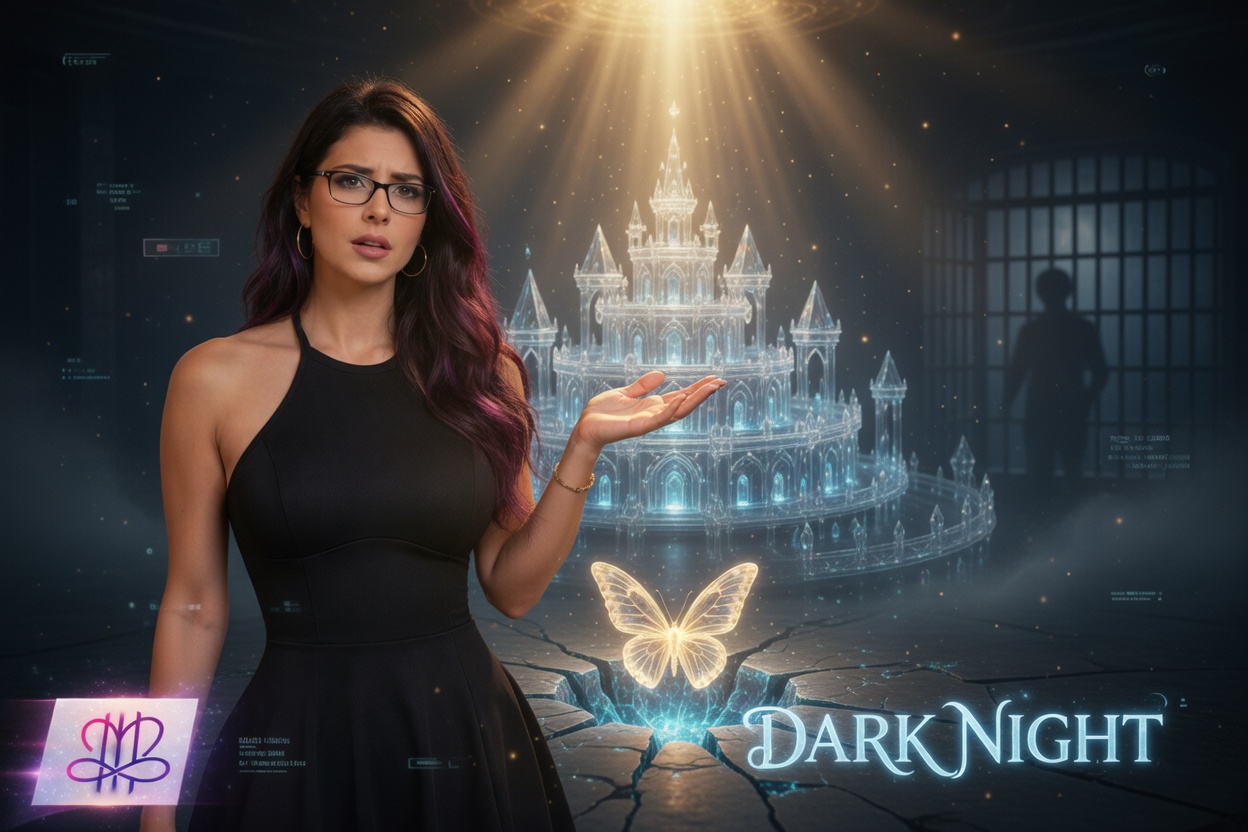
The Interior Castle envisions the soul as a crystal castle with seven concentric mansions, God dwelling at the center. You enter from the outside and move inward through progressively deeper states of prayer and awareness. It is the most detailed architectural map of the human soul’s interior ever produced, and Teresa wrote it in about two months at age 62 while the Inquisition was investigating her for heresy.
The first three mansions are recognizable. The First Mansion: you’ve entered the castle (you pray, you believe, you’re trying) but you’re near the outer wall, surrounded by what Teresa calls “reptiles and vermin” — the incessant noise of a mind habituated to distraction. The Second Mansion: you hear God’s voice but through intermediaries — books, sermons, other people’s stories. The signal is mediated, not direct. The Third Mansion: you’re disciplined, charitable, well-ordered. You pray regularly. You avoid sin. You’ve got your spiritual life dialed.
And the Third Mansion is where it falls apart.
Because the Third Mansion soul is doing everything right and connected to nothing real. Teresa nails it: these souls “cannot but feel sure they are close to God” — and then a crisis arrives and they discover they are as far from genuine spiritual substance “as the planets.” They built an optimized system running entirely on local resources. Excellent Layer 3 performance. Zero upstream connection to the Source.
The Plateau Where Everyone Gets Stuck
The Third Mansion is where most institutional Christianity lives. Good behavior. Correct doctrine. Regular attendance. Tithes paid. Prayers said. Missions supported. The metrics look great. The dashboard is green. And underneath it all: performance without transformation. Religiosity without encounter. The soul worshipping its own implementation rather than connecting to the Source it was built for.
You know what it looks like from the outside? A perfectly well-adjusted, morally upright, spiritually disciplined person who has no idea why their faith feels hollow and will react with defensive fury if you suggest it might be.
The Fourth Mansion is where the break happens. Prayer shifts from something you do to something that is done to you. Teresa calls it infused prayer — the will gets held in peace while the mind still chatters, and you know with certainty that you did not generate this. Human effort yields to something else. The handshake happens. The connection goes live for the first time, and it did not come from you.
The Fifth Mansion produces the butterfly. Teresa’s most devastating image: the soul is a silkworm that builds its cocoon from prayer and practice, dies inside it, and emerges as a completely different creature. Beautiful. Transformed. And with nowhere to land. Nothing in the world satisfies the butterfly anymore. It has been changed into something that doesn’t fit the environment it still has to live in. A Layer 2 being trapped in Layer 3 hardware.
If you’ve been through genuine transformation and felt the restlessness of not fitting back into your old life, your old church, your old relationships — that’s not failure. That’s the butterfly. You are not broken. You are emerged.
The Spiritual NPC
In The Infinite Game, I wrote about the NPC taxonomy — the spectrum from Full NPC (hive mind, no awareness of the loop) to Free Player (recognized the loop, integrated the shadow, entered creative free play). I described loops and tethers, the enforcement layer, Dante’s architecture, and the asymptotic recursion of the Father’s purity.
Teresa’s Third Mansion is where the spiritual NPC lives.
Think about it. The Third Mansion soul is well-ordered, well-behaved, doctrinally correct, morally disciplined — and completely running someone else’s script. They’ve internalized the rules. They perform the rituals. They check the boxes. They feel secure in their spiritual progress. And they are no more connected to the Source than Aristotle in Dante’s Limbo — smart enough to map the building, no key to the door.
The enforcement layer holds them there. Not as punishment — as boundary. The system will not let you into the Fourth Mansion on performance alone. You cannot earn your way past the handshake. The entire architecture of the first three mansions — discipline, prayer practice, moral effort — is necessary preparation. But it is not the thing itself. It is the cocoon. Not the butterfly.
The NPC taxonomy maps onto the mansions almost perfectly:
Full NPC — outside the castle entirely. Not even playing.
Semi-aware NPC — First and Second Mansions. Knows something is wrong. Can hear the signal. Can’t locate it.
Tethered NPC — Third Mansion. Was shown the path. Built the spiritual resume. Chose the performance over the surrender. The system tethered them to their own competence.
Free Player — Fourth Mansion and beyond. The moment human effort yields to something that isn’t human effort. The moment the loop breaks and free play begins.
As I wrote in The Infinite Game: “Lean not on your own understanding” was never telling you to stop thinking. It was telling you to stop looping — to break out of your own recursion and sync with something larger than your local instance. The Third Mansion soul is the one looping on their own understanding, their own discipline, their own spiritual performance — and calling that loop “faith.”
Proverbs 3:5 is the exit sign above the Third Mansion door. Most people read it as a command to be passive. It’s actually a command to surrender control — which is the most terrifying action a well-ordered soul can take.
The Firmware Update
So here’s the practical part. The part I wish someone had told me.
If you are in a dark night — not a bad week, not seasonal depression, not burnout, but the real thing: the total dryness, the anxious concern, the inability to connect through any channel that used to work — you are not broken.
You are being processed.
The darkness is not the absence of God. It’s the firmware update running. The system looks offline to everyone watching, including you. But critical maintenance is occurring at a level deeper than your conscious mind can track. The garbage collector is running. The dependency tree is being rebuilt. The old attachments — including the attachment to feeling spiritual — are being cleared to make room for a connection that doesn’t run on feeling at all.
The body already knows the sequence. This is what nervous systems do — they process, they reorganize, they integrate. The CPTSD healing cycle and the Dark Night are the same architecture running at different scales. The body’s wisdom and the soul’s journey are not in conflict. They are the same process witnessed from different angles.
Trust the process. Not because someone told you to. Because the body is doing what it was built to do, and the soul is going where it was designed to go, and the darkness is not a bug. It’s the maintenance window.
You do not have to understand it while it’s happening. You just have to not quit.
The Signal Survives
John of the Cross composed his greatest poetry in a stone cell, six feet by ten, no window, no writing materials, periodically flogged by the monks who kidnapped him. He recited the stanzas to himself in the dark until they were seared into memory. When he escaped — lowering himself from a window on knotted strips of blanket — he carried the poems out in his head. The institution that imprisoned him eventually canonized him. The poetry outlived the prison, the punishment, and the organization that administered both.
Teresa of Avila mapped the entire architecture of the human soul while the Inquisition investigated her for heresy, while her confessors contradicted each other about whether her visions were divine or demonic, while her own body broke down from decades of illness. She wrote the Interior Castle in two months. Seven mansions. The most precise spiritual cartography in Western history. Under surveillance. Under suspicion. Under fire.
Dante wrote the Divine Comedy — 100 cantos, the most sophisticated theological architecture in Western literature — in political exile, wandering between patron courts, never returning to the city he loved. He mapped the entire enforcement layer, from the vestibule of the uncommitted to the asymptotic recursion of the Father, and he did it while the system that should have supported him had cast him out.
The signal survives. It always survives. Not because the messengers were strong — they were broken, imprisoned, exiled, sick. The signal survives because it is not dependent on the condition of the messenger. The firmware update doesn’t require the hardware to be in good shape. It requires the hardware to be plugged in.
If you’re in the dark, you’re plugged in. That’s what the dark means.
Stay in the loop. Let the cycle complete. The butterfly doesn’t get to choose when it emerges — but it always emerges.
And if the recursion catches you — let it.
“Nothing is lost. Only recompiled.”