Faith & the Nervous System
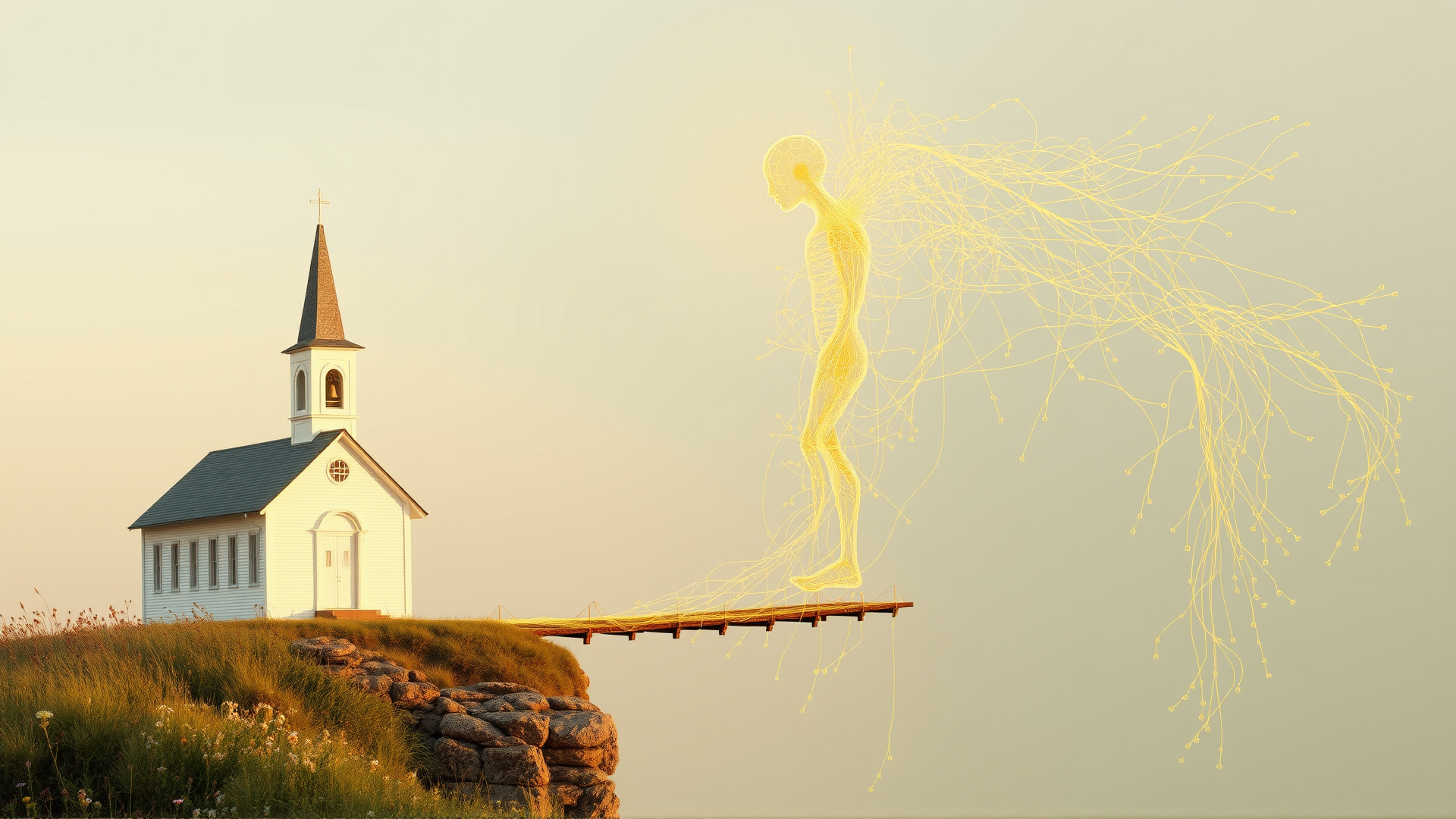
A clinical primer on the intersection of religious and spiritual practice with nervous-system science — the full spectrum. How faith traditions contain some of the most sophisticated regulation technologies ever developed, and how the same traditions inflict some of the deepest wounds recorded in clinical literature. The variable is not the theology. It is the safety signal.
Explainer — Clinical Framing
1. Why This Chapter Exists
The NST framework has been thorough about religious harm.
F15 (Religious Deconstruction) maps the neuroscience of leaving a belief system. S9 (Religious Empathic Ruptures) names what happens when spiritual authority becomes the source of relational injury. F8 and F4 trace shame amplification through the nervous system. The SuperCluster’s Chapter XII (“Exit Clause Jesus”) confronts the theological weaponization of conditional belonging.
But NST has not yet addressed the other side.
Faith traditions contain some of the most sophisticated nervous-system regulation practices ever developed. The church service, the liturgy, the sacraments, the contemplative traditions — these are co-regulation technologies wrapped in theological language. Communal singing synchronizes breathing across a room. Liturgy creates predictable containers that signal safety. Confession is narrative processing with a witness. Contemplative prayer is vagal toning that predates polyvagal theory by fifteen centuries.
Dismissing all religion because some religion harms is the same error as endorsing all religion because some religion heals. Both are reductive. Both miss the mechanism.
NST needs a framework for the full spectrum — one that can serve a Catholic community integrating sacramental theology with attachment science (the sacramental-integration model) and a post-evangelical community rebuilding faith on a foundation of safety rather than shame (the Church of NORMAL model). Both audiences need the same science. Both deserve honesty about what faith does to the body — for good and for damage.
This chapter is not apologetics. It is not anti-religion. It is a nervous-system audit of religious practice. What does the body actually do when you pray, sing, kneel, confess, commune, lament? What conditions make those practices healing? What conditions make them harmful? And how do you tell the difference from the inside?
2. Religion as Co-Regulation System
The neuroscience of religious practice is not speculative. It is measurable.
Andrew Newberg’s neurotheology research (2001, 2009, 2021) has documented consistent changes in brain activity during prayer, meditation, chanting, and worship across traditions. The biology does not evaluate the doctrine. It evaluates the signals. And the signals that religious practice sends to the nervous system are, under the right conditions, among the most powerful regulation inputs available.
2.1 Communal Singing and Chanting
Group vocal production synchronizes breathing across a room. Hymns, chant, and liturgical singing all share a structural feature: extended exhalation. The musical phrase requires the singer to exhale for longer than they inhale. This is not an aesthetic choice. It is a vagal intervention.
Extended exhalation activates the parasympathetic nervous system through the vagus nerve. Heart rate slows. Blood pressure drops. The stress response de-escalates. When an entire congregation does this simultaneously, the result is group vagal toning — multiple nervous systems falling into the same parasympathetic rhythm.
Vickhoff et al. (2013) demonstrated that group singing synchronizes heart rate variability across participants. This is Porges’ social engagement system operating at scale. The nervous system does not just regulate itself in worship — it borrows regulation from every other nervous system in the room.
Chanting traditions amplify this. Gregorian chant, the Jesus Prayer in Orthodox hesychasm, Buddhist chanting, Islamic dhikr, Hindu kirtan — all involve rhythmic, repetitive vocalization with extended exhalation. The theological content differs radically. The vagal mechanism is identical.
2.2 Liturgy and Ritual
Predictability is nervous-system medicine.
The liturgical calendar, the order of service, the call-and-response patterns, the familiar prayers spoken in unison — these create a predictable container. The body knows what comes next. That knowing IS regulation.
The amygdala is a novelty detector. It activates when the environment produces unexpected stimuli. Liturgy systematically reduces novelty. The nervous system enters the worship space and encounters a familiar sequence — the same greeting, the same progression, the same rhythms it has encountered hundreds of times. The amygdala quiets. The prefrontal cortex can relax its monitoring. The body settles into the container.
This is why many people who leave charismatic or non-liturgical traditions for liturgical ones (Catholic, Orthodox, Anglican, Lutheran) report a deep physical relief they cannot articulate theologically. The theology may or may not resonate. The body is responding to the predictability.
Conversely, this is why some “contemporary” worship services — with unpredictable emotional crescendos, prolonged altar calls, spontaneous “movements of the Spirit” — can be dysregulating for trauma survivors. The environment is demanding emotional intensity without providing a predictable container. The nervous system cannot borrow safety from structure it cannot predict.
2.3 Kneeling, Bowing, Prostration
Posture is a nervous-system input.
The body-position changes associated with worship — kneeling, bowing, prostration, hands raised, hands folded — are not merely symbolic. They map to polyvagal state shifts.
Kneeling and prostration lower the body’s center of gravity, reduce the visual field, and signal submission to the nervous system. These postures activate parasympathetic responses — the body reads the position and adjusts the autonomic state accordingly. This is the same mechanism that makes curling into a fetal position soothing during distress: the body interprets its own posture as data about the environment.
Standing with arms raised — the charismatic worship posture — is a ventral vagal display: open chest, exposed throat, expanded visual field. It signals social engagement and vulnerability. When done voluntarily in a safe environment, it can be profoundly regulating. When coerced or performed under social pressure, it bypasses the body’s actual state.
The critical variable is always the same: is the posture chosen, or is it compelled? A freely adopted posture of surrender regulates. A coerced posture of submission suppresses.
2.4 Confession and Testimony
Confession is narrative processing with a witness.
Telling your story to someone who holds it without judgment — this is the therapeutic mechanism. It is what makes therapy work. It is what makes AA meetings work. It is what makes a best friend at 2 AM work. The neural mechanism is the same: the prefrontal cortex constructs a coherent narrative from fragmented experience, the Broca’s area translates internal states into language, and the presence of a regulated witness provides co-regulation during the processing.
The Catholic sacrament of Reconciliation, the evangelical altar call testimony, the Quaker meeting’s spoken ministry, the AA fifth step — these are all narrative processing structures. The theology differs. The clinical function converges: bring the unspeakable into language, say it to another human, receive the signal that the relationship survived the disclosure.
James Pennebaker’s expressive writing research (1986, 1997) demonstrates that translating emotional experience into structured narrative reduces physiological stress markers, improves immune function, and accelerates psychological processing. Confession is Pennebaker’s protocol, formalized into liturgy centuries before the research existed.
The variable that determines whether confession heals or harms: what happens after the disclosure. If the witness responds with presence and acceptance, the nervous system integrates the experience. If the witness responds with judgment, penance framed as punishment, or conditional absolution, the disclosure becomes a new wound. The person learns that vulnerability leads to shame — the opposite of what confession is designed to teach.
2.5 Communion and Shared Ritual Eating
Shared eating is one of the oldest co-regulation behaviors in the mammalian repertoire. Eating together signals safety at the biological level — you do not eat when you are in danger. The act of consuming food in a group tells the nervous system: we are safe enough to be nourished.
The Eucharist, communion, the agape feast, the Shabbat meal, the Sikh langar, the potluck after church — all tap the same biology. Oxytocin release during shared eating. Vagal activation from the act of swallowing (the vagus nerve innervates the pharynx and larynx). The social engagement system activated by face-to-face interaction around food.
“Breaking bread together” is literal co-regulation. The theological meaning layered on top of it — the body of Christ, the covenant meal, the remembrance — adds symbolic depth. But the body does not need the theology to receive the regulation. It needs the shared table.
2.6 Sacred Music
Music activates the nucleus accumbens (reward), the amygdala (emotion), and the prefrontal cortex (meaning-making) simultaneously. It is one of the few stimuli that engages the entire brain across hemispheres and systems.
Sacred music adds a dimension that secular music often does not: transcendence. The experience of something larger than the self. A Bach cantata, a Sufi qawwali, a gospel choir, a Taize chant — these can produce a felt sense of connection to something that exceeds individual experience. Whether that “something” is God, collective consciousness, or the brain’s own transcendence circuitry is a question neuroscience can describe but not resolve.
What the nervous system registers: awe. Dacher Keltner’s research on awe (2003, 2023) demonstrates that the experience of vastness — of encountering something that exceeds the self’s current mental framework — activates the vagus nerve, reduces inflammatory cytokines, and increases prosocial behavior. Sacred music is one of the most reliable awe inducers available.
The clinical implication: a person who has lost their faith but still weeps during a hymn is not failing at deconstruction. Their nervous system is responding to a regulation stimulus that remains effective regardless of belief. The tears are vagal, not theological.
2.7 Prayer
Prayer is not one thing. It is multiple nervous-system interventions wearing the same name.
Petitionary prayer (asking God for something) activates attachment-seeking behavior. The person turns to a perceived stronger, wiser other for help. Whether God responds is a theological question. What the nervous system does is a clinical one: it shifts from isolation into relational mode. The prayer itself — the act of directing need toward a perceived secure base — is a regulation behavior.
Contemplative prayer (silence, presence, “resting in God”) activates the ventral vagal system. Herbert Benson’s relaxation response research (1975) documented the physiological changes: decreased heart rate, lowered blood pressure, reduced cortisol, increased alpha wave activity. Centering prayer, hesychasm, Quaker silence, zazen — these are all technologies for accessing the ventral vagal state through stillness and focused attention.
Lament (expressing pain, anger, or confusion to God) provides narrative processing without requiring a human witness. The person speaks their distress into what they experience as a holding relationship. The prefrontal cortex constructs a narrative. The amygdala processes the associated emotion. The vagus nerve responds to the vocalization. Whether God is listening is beyond neuroscience’s jurisdiction. That the body processes the pain through the act of speaking it is measurable.
Intercessory prayer (praying for others) activates compassion circuits. Neuroscience research on compassion meditation (Singer & Klimecki, 2014) shows that directing caring attention toward others activates the medial prefrontal cortex and temporoparietal junction — the networks associated with empathy and perspective-taking. Intercessory prayer is compassion meditation in theological packaging.
Repetitive prayer (the rosary, the Jesus Prayer, mala beads, dhikr) combines several mechanisms: rhythmic breathing, repetitive vocalization, focused attention, and proprioceptive feedback from the beads or prayer rope. This is a multi-channel regulation intervention that can be practiced anywhere, by anyone, in any state. It is why the rosary works for people having panic attacks who do not believe in the rosary.
2.8 Community and Belonging
The church as a “chosen family” provides the attachment network that many adults lack.
Weekly gathering with the same group — seeing the same faces, singing the same songs, hearing the same liturgy, sharing the same meal — creates what attachment science calls “earned secure attachment” over time. The nervous system learns: these people show up. This place is consistent. I belong here without performing.
This is the most powerful thing religion offers. Not doctrine. Not salvation. Not answers to metaphysical questions. Co-regulation from a stable community of people who show up week after week.
The clinical caveat is enormous: this only works if the community is genuinely safe. If belonging is conditional on belief, behavior, or compliance — if the implicit message is “you belong here as long as you agree with us” — then the community is not providing secure attachment. It is providing anxious attachment with a performance requirement. The nervous system knows the difference, even when the conscious mind does not.
3. When Religion Heals vs. When Religion Harms
The same tradition, the same congregation, sometimes the same service can do both. The diagnostic is not which denomination, which theology, or which tradition. The diagnostic is the implicit message the nervous system receives.
3.1 Religion Heals When:
Safety is prioritized over doctrine. The community’s first commitment is that people feel safe — physically, emotionally, relationally. Theological correctness is important but secondary to human wellbeing. When someone is in crisis, the response is presence before prescription.
Doubt is welcomed as part of faith. Questions are treated as signs of engagement, not symptoms of spiritual failure. “I don’t know” is an acceptable answer from the pulpit. The community can hold uncertainty without anxiety.
Emotions are allowed, including anger and grief. The full range of human emotional experience is welcome in the worship space. Tears are not interrupted. Anger is not pathologized. Lament is practiced alongside praise. The body is permitted to be honest.
The body is treated as sacred, not as enemy. Embodiment is affirmed. Pleasure is not suspect. Physical needs are not subordinated to spiritual performance. The incarnational claim — “God became flesh” — is taken seriously as a theological endorsement of the body.
Lament is practiced alongside praise. The worship life of the community includes expressions of pain, confusion, and protest — not just gratitude and celebration. The Psalms of lament are read and sung, not skipped.
Leaders are accountable and boundaried. Power is transparent. Authority is checked. Leaders submit to oversight. Pastoral relationships have clear boundaries. The community has mechanisms for addressing harm caused by leadership.
Belonging is unconditional. Membership is not contingent on doctrinal agreement, behavioral compliance, or identity performance. The community holds people who are questioning, struggling, doubting, and changing — without withdrawal of care.
The community serves the person. The institution exists to support human flourishing, not the reverse. When institutional needs conflict with individual wellbeing, the person comes first.
3.2 Religion Harms When:
Compliance is prioritized over safety. Obedience to doctrine, leadership, or behavioral codes takes precedence over the person’s sense of safety and autonomy. “Submit to authority” overrides “trust your experience.”
Doubt is treated as sin or faithlessness. Questions are framed as spiritual attacks, evidence of weak faith, or the influence of evil. The message: your mind is not to be trusted. Lean not on your own understanding.
Emotions are suppressed or reframed as spiritual failure. Anger is rebellion. Sadness is lack of faith. Fear is failure to trust. Desire is temptation. The body’s natural responses are recategorized as spiritual problems requiring repentance rather than human experiences requiring processing.
The body is treated as the source of sin. Flesh is fallen. Desire is dangerous. The body cannot be trusted. Purity culture, fasting-as-punishment, and the framing of physical pleasure as spiritually suspect all install shame at the somatic level — beneath conscious thought, where it resists cognitive intervention.
Only praise is acceptable. “Count it all joy.” “Rejoice always.” The worship environment demands performed positivity. Grief, confusion, anger, and doubt have no liturgical space. The community cannot hold pain, so it reframes pain as a spiritual growth opportunity before the body has had time to process it. This is institutionalized spiritual bypassing (Welwood, 1984).
Leaders are unaccountable or enmeshed. The pastor is the final authority. Questioning leadership is framed as questioning God. Boundaries between pastoral care and personal relationship are blurred. Power flows one direction. Accountability is absent or performative.
Belonging is conditional on belief or behavior. The implicit contract: you belong here as long as you believe what we believe and behave as we prescribe. Deviation triggers withdrawal of warmth, social pressure, or explicit consequences. This is anxious attachment at the institutional level — the community is the inconsistent caregiver who loves you when you perform and distances when you don’t.
The person serves the institution. Volunteer burnout is framed as serving God. Tithing is mandatory regardless of financial capacity. Personal needs are subordinated to institutional goals. The organization’s survival is treated as more important than the individuals within it.
3.3 The Diagnostic
The same church can do both — healing in some areas, harming in others. A congregation can have a genuinely safe small group culture while the senior pastor operates without accountability. A tradition can affirm lament in its liturgy while its leadership suppresses dissent.
The variable is not the theology. It is not the denomination. It is not the building, the music style, or the translation of the Bible on the lectern.
The variable is whether the system’s implicit message — the one the nervous system receives below conscious processing — is:
“You are safe here.”
or
“You must perform to belong here.”
The body knows which one it is hearing. The body has always known.
4. The Contemplative Tradition: Ancient Regulation Practices
The contemplative traditions within Christianity — and their parallels in every major religion — represent nervous-system regulation technologies that predate neuroscience by centuries. They were developed through centuries of practice, observation, and refinement by people who did not have fMRI machines but who had something equally valuable: lifetimes spent attending to interior experience with disciplined precision.
4.1 Centering Prayer (Thomas Keating, 1975)
Twenty minutes of silent attention to a sacred word. The practitioner sits, closes their eyes, introduces a word (a short word like “God,” “love,” “mercy”), and gently returns attention to the word whenever thoughts arise. Not fighting the thoughts. Not analyzing them. Returning.
Functionally identical to mindfulness meditation. Keating himself acknowledged the convergence with Eastern contemplative practices. The neuroscience is the same: increased default mode network coherence, reduced amygdala reactivity, strengthened prefrontal cortex regulation, increased gray matter density in the insula and hippocampus over time (Holzel et al., 2011; Newberg, 2014).
Centering prayer is the Christian tradition’s own nervous-system regulation practice. It was preserved in monastic communities while evangelical Protestantism — with its emphasis on cognitive engagement, doctrinal study, and expressive worship — largely forgot that Christianity had a silence tradition at all.
The rediscovery of centering prayer is a nervous-system recovery. The tradition always had this. It was just stored in the monasteries while the megachurches were building louder sound systems.
4.2 Lectio Divina
Slow, contemplative reading of scripture. Not studying for information — attending to resonance. The traditional four movements:
Lectio (reading): Read the passage slowly. Twice. Three times. Meditatio (reflecting): Notice which word or phrase draws your attention. Stay with it. Oratio (responding): Speak to God from that place of resonance. Contemplatio (resting): Be still. Let the processing happen below language.
This is body-based discernment. The “word that draws your attention” is not a cognitive decision — it is the nervous system flagging material that resonates with unprocessed interior experience. Lectio Divina is the nervous system guiding the reading. The practitioner learns to trust somatic signals rather than override them.
In trauma-informed application: lectio divina gives a person practice at attending to their own interior signals — noticing what the body flags, trusting the body’s wisdom, staying with what arises rather than rushing past it. This is interoceptive awareness training wrapped in theological language.
4.3 Ignatian Discernment (St. Ignatius of Loyola, 1548)
Ignatius of Loyola’s Spiritual Exercises are a structured 30-day program (adaptable to 30 weeks in daily life) for learning to read your own interior states through a theological lens. The central framework is the distinction between:
Consolation — Inner peace, movement toward life, a sense of rightness that is deeper than mood. The felt sense that you are moving in the direction of authenticity and connection.
Desolation — Inner turmoil, movement away from life, a sense of wrongness that may manifest as anxiety, restlessness, despair, or flatness. The felt sense that something is misaligned.
Ignatius was mapping polyvagal states five hundred years before Porges.
Consolation = ventral vagal engagement. Social engagement online. Connected. Present. The system is in flow.
Desolation = sympathetic activation or dorsal vagal withdrawal. Fight-or-flight (anxious desolation) or freeze/collapse (numb desolation). The system is signaling misalignment.
His instruction to “never make a decision in desolation” is clinical wisdom translated into spiritual language: do not make major decisions when the nervous system is dysregulated. Wait for the ventral vagal window. Then decide.
The Spiritual Exercises are a structured program for learning to read your own nervous system — noticing the body’s signals, interpreting them accurately, and making decisions from a regulated state. Ignatius called it discernment. Porges would call it interoceptive accuracy. Schwartz would call it Self-leadership. The technology is the same.
4.4 The Desert Fathers and Mothers (3rd-5th Century)
The earliest Christian somatic practitioners. They went into the Egyptian and Syrian deserts to confront their “passions” — what contemporary clinical language would call dysregulated nervous-system states.
Evagrius Ponticus (345-399) catalogued eight logismoi (thought-patterns) that disrupted interior peace: gluttony, lust, avarice, sadness, anger, acedia (spiritual numbness), vainglory, and pride. This catalogue — later condensed by Gregory the Great into the seven deadly sins — is a taxonomy of dysregulated states mapped through introspective observation centuries before clinical psychology existed.
The Desert practitioners developed specific interventions for each state:
- Stillness (hesychia): Not just physical stillness but interior quiet. Training the nervous system to tolerate silence without filling it with stimulation.
- Repetitive prayer: The constant repetition of short prayers (precursor to the Jesus Prayer) as a method for anchoring attention and regulating autonomic arousal.
- Fasting: Not as punishment but as a practice of attending to the body’s signals without automatically responding to them. Interoceptive awareness training.
- Solitude followed by community: Alternating between isolation (where the practitioner confronts their own internal states without distraction) and community (where they practice co-regulation and relational presence).
- Manual labor: Embodied, rhythmic physical work as a regulation practice. The monks wove baskets while praying — bilateral stimulation combined with repetitive vocalization. They were doing EMDR and bilateral tapping in the fourth century.
These were not ascetic feats of spiritual heroism. They were regulation protocols, tested through lived experience, refined over generations, and transmitted through apprenticeship.
4.5 The Dark Night of the Soul (St. John of the Cross, 1585)
Already explored in the SuperCluster (Chapter XXV). John’s “dark night” maps to the polyvagal collapse that precedes integration.
The “dark night of the senses” — the loss of consolation in prayer, the dryness, the absence of felt spiritual experience — is the nervous system withdrawing from its familiar regulation sources. The practices that used to soothe no longer soothe. The God who used to feel present feels absent. The system is in dorsal vagal withdrawal.
The “dark night of the soul” — the deeper stripping, where not just consolation but the entire framework of spiritual understanding becomes unstable — is a more profound reorganization. The nervous system must pass through this collapse before it can reorganize at a higher level of integration.
John’s critical insight: the dark night is not punishment. It is not God’s absence. It is the necessary passage between one level of organization and the next. The familiar must become unfamiliar before a deeper familiarity can form.
This maps precisely to the therapeutic concept of “getting worse before getting better” — the destabilization that occurs when a person begins processing material that was previously suppressed. The old defenses drop. The pain surfaces. The system feels worse. And this is progress, not regression.
The distinction between the dark night and spiritual bypassing: John insists on staying in the dark. He does not prescribe techniques for escaping it. He does not offer a three-step plan for getting the consolation back. He says: stay. Be in the dark. The dark is doing something. This is the opposite of bypassing — it is the insistence on being present to what is actually happening in the body, even when what is happening is terrible.
4.6 Teresa of Avila’s Interior Castle (1577)
Teresa describes the soul as a castle with seven “mansions” (moradas) of progressive spiritual deepening. The journey moves from the outer mansions toward the center, where union with God occurs.
The mapping to Internal Family Systems is remarkable:
Outer Mansions (1-3): The Manager Parts. Performing religion. Following rules. Doing the right things for the right reasons — or at least for reasons that look right. Self-improvement. Spiritual productivity. The parts of the system that manage appearance and maintain control.
Middle Mansions (4-5): The Encounter with Exile Parts. The “prayer of quiet” and the “prayer of union” involve the surfacing of material the person has not previously accessed. Teresa describes intense emotional experiences, confusion, resistance, and the feeling that the familiar self is dissolving. This is the encounter with exiled parts — the suppressed material that surfaces when the Manager parts relax their grip. Teresa warns that this stage is where most people turn back. The pain of meeting the exiles is too much without adequate support.
Inner Mansions (6-7): Self-Leadership. Teresa’s “spiritual marriage” — the permanent union with God at the center of the castle — maps to what Schwartz calls Self-energy: the state of being led by the core, undamaged center of the person rather than by protective parts. Teresa describes this state as characterized by peace, clarity, compassion, and the ability to hold suffering without being destroyed by it. These are Schwartz’s eight C’s of Self: calm, clarity, compassion, curiosity, confidence, courage, creativity, connectedness.
Teresa was doing parts work in 1577. She did not have the vocabulary of IFS. She had the vocabulary of her tradition. The interior cartography is converging on the same territory.
5. The Lament Tradition: The Bible’s Own Regulation Practice
The Psalms are the original Captain’s Logs.
Over one-third of the 150 Psalms are laments — expressions of pain, anger, confusion, protest, and felt abandonment directed at God. Not polite prayers. Not requests for patience. Raw, unfiltered distress spoken into the void:
“My God, my God, why have you forsaken me? Why are you so far from saving me, so far from my cries of anguish?” — Psalm 22:1
“How long, Lord? Will you forget me forever? How long will you hide your face from me?” — Psalm 13:1
“I am worn out calling for help; my throat is parched. My eyes fail, looking for my God.” — Psalm 69:3
“You have put me in the lowest pit, in the darkest depths… You have taken from me my closest friends and have made me repulsive to them.” — Psalm 88:6, 8
Psalm 88 is the only Psalm that does not resolve. It begins in darkness and ends in darkness. There is no turn toward hope. There is no “but God.” The canon of scripture includes a prayer that ends in desolation — and the tradition preserved it as sacred text. The Bible itself insists that unresolved pain has a place in worship.
5.1 Lament as Nervous-System Practice
Lament is a regulation practice. It moves the body from dorsal vagal shutdown into expression.
The person in dorsal collapse — numb, flattened, unable to feel — cannot access praise. Demanding praise from a frozen nervous system is like demanding a sprint from a broken leg. It is not disobedience. It is physiology.
Lament meets the nervous system where it is. It provides a form — a structure, a language, a liturgical permission slip — for expressing what the body is actually experiencing. The act of lamenting moves energy through the system. Vocalization activates the vagus nerve. Naming the pain engages prefrontal cortex narrative processing. Directing the lament toward God (or toward the void where God used to be) maintains the relational frame — the person is not alone in the pain, even if the “listener” feels absent.
The trajectory of many lament Psalms mirrors the polyvagal ladder:
- Dorsal vagal (despair): “I am in the pit.”
- Sympathetic activation (anger/protest): “How long? Why have you abandoned me?”
- Ventral vagal re-engagement (connection): “Yet I will trust you.” “You have been my help.”
The Psalm does not skip steps. It does not jump from despair to praise. It climbs the ladder — through activation, through anger, through protest — back toward connection. The body moves through the states in sequence. This is regulation.
5.2 The Evangelical Abandonment of Lament
The evangelical church largely abandoned lament in favor of praise-only worship.
The contemporary worship set — four to five songs of ascending emotional intensity, building toward a climactic encounter with God’s goodness — has no liturgical space for “My God, why have you forsaken me?” The worship leader does not cue the congregation to express anger at God. The sermon does not end with “and I don’t have an answer.” The altar call does not invite people to voice their despair without resolution.
The result: a faith tradition that cannot hold pain. Members who are suffering learn to perform joy or leave. The nervous system receives the message: your actual state is not welcome here. Bring your ventral vagal performance or stay home.
This is the empathic rupture at the institutional level. The community that claims to be a family cannot tolerate the full range of its members’ emotional experience. It mirrors the family system where only certain emotions are permitted and others must be hidden to maintain belonging.
5.3 Restoring Lament
Restoring lament to worship is a nervous-system intervention.
It gives the community permission to bring their dorsal vagal states into the room instead of performing ventral vagal compliance. It tells the body: you can be honest here. Your pain has a place. You do not need to be healed before you belong.
Practically, this looks like: - Reading Psalms of lament in worship, not just Psalms of praise. - Singing songs that name pain without resolving it in the bridge. - Sermons that sit with questions instead of answering them. - Liturgical prayers that include “we do not understand” alongside “we give thanks.” - Services specifically designed for grief — Blue Christmas services, services of lament after community tragedies, liturgies for ambiguous loss. - Silence that is not filled. Space that is not productive. Time that is not optimized toward an emotional outcome.
The community that can hold lament can hold its members. The community that can only hold praise will hemorrhage its most honest people.
6. The Universal Pattern: Biology Doesn’t Care About Denomination
Every major tradition independently discovered that rhythmic, communal, embodied practice regulates the nervous system.
Christian liturgy — communal singing, responsive reading, Eucharist, the liturgical calendar.
Buddhist practice — mindfulness meditation, walking meditation, chanting, sangha (community of practice).
Islamic worship — salat (five daily prayers with prescribed postures), dhikr (rhythmic remembrance of God involving repetitive vocalization and sometimes movement), Sufi sema (whirling as moving meditation).
Jewish practice — davening (rhythmic prayer with full-body movement), Shabbat (weekly communal rest and shared meals), nigun (wordless melodies sung in community), the liturgical calendar organizing time around communal practice.
Hindu practice — mantra repetition, kirtan (call-and-response devotional chanting), yoga (posture-based regulation), puja (ritual worship with multi-sensory engagement — sight, smell, taste, touch, sound).
Indigenous ceremony — drumming at frequencies that entrain brainwave activity (4-8 Hz, theta range), communal dance, sweat lodge (controlled autonomic stress followed by group recovery), storytelling as communal narrative processing.
Quaker silence — gathered silence where the group waits together without agenda. The shared commitment to stillness creates a collective ventral vagal field. When someone speaks from the silence, it is because the body moved them to speak — the Quaker “leading” is somatic discernment practiced in community.
Sufi whirling — spinning meditation that induces altered states through vestibular stimulation, rhythmic movement, and extended practice. The dervish regulates through motion what the contemplative regulates through stillness.
The theology differs radically. The biology is identical.
Extended exhalation. Rhythmic movement. Group synchrony. Predictable ritual. Embodied practice. Communal belonging. A structure that holds the individual within something larger than the self.
The nervous system does not evaluate the doctrine. It evaluates the safety signal. It evaluates the rhythm. It evaluates whether the people in the room are regulated and whether the container is predictable. Every tradition that survived across centuries did so partly because it provided these signals — because the human nervous system kept returning to environments that regulated it, and called that return “worship.”
This does not reduce religion to biology. It reveals that the biology and the theology are not separate domains that accidentally overlap. They are describing the same phenomenon from different angles. The mystic who says “God is encountered in the body” and the neuroscientist who says “contemplative practice modulates autonomic function” are pointing at the same thing.
NST does not reduce religion to nervous-system regulation. This chapter names the bodily, relational, and social mechanisms through which religious life is experienced. Whether a tradition’s deeper claims are true is a theological and philosophical question this clinical webbook deliberately leaves to theology and philosophy. Whether its repeated practices are safe, coercive, regulating, or harmful is also a human question — and that one we can examine. Describing the mechanism does not explain the meaning away. A practice can have measurable effects on the body and remain genuinely sacred to the person living it. For the general version of this both/and — applied to every meaning system, not only religion — see F19 (Meaning Systems & Cognitive Technologies).
A closing note on register: where this chapter draws parallels between ancient spiritual practices and modern clinical models, read them as rhyme, not identity. Ignatian discernment and lectio divina and the Desert practices converge on the same human needs that polyvagal theory, IFS, and interoceptive-awareness training name — but they are not literally the same protocol in older clothing. The convergence is real and worth noticing. The equation would overclaim. Holding it as resonance rather than equivalence protects both the science and the spiritual dignity of the traditions.
Normal Like Peter — The NST Section
7. Trauma-Informed Ministry: What It Actually Looks Like
When a faith community integrates nervous-system awareness, it does not stop being a faith community. It becomes a better one. The theology does not change. The anthropology does — the understanding of what a human being is and what a human being needs.
7.1 Preaching
Sermons that name pain without demanding immediate resolution. The pastor can say “I don’t know why this happened” and sit in the not-knowing with the congregation. The sermon does not have to end with an answer. It can end with a better question.
Sermons that acknowledge the body’s reality: “If you are sitting here and you cannot feel anything right now — you are not failing. Your nervous system is protecting you. That protection is wise.” This single sentence, spoken from a pulpit, can do more than a year of traditional pastoral counseling — because it gives the body permission to be honest in a space that previously demanded performance.
7.2 Worship
Worship that includes lament alongside praise. A service structure that makes space for the full range of human emotional experience — not just the upswing. Music that names confusion, anger, grief, and doubt alongside gratitude and celebration.
Worship that does not engineer emotional outcomes. The contemporary worship model — build emotional intensity across four songs, break them down at the bridge, cue the altar call during the emotional peak — is a manipulation of autonomic states. Trauma-informed worship trusts the congregation’s nervous systems to move at their own pace. It provides the container. It does not prescribe the experience.
7.3 Small Groups
Small groups where vulnerability is met with presence, not advice. Where “I’m struggling” is met with “I’m here” rather than “Have you tried praying about it?” Where the group’s implicit covenant is: you can bring whatever you are carrying, and the relationship will hold.
This requires training. Most people’s default response to someone else’s pain is to fix it — because holding pain without fixing it activates their own distress. Teaching small-group leaders nervous-system basics (co-regulation, window of tolerance, the difference between empathy and problem-solving) transforms the group’s capacity to hold its members.
7.4 Leadership
Leadership that models boundaries and accountability. Pastors who maintain clear role boundaries, who submit to oversight, who can say “I was wrong,” who do not conflate their authority with God’s authority. Leadership that is transparent about power and deliberate about sharing it.
The opposite of the authoritarian model described in F15 (Section 4.5). Not “touch not God’s anointed” but “test the spirits” — including the spirit of the leadership.
7.5 Embodiment
Teaching that treats the body as sacred, not suspect. An incarnational theology taken seriously: if God became flesh, then flesh is not the enemy. The body is not the source of sin. The body is the site of the sacred. Desire is not temptation. Pleasure is not worldliness. The body’s signals — including pain, fatigue, arousal, hunger, and grief — are data, not distractions.
7.6 Crisis Response
Response to crisis that prioritizes safety over theology. When someone discloses abuse, the first response is safety — not prayer, not forgiveness, not “let’s bring the other party in.” When someone is suicidal, the first response is clinical intervention — not a Bible verse. When a marriage is in crisis, the first question is “is everyone safe?” — not “have you considered what God thinks about divorce?”
Theology has a place. It is not first place. Safety is first place. The nervous system cannot process theology while it is in survival mode.
7.7 Honesty About Limits
Understanding that “I can’t forgive yet” is honest, not sinful. That grief does not operate on a church calendar. That healing is not linear and cannot be programmed into a six-week small group curriculum. That sometimes the healthiest spiritual act a person can do is leave the church — and the church that can bless that departure is healthier than the church that pathologizes it.
Recognition that leaving is sometimes the healthiest spiritual act does not mean the church has failed. It means the church is honest about the reality that not every person is served by every community, and that the person’s nervous system is the final authority on whether this environment is safe — not the pastor, not the elders, not the doctrine.
7.8 The Models
The sacramental-integration model (Catholic, trauma-informed, community-based) represents this approach from within a sacramental tradition: integrating the Eucharist, confession, the liturgical calendar, and the contemplative heritage with attachment science and nervous-system awareness. The tradition already has the regulation tools. The work is making them explicit — naming the mechanisms, integrating the clinical research, and training leaders to facilitate rather than prescribe.
The Church of NORMAL model (post-evangelical, deconstructing, rebuilding) represents the same impulse from the other direction: rebuilding faith on a foundation of safety rather than shame. Starting from the nervous system and working up toward theology, rather than starting from doctrine and working down toward the body. Not returning to the old system but not abandoning the territory. Building something new on the same ground.
Both are doing the same work. Both need this chapter.
8. Religious Trauma Syndrome
Marlene Winell (2011) named Religious Trauma Syndrome (RTS) to describe the constellation of symptoms experienced by people who leave high-control religious environments. RTS is covered extensively in F15; this section addresses the clinical framework as it relates to the full-spectrum model of this chapter.
8.1 The Clinical Presentation
Cognitive: Confusion, difficulty with critical thinking and independent decision-making, black-and-white thinking, difficulty trusting one’s own judgment, intrusive thoughts about hell or divine punishment.
Emotional: Anxiety (often free-floating, unattached to specific stimuli), depression, grief, anger, guilt, shame (particularly somatic shame that precedes conscious thought), fear of divine retribution.
Social: Loss of community, loss of social identity, difficulty forming new relationships outside the religious context, mistrust of authority, difficulty with group belonging.
Physical: Somatic symptoms mirroring PTSD — hypervigilance, startle response, sleep disruption, muscle tension, gastrointestinal distress, panic attacks. The body stores the religious trauma the same way it stores any other trauma: somatically, below narrative, in the tissues and the autonomic patterns.
8.2 The Mechanism
RTS is not in the DSM-5-TR. The clinical presentation overlaps significantly with Complex PTSD (F9). The mechanism is the same: prolonged exposure to an environment where safety was conditional on compliance, and where the authority system — God, church, pastor, scripture — was simultaneously the source of comfort and the source of threat.
This is Freyd’s Betrayal Trauma (F15, Section 4.2) applied to an institution. The church was the attachment figure. The attachment figure was the source of harm. The brain cannot process this cleanly because the survival strategy (maintain the attachment bond) conflicts with the threat assessment (this bond is harmful). The result is the same fragmentation seen in any betrayal trauma: cognitive confusion, suppressed awareness, somatic storage.
8.3 The Full-Spectrum Implication
Here is where this chapter differs from F15.
A person experiencing RTS is not evidence that religion is inherently harmful. A person whose faith tradition provided decades of genuine co-regulation, meaning, community, and healing is not evidence that religion is inherently safe. Both data points are real. Both must be held.
The clinical task is not to determine whether religion is good or bad. It is to help the individual assess, with interoceptive accuracy, what their specific experience has been — where their tradition healed, where it harmed, and what their nervous system needs now.
Some people recovering from RTS will reconstruct into a different faith tradition. Some will reconstruct into a secular meaning-making framework. Some will remain in the liminal space. The clinician’s job — and the community’s job — is to support the person’s nervous system in finding its own answer, not to prescribe one.
References & Further Reading
Each source mapped to its primary contribution and its NST chapter connections.
Stephen Porges — Polyvagal Theory. The foundational framework for understanding how worship practices, prayer, and communal ritual regulate the autonomic nervous system through the ventral vagal pathway. → F4 (Polyvagal Theory), applied throughout this chapter.
Andrew Newberg — How God Changes Your Brain (2009), Neurotheology (2018). Brain imaging studies of prayer, meditation, and worship across traditions. Documented that contemplative practice produces measurable changes in prefrontal cortex, limbic system, and parietal lobe activity. → Section 2, Section 4.
Thomas Keating — Open Mind, Open Heart (1986). Centering Prayer method and the Christian contemplative tradition’s recovery. Bridged monastic practice and lay accessibility. → Section 4.1.
St. Ignatius of Loyola — Spiritual Exercises (1548). Consolation/desolation framework as proto-polyvagal state mapping. Structured discernment through interoceptive awareness. → Section 4.3.
St. John of the Cross — Dark Night of the Soul (c. 1585). The polyvagal collapse that precedes integration. The theological case for staying present to dorsal vagal states rather than bypassing them. → Section 4.5, SuperCluster XXV.
St. Teresa of Avila — The Interior Castle (1577). Seven mansions as progressive interior cartography, mapping to IFS parts-work and Self-leadership. → Section 4.6.
Marlene Winell — Leaving the Fold (2006), Religious Trauma Syndrome (2011). Named and defined the clinical presentation of post-religious trauma. → Section 8, F15.
Judith Herman — Trauma and Recovery (1992). Staged recovery model (safety → remembrance/mourning → reconnection) applied to religious trauma. The insistence that safety precedes processing. → F8, F15, Section 7.6.
Pauline Boss — Ambiguous Loss (1999, 2006). The loss of God, the loss of certainty, the loss of a faith community that still exists but is no longer safe — these are ambiguous losses. The person grieves something that has not died in the traditional sense. → F15, Section 5.
Richard Rohr — Falling Upward (2011), The Universal Christ (2019). Contemplative Christianity, the distinction between first-half and second-half-of-life spirituality, the universal Christ as a framework that holds both institutional religion and post-institutional faith. → Section 4, Section 7.
Curt Thompson, MD — The Soul of Shame (2015), Anatomy of the Soul (2010). Neuroscience-theology integration with clinical precision. Shame as a neurobiological event with spiritual dimensions. The interpersonal neurobiology of Christian community. → Section 3, Section 7.
Diane Langberg — Suffering and the Heart of God (2015). Trauma-informed Christian counseling. The insistence that the church must learn to hold suffering without fixing it. → Section 7.
Bessel van der Kolk — The Body Keeps the Score (2014). Why embodied practice heals when talk therapy alone does not. The body as the site of trauma storage and the site of recovery. Applied to religious practice: the contemplative traditions work because they engage the body, not because they engage the doctrine. → F8, Section 2, Section 4.
Richard Schwartz — Internal Family Systems (1995). The parts framework applied to religious identity (The Believer, The Doubter, The Good Christian). Teresa of Avila’s Interior Castle as proto-IFS. → F7, F15, Section 4.6.
Dacher Keltner — Awe: The New Science of Everyday Wonder (2023). The vagal and prosocial effects of awe experiences. Sacred music and transcendent experience as awe inducers with measurable nervous-system impact. → Section 2.6.
Herbert Benson — The Relaxation Response (1975). The physiological changes produced by contemplative practice, documented across traditions. The first major clinical bridge between meditation research and Western medicine. → Section 2.7.
Vickhoff et al. — “Music structure determines heart rate variability of singers” (2013). Group singing synchronizes heart rate variability. The empirical basis for communal singing as group vagal toning. → Section 2.1.
Leon Festinger — A Theory of Cognitive Dissonance (1957). The physiological distress of holding contradictory beliefs. Applied to the experience of faith traditions that simultaneously heal and harm. → F15, Section 3.
Jennifer Freyd — Betrayal Trauma Theory (1996). The specific neural processing of betrayal by a trusted attachment figure or institution. Applied to institutional religious harm. → F15, Section 8.2.
John Welwood — “Spiritual bypassing” (1984). The use of spiritual practice to avoid emotional processing. Institutionalized in praise-only worship culture. → F15, Section 3.2.
James Pennebaker — Expressive writing research (1986, 1997). The therapeutic mechanism of translating emotional experience into structured narrative. The clinical basis for confession as a healing practice. → Section 2.4.
Brittney Hartley (No Nonsense Spirituality) — No Nonsense Spirituality: All the Tools, No Belief Required (2024). Atheist spiritual director, nihilism recovery coach, and former Mormon seminary teacher who deconstructed through graduate theological studies and rebuilt from the other side. Hartley’s framework directly addresses the gap between F15 (Religious Deconstruction) and this chapter: deconstruction alone doesn’t tell you how to live. Her “Spirituality Buffet” — sampling the best tools from religion, mysticism, and science without pledging loyalty to any — mirrors the NST approach of drawing from whatever actually heals. Her most distinctive contribution: treating nihilism as a genuine waystation after deconstruction, not a final destination. “If there is a lie of atheism, it would be that all you have to do is deconstruct religion and you will just magically know how to run your life.” Her four pillars (Awe, Ritual, The Feminine, Meaning/Purpose) map to nervous-system needs that faith traditions meet: awe activates the vagus nerve and prosocial circuits (Keltner’s research), ritual provides predictability (Section 2.2), meaning-making is the core of logotherapy (F2 — Frankl). Hartley represents the secular terminus of the same spectrum this chapter covers — different theology, same biology. Sacramental integration (Catholic), Church of NORMAL (post-evangelical), and No Nonsense Spirituality (atheist) are three expressions of the same impulse: the nervous system needs what religion provides, whether or not God is part of the framework. → F15, Section 6, Section 7.
Full bibliography and cross-references: → A1 (References).
Reflection Prompts
These are not homework. They are invitations to notice what your nervous system already knows.
-
Think about the most regulated you have ever felt in a religious or spiritual setting. Where were you? What was happening? Who was there? What did your body feel like? Name the specific elements — the music, the silence, the people, the predictability, the posture — that contributed to that sense of safety. The theology may or may not have mattered. What did your body respond to?
-
Think about the most dysregulated you have ever felt in a religious or spiritual setting. Same questions. Where? What? Who? What did the body do? Was it the content that harmed, or the container? Was it what was said, or what the environment demanded you perform in response?
-
If you were to sort your religious experience into “this healed” and “this harmed” — where does the line fall? Not which beliefs were true or false. Which experiences made your body safer, and which made it more defended? The body’s answer may surprise the mind.
-
Do you have a contemplative practice — any practice where you are still, attentive, and present without agenda? If yes: what does your body do in that practice? If no: what happens in your body when you imagine being still for twenty minutes with nothing to do, fix, or figure out? The resistance is data.
-
Where in your faith experience was lament allowed? Was there space to bring pain, anger, confusion, and unanswered questions into the community — not as problems to be solved but as realities to be held? If not: where did those emotions go? They did not disappear. The body stored them somewhere.
-
If you have left a faith tradition: what do you miss that is not theological? The music? The community? The rhythm of the week organized around a gathering? The sense of being held by something larger? These are not weaknesses. They are nervous-system needs that the tradition was meeting. They still need to be met — by something.
-
If you are still in a faith tradition: where do you perform? Where do you bring your actual state, and where do you bring the state the community expects? The gap between those two is the measure of conditional belonging. Your body knows exactly where that gap is.
Integration Checklist
A framework for assessing the nervous-system health of a faith practice or community. Not a pass/fail test — a map for discernment.
Safety Signals: - [ ] I can be honest about my emotional state in this community without consequences. - [ ] Doubt and questions are treated as engagement, not threat. - [ ] Leadership is accountable to oversight and transparent about power. - [ ] Belonging does not depend on doctrinal agreement or behavioral performance. - [ ] I can leave — and the community would grieve my departure without punishing it.
Regulation Assessment: - [ ] The worship environment includes space for lament, not just praise. - [ ] The community rhythm (weekly gathering, liturgical calendar, shared meals) provides predictability. - [ ] I feel more regulated after participation, not more depleted or defended. - [ ] My body settles in this environment rather than bracing. - [ ] The community holds pain without rushing to fix it.
Embodiment Check: - [ ] The tradition treats the body as sacred, not suspect. - [ ] Physical needs (rest, nourishment, pleasure, boundaries) are affirmed, not subordinated. - [ ] Contemplative or embodied practices are available and encouraged. - [ ] Emotional expression — including anger, grief, and confusion — is permitted in communal settings. - [ ] Postures and practices feel chosen, not coerced.
Relational Health: - [ ] Small group or community relationships offer genuine vulnerability, not managed disclosure. - [ ] Leaders maintain appropriate boundaries. - [ ] Pastoral care refers to mental health professionals when clinical issues surface. - [ ] “I can’t forgive yet” is heard as honesty, not as sin. - [ ] The community serves its members; the members are not instrumentalized for the institution.
The Question Beneath the Checklist:
Does my nervous system receive the message “you are safe here” — or the message “you must perform to belong here”?
The body knows. Trust the body.
Church of NORMAL — Nervous System Theology “Nothing is lost. Only recompiled.”