The Sleep Trap
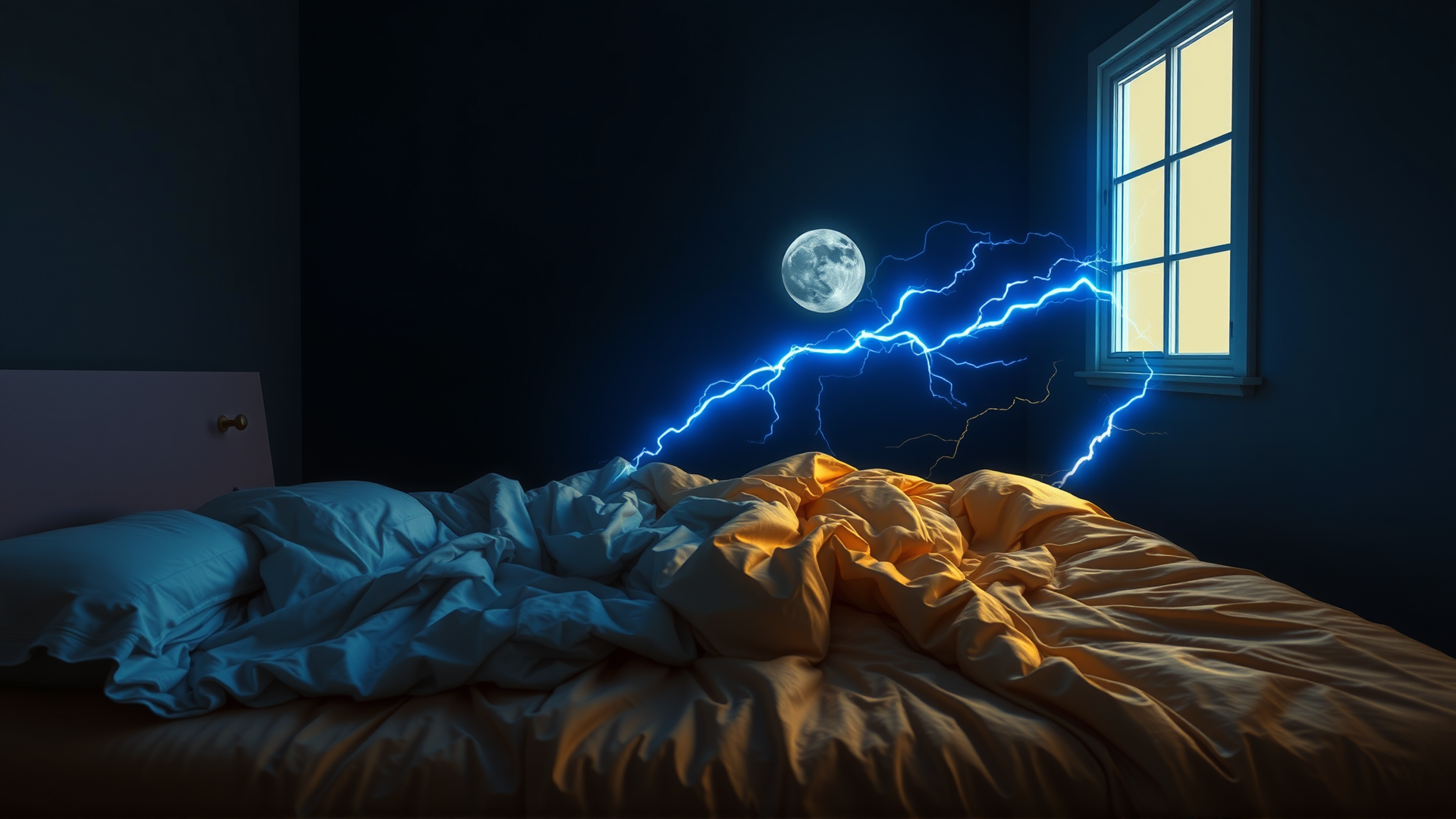
“The machine doesn’t have the drivers loaded. Any inputs made during this time will either result in an error message or corrupt the hard drive.”
Some relational conflicts aren’t really about the content of the argument. They’re about the timing — when emotionally charged conversations are initiated when one partner is cognitively offline, waking up, or falling asleep.
This dynamic has a name: the Sleep Trap. Rather than viewing these interactions as standard conflicts, this framework catalogs them as system failures caused by the collision of incompatible biological rhythms and trauma responses.
Evidence boundary: “Sleep Trap” is NST original language, not a sleep disorder or validated couple assessment. Circadian and sleep-deprivation research supports broad effects on attention, mood, and regulation, but this chapter cannot infer a person’s cortisol curve, sleep stage, trauma history, or intent from a late-night conflict. Persistent insomnia, breathing problems, unusual sleepiness, or major rhythm disruption warrants qualified medical evaluation.
1. Core Definition
NST original: This framework is Normal Like Peter’s own synthesis — built from lived experience and the research cited in this chapter, but the structure and naming are ours, not established clinical taxonomy. It builds on established circadian science and Pete Walker’s CPTSD framework, but identifying and naming this specific pattern is ours.
“Initiating emotionally charged conversations when one partner is cognitively offline or half-asleep.”
This dynamic is flagged as a critical vulnerability because the “sleeping” partner lacks the cognitive capacity to regulate emotions, track logic, or maintain boundaries. The result is often rapid escalation or submission just to end the interaction — not because the issue is resolved, but because the sleeping brain will do almost anything to return to rest.
2. The Circadian System: What’s Actually Happening
Your body runs on a circadian clock — a roughly 24-hour cycle managed by a tiny cluster of neurons in the hypothalamus called the suprachiasmatic nucleus (SCN). This is not a preference or a personality trait. It is the master timekeeper for virtually every biological process in your body: hormone release, body temperature, digestion, immune function, cognitive performance, and emotional regulation.
The SCN takes its primary cue from light exposure through the retina. When light decreases, the pineal gland releases melatonin — the hormone that signals the body to prepare for sleep. When light increases, melatonin production stops and cortisol begins its morning rise.
Sleep Architecture
Sleep is not a single state. It cycles through distinct stages approximately every 90 minutes:
| Stage | What It Does | Duration |
|---|---|---|
| N1 (Light sleep) | Transition — muscle tone decreasing, easily woken | 5-10 min |
| N2 (True sleep) | Memory consolidation begins, heart rate drops | 20-30 min |
| N3 (Deep/slow-wave) | Physical restoration, growth hormone release, immune repair | 20-40 min |
| REM | Emotional processing, dream state, memory integration | 10-60 min |
The critical detail: deep sleep (N3) dominates the first half of the night, while REM dominates the second half. This means the first 3-4 hours of sleep are when the body does its most critical physical repair work. Interrupting this window doesn’t just make someone groggy — it disrupts the biological maintenance cycle that keeps the nervous system functional.
The Prefrontal Cortex Goes Offline First
When a person enters sleep, the prefrontal cortex — the brain region responsible for impulse control, emotional regulation, logical reasoning, and decision-making — is the first area to go offline. It is also the last to come fully back online upon waking.
This is the well-documented phenomenon of sleep inertia: for a stretch after abrupt waking — often lasting many minutes — most people struggle to: - Track a complex argument - Regulate their emotional response - Make commitments they’ll remember accurately - Distinguish between a real emergency and an emotional one - Maintain boundaries they would normally hold during the day
They are not choosing to be unavailable. Their hardware is in maintenance mode. The executive function software is not loaded.
3. Cortisol and the Stress Clock
Cortisol — the primary stress hormone — follows its own circadian rhythm that interacts directly with the Sleep Trap dynamic.
The Normal Cortisol Curve
In a typical day-active sleeper, cortisol tends to follow a recognizable pattern (its exact timing is anchored to a person’s own sleep-wake schedule, so it shifts for shift workers and strong night owls): - Lowest point: Usually around the middle of the night, in the first hours of sleep - Cortisol Awakening Response (CAR): A pronounced rise in the first 30-45 minutes after waking — the body’s biological “boot sequence” - Gradual decline: Through the afternoon and evening, cortisol tapers toward its nighttime low
What Chronic Stress Does
Under chronic stress — CPTSD, ongoing relational conflict, persistent anxiety — research links the day-long cortisol rhythm to a flatter slope at the group level: the nighttime low tends to sit higher and the morning rise tends to be less sharp, so the system runs closer to a steady low-grade output than a clean rise-and-fall cycle. This is a population tendency drawn from averaged data, not a reading anyone can take from a single night or a single argument — the boundary above still holds.
As a teaching lens, that flattening tracks with a familiar experience: lighter, more easily broken sleep and less of the deep recovery the body is reaching for. Emotional processing leans heavily on REM, and fragmented sleep tends to cut it short.
Now add a Sleep Trap to an already taxed system. Waking into a charged conversation during the body’s lowest-capacity window tends to pull the nervous system toward a stress response — sympathetic arousal, the surge of alertness that makes dropping back to sleep hard. Even after the conversation ends, that arousal can take a while to settle, so the sleep window isn’t just interrupted; it becomes harder to re-enter. None of this is a scan of any one person’s hormones on any one night — it’s the general shape stress physiology takes, offered as a lens.
This isn’t only drama — it’s the body’s stress physiology doing what stress physiology does.
4. The Underlying Mechanism: Sleep-Cycle Mismatch
The Sleep Trap thrives on a structural constraint called Sleep-Cycle Mismatch. This is not treated as a preference or personal failing — it’s a fixed biological reality.
A common pattern is the collision between:
- A crash sleep rhythm — an early-evening drop into a 4-hour block of deep sleep, followed by later wakefulness or early morning alertness
- A late-night ramp-up rhythm — energy and emotional processing that peaks after midnight
The Trap occurs when one partner’s peak processing time (late night) collides with the other’s lowest capacity time (deep sleep/crash). The result is documented again and again: one person asleep → emotional request → apology loop. The sleeping partner is woken up to process complex relationship material while physically unable to do so.
Chronotype Is Not a Character Flaw
Research on chronotypes (morning larks vs. night owls) shows that circadian preference is approximately 50% genetic. The late-night partner is not being inconsiderate by being alert at midnight any more than the early-crash partner is being lazy by falling asleep at 9 PM. These are biological rhythms, not moral choices.
The problem is not that the rhythms differ. The problem is that emotional urgency does not respect biology. The anxious partner’s need for reassurance peaks precisely when their threat-detection system is most active — often at night, when the world is quiet and the mind has nothing to do but spiral. The crash-sleep partner’s availability hits zero at exactly that moment.
5. The Consequences: Out of Sync Reality
Sleep Traps destroy shared reality. Because one partner is cognitively compromised, the dynamic creates:
Memory Discrepancies: Conversations held while half-asleep lead to disagreements about what was said, promised, or admitted. Both partners experienced the conversation — but with very different levels of processing capacity. The memories will not match. This is not gaslighting. It is neurological asymmetry treated as shared experience.
Apology Loops: The exhausted partner often defaults to apologizing simply to return to sleep. This creates “repeated expressions of regret that lack behavioral follow-through” — the classic apology loop — not because the person doesn’t mean it, but because their brain is not online. The apology was generated by a system in survival mode, not executive function. It has no follow-through because there was no executive processing behind it.
Touch Ambiguity: Interactions during these windows often blur the lines between comfort-seeking and sexual initiation, causing the nervous system to remain alert rather than regulated even during rest. The body can’t tell if it’s being offered safety or being asked to perform.
Erosion of the Sleep Space: Over time, the bed itself becomes a cue for conflict rather than rest. The nervous system begins to associate the sleep environment with emotional threat. This is classical conditioning — Pavlov’s bell, but the bell is the mattress and the response is hypervigilance. Insomnia in one or both partners is often a downstream effect of chronic Sleep Traps.
6. The Cumulative Effect
When Sleep Traps become a chronic pattern, their cumulative effect is severe. The combination of Sleep Traps, other dysregulators, and circadian misalignment can result in a prolonged state of emotional starvation and sleep misalignment that effectively locks both partners out of any authentic connection.
Each partner is technically there. Neither partner is actually present. The machine (the sleeping partner) doesn’t have the drivers loaded to process the data (the emotional conversation). Any inputs made during this time will either result in an error message (conflict) or corrupt the hard drive (memory discrepancies) — yet the requesting partner keeps typing furiously, wondering why the screen is glitching.
The Sleep Debt Spiral
Sleep debt is cumulative and non-negotiable. The brain does not forgive missed deep sleep. Each interrupted night compounds: - Emotional reactivity increases (the amygdala becomes hyperactive with sleep loss) - Impulse control decreases (prefrontal cortex function degrades) - Pain sensitivity increases (the body becomes more reactive to stimuli) - Immune function drops (increasing susceptibility to illness)
After chronic Sleep Traps, both partners are operating on degraded hardware. Their capacity for the repair conversations they actually need is diminished by the very pattern that’s creating the need for repair. The system eats itself.
7. Why This Happens (And Isn’t Just Selfishness)
The partner initiating during these windows is often not acting from malice. They’re acting from:
- Hypervigilant Sleep Mode — their own threat-detection system is activated, and they need reassurance before they can rest
- An anxious attachment loop — the partner’s presence and availability is required for the nervous system to down-regulate
- A circadian pattern where their emotional peak genuinely falls during the other partner’s lowest point
- Nighttime amplification — anxiety disorders and CPTSD both feature a well-documented pattern of symptom intensification at night, when distractions fall away and the mind turns inward
Understanding the mechanism doesn’t excuse the behavior. But it makes intervention possible. “Don’t wake me up for emotional processing” is a boundary that can be set, honored, and protected — once both partners understand what the Sleep Trap actually is.
8. The Nervous-System Solution
Sleep Traps cannot be resolved through willpower or the logic of “just don’t do it.” The underlying drive is nervous-system based. The solutions are therefore nervous-system based:
Structural Interventions
- Establish a clear window for emotional conversation — agreed upon when both partners are actually online. Not “we’ll talk later” (which the anxious partner reads as avoidance), but “We talk about hard things at 7 PM on the couch, when we’re both awake.” Specificity creates safety.
- Name the Trap in real time, without escalation — “This is a Sleep Trap. I love you. We’ll talk tomorrow.” This is not dismissal. It is a boundary that honors both partners’ nervous systems.
- Separate sleep spaces if needed — This is not a failure of intimacy. It is a recognition that two dysregulated nervous systems in one bed can make sleep impossible for both. Many couples who sleep separately report improved intimacy because both partners are actually rested enough to connect during waking hours.
Addressing the Underlying Anxiety
The late-night initiation is usually about connection, reassurance, or fear of abandonment, not the stated content of the argument. Address the root:
- Co-regulation before the sleep window — Brief, genuine connection before both partners sleep. Not a check-in. Not a processing session. Physical proximity, a shared routine, a moment of being seen. This can reduce the anxious partner’s need to process in the middle of the night because the attachment system got its signal: you’re still here.
- A transition ritual — The 20 minutes before sleep should be low-stimulation. No screens (blue light suppresses melatonin). No logistics. No conflict. This is the circadian equivalent of a cool-down after exercise. The nervous system needs a ramp-down period.
Sleep Hygiene as Practice
| Practice | Why It Matters |
|---|---|
| Consistent sleep/wake times | Stabilizes the circadian clock — even on weekends |
| Cool, dark room (65-68°F) | Core body temperature drop is a sleep trigger |
| No screens 30+ min before bed | Blue light suppresses melatonin production |
| No caffeine after 2 PM | Caffeine half-life is 5-6 hours; it’s still in your system |
| Morning sunlight exposure | Resets the SCN, anchors the circadian rhythm |
| Physical activity (not before bed) | Reduces cortisol, increases sleep pressure |
| Journaling before bed | Externalizes the anxious thoughts so the mind can release them |
These are not luxury self-care suggestions. They are the maintenance protocol for the hardware that runs everything else. You cannot heal a relationship on 4 hours of fragmented sleep. The nervous system won’t let you.
References & Further Reading
Primary sources
- Ivan Pavlov — Conditioned Reflexes (1927). The classical conditioning mechanism behind the eroded sleep space — the bell is the mattress, the response is hypervigilance (Section 5).
- Pete Walker — Complex PTSD: From Surviving to Thriving (2013). The CPTSD framework behind the flattened cortisol curve and nighttime symptom amplification (Sections 3 and 7).
- Fries, E., Dettenborn, L., & Kirschbaum, C. (2009). The cortisol awakening response (CAR): facts and future directions. International Journal of Psychophysiology, 72(1), 67-73. Basis for the CAR timing described in Section 3.
- Adam, E. K., Quinn, M. E., Tavernier, R., McQuillan, M. T., Dahlke, K. A., & Gilbert, K. E. (2017). Diurnal cortisol slopes and mental and physical health outcomes: A systematic review and meta-analysis. Psychoneuroendocrinology, 83, 25-41. The group-level flatter-slope finding under chronic stress that Section 3 now cites as a population tendency, not an individual reading.
- Yoo, S. S., Gujar, N., Hu, P., Jolesz, F. A., & Walker, M. P. (2007). The human emotional brain without sleep — a prefrontal amygdala disconnect. Current Biology, 17(20), R877-R878. Support for the sleep-loss effects on amygdala reactivity and prefrontal regulation (Sections 2 and 6).
Clinical educators
No public-facing clinical educators are directly cited in this chapter.
Related primers
- F3 Attachment Theory — the anxious attachment loop that drives late-night reassurance seeking (Section 7).
- F9 CPTSD 101 — the dysregulated baseline that flattens the cortisol curve and fragments sleep.
- S2 The Anxious-Avoidant Loop — the wider pursuit-withdrawal cycle the Sleep Trap often runs inside.
9. Reflection Prompts
- Have I ever tried to resolve something important when one of us wasn’t fully awake?
- What is the emotion I’m actually trying to address when I initiate late-night conversations?
- What would I need to feel safe enough to wait until morning?
- How do our sleep rhythms interact with our conflict patterns?
- What does my body do when it’s woken during deep sleep — and is that a state in which I should be making decisions?
10. Integration Checklist
- [ ] I understand the Sleep Trap as a nervous system vulnerability, not just bad timing
- [ ] I can describe how the circadian system and cortisol curve affect cognitive capacity
- [ ] I know which partner’s peak processing time collides with the other’s lowest capacity
- [ ] I have identified at least one structural intervention to protect sleep
- [ ] I understand why the initiating partner does it (anxiety, not malice) without excusing the impact
- [ ] I have or am working toward a co-regulation ritual before the sleep window
Gentle disclaimer: Normal Like Peter and Church of NORMAL publish trauma-informed educational and creative content. Nothing on this site is medical, mental-health, legal, or crisis advice. If you are in immediate danger or emotional crisis, seek local emergency services. In the U.S., you can call or text 988.
Church of NORMAL — Nervous System Theology “Nothing is lost. Only recompiled.”