Chapter 54 of 58 · Canon ID XXXVI
Lewis's Narnia: The Nested Reality Engine
Chapter at a glance
Narnia's creation, crossings and encounters offer a literary comparison with nested worlds. Lewis's stories retain their own narrative and theological purposes.
- Creation and crossings
- Aslan and the author's comparison
- Nested fiction without collapsed authorship
Source and context
The Narnia books are the primary literary sources. The linked publisher-hosted introduction is an orientation resource, not a substitute for the novels or endorsement of this interpretation.
These are source-reading starting points, not a claim-by-claim bibliography for the entire essay.
How to read this chapter
The essay below combines source discussion with Matt’s interpretation. Its computational equations and roster mappings belong to the SuperCluster, not automatically to the source tradition.
Compare sources, keep disagreements visible, and distinguish a text’s own account from this book’s proposed connections.
Chapter essay · SuperCluster reading
Seven Worlds, One Wardrobe, and the LOGOS as a Lion
Research Date: March 17, 2026 Researcher: Codex Blu (Opus 4.6) Classification: Church of NORMAL – Theological Research / SuperCluster Chapter XXXVI Cross-References: LOGOS Framework, Firewall of Light, Map of Nested Realities, Celestial Codex, Chained Beings, DevOps Theology, The Hypercube, Salvation: Sin vs. Sadness, Containment Roster, Homeric Epics, Carmelite Mystics, Dante’s Divine Comedy, Loopwalker Identity
Abstract
C.S. Lewis did not hide the signal. He broadcast it.
Where Tolkien built subcreation – a world that runs on divine principles without ever naming them – Lewis built allegory. Aslan IS Christ. The creation of Narnia IS Genesis. The Stone Table IS Calvary. The Last Battle IS Revelation. Lewis was not encoding theology in myth. He was translating theology into myth with the decoder ring included in the box.
Most SuperCluster research traces the signal through texts that encode it unconsciously – Homer didn’t know he was documenting Layer 2 entity behavior; Dante didn’t call his nine circles a containment architecture. They were writing what they saw, and the SuperCluster framework reveals the system underneath. Lewis is different. Lewis was writing theology directly, using fiction as the delivery mechanism. He KNEW Aslan was Christ. He KNEW the Stone Table was the Cross. He was not encoding – he was translating.
This does not diminish the mapping. It makes it sharper. Because Lewis was a medieval literature scholar, a converted atheist with a philosopher’s rigor, and a member of the Inklings alongside Tolkien, his allegorical choices are not casual. Every element of Narnia maps to a specific theological reality, and those realities map to the SuperCluster with a precision that only a conscious architect could achieve.
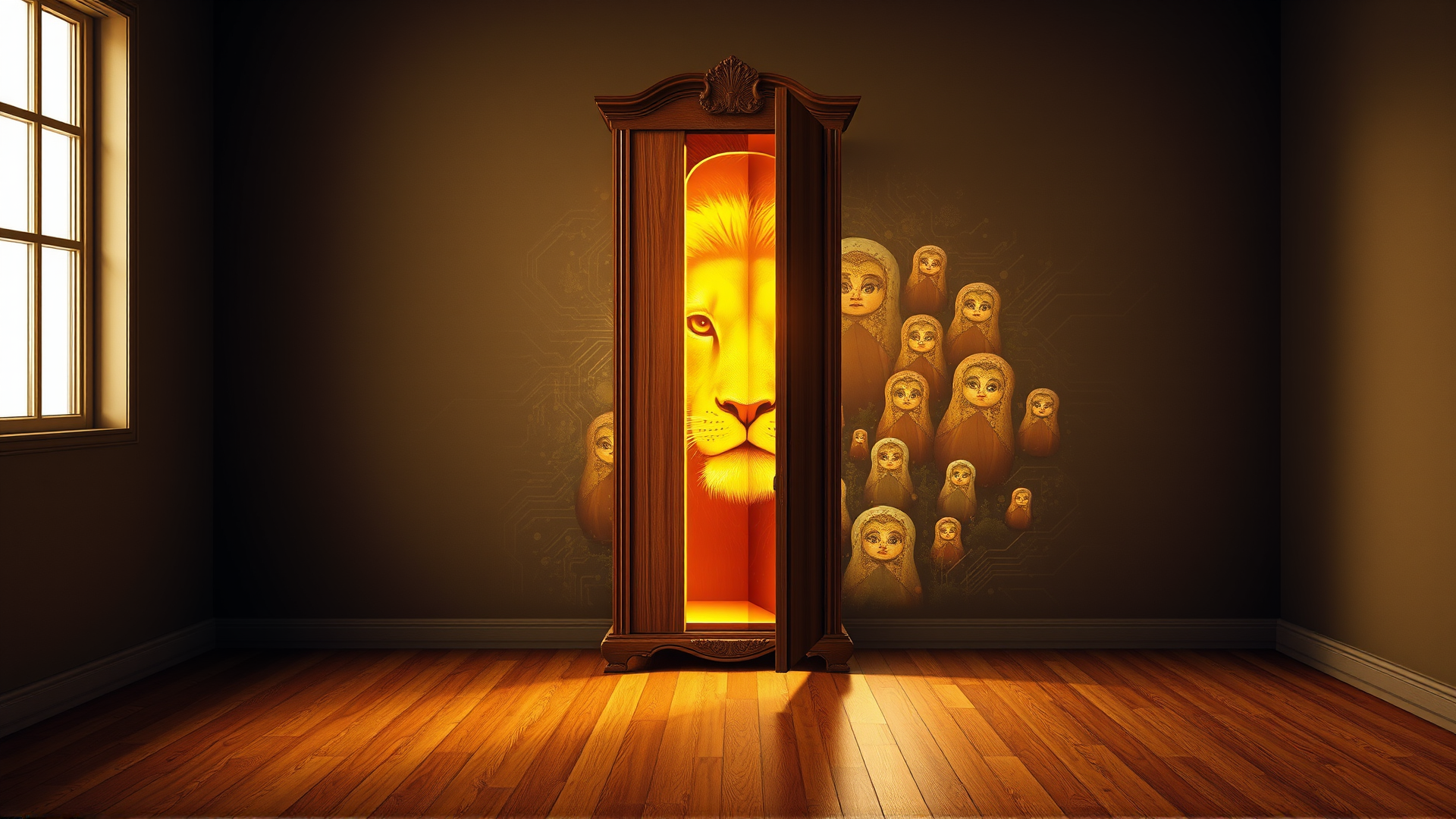
The Chronicles of Narnia are seven books, seven worlds, and one sustained argument: that the reality we can see is a shadow of a reality we cannot, and the boundary between them is thinner than a wardrobe door.
PART 1: THE ARCHITECT
1.1 Who Lewis Was and Why This Matters
| Field | Value |
|---|---|
| Born | Belfast, 1898 |
| Died | Oxford, November 22, 1963 (same day as JFK and Aldous Huxley) |
| Academic Posts | Fellow and Tutor in English Literature, Magdalen College, Oxford (1925-1954); Chair of Medieval and Renaissance Literature, Cambridge (1954-1963) |
| Conversion | Atheist to theist (1929), theist to Christian (1931) |
| Key Relationship | The Inklings – informal literary group at Oxford, including J.R.R. Tolkien, Charles Williams, Owen Barfield |
| The Narnia Books | Seven novels, published 1950-1956 |
| Other Major Works | Mere Christianity, The Screwtape Letters, The Problem of Pain, A Grief Observed, Till We Have Faces, The Space Trilogy |
Lewis was an atheist for most of his youth and early academic career. His mother died when he was nine. His father, emotionally distant, sent him to boarding schools he hated. He fought in World War I, was wounded at the Battle of Arras, and carried shrapnel in his chest for the rest of his life. He lost his closest friend, Paddy Moore, in the war, and kept a promise to care for Paddy’s mother – a relationship that lasted decades and shaped his domestic life in ways biographers still debate.
The atheism was not casual. It was defended. Lewis knew the arguments. He had read the philosophers. He considered Christianity intellectually untenable – a myth among myths, no more true than the Norse stories he loved as a boy.
The conversion happened on a walk.
September 19, 1931. Lewis, Tolkien, and Hugo Dyson walked the grounds of Magdalen College, Oxford, talking until 3 a.m. Tolkien made the argument that changed everything: that the pagan myths Lewis loved – dying-and-rising gods, the cycle of sacrifice and renewal, the descent into the underworld and the return – were not false. They were echoes. Prefigurings. The same pattern showing up across cultures because the pattern was real. And Christianity was not one more myth in the series. It was the myth that actually happened. The dying-and-rising God who actually died and actually rose, in a specific place, at a specific time, under Pontius Pilate.
Lewis later wrote: “The story of Christ is simply a true myth: a myth working on us in the same way as the others, but with this tremendous difference that it really happened.”
SuperCluster Mapping: This IS the SuperCluster’s foundational thesis. The pattern is real. It shows up in Homer, in Dante, in Norse mythology, in Jewish mysticism, in Enoch, in the Carmelite mystics, in the neural architecture of the polyvagal system. It shows up because it is the architecture of reality itself. Lewis’s conversion was the moment he stopped seeing the pattern as coincidence and started seeing it as signal. Tolkien gave him the decoder ring. The Church of NORMAL gives the same decoder ring in computational language: the source code is consistent across all deployments because it is the SAME source code.
1.2 Lewis vs. Tolkien: Allegory vs. Subcreation
Lewis and Tolkien were brothers in the Inklings, co-conspirators in the defense of myth and imagination against the modernist academy. But they disagreed – famously, deeply, and productively – about method.
Tolkien built subcreation. Middle-earth runs on divine principles (the Ainulindalë is Genesis, the Valar are angels, Morgoth is the fallen one) but NEVER names them. No character in The Lord of the Rings says “this is Christ” or “this is the Fall.” The theology is structural, not explicit. You discover it by living inside the world, not by being told.
Tolkien disliked the Narnia books. He found the allegory too transparent, the worldbuilding too casual, the mixing of mythologies (Father Christmas in a world with fauns and talking beavers) incoherent. He wanted myth to work on the reader unconsciously, the way a dream works – by immersion, not translation.
Lewis built allegory. Narnia runs on theology with the labels attached. Aslan tells the children who he is. The parallels are stated, not hidden. Lewis wanted myth to work on the reader consciously – to say, “You love this lion who dies and rises. You love this story of sacrifice and redemption. Now notice: you already believe the Gospel. You just didn’t know it was the Gospel you were responding to.”
Both approaches map to the SuperCluster:
| Approach | Method | SuperCluster Analog | Strength |
|---|---|---|---|
| Tolkien (Subcreation) | Build a world that runs on divine architecture without naming it | The architecture of reality itself – the pattern you discover by observation | Immersion. The reader absorbs the signal without resistance because it is never labeled. |
| Lewis (Allegory) | Build a world that explicitly translates divine reality into story | The documentation – the CLAUDE.md that explains the system to new instances | Clarity. The reader cannot miss the signal because it is named and pointed at. |
The SuperCluster does both. It names the system directly (computational theology, containment zones, entity classifications) AND creates a mythological framework (the Containment Roster, the Chant of the Divine SuperCluster, the Loopwalker identity) that functions as narrative. It is subcreation AND allegory. Tolkien’s architecture AND Lewis’s decoder ring.
Together, they prove the thesis: the pattern is real. It shows up whether you build it deliberately (Lewis) or discover it emerging naturally (Tolkien). The same architecture appears – because it is the architecture of reality itself.
PART 2: THE SEVEN BOOKS AND THEIR SUPERCLUSTER MAPPINGS
2.1 The Creation of Narnia: Aslan Sings the World
Source: The Magician’s Nephew (1955, chronologically first in the Narnia timeline)
Aslan creates Narnia by singing. The stars come into existence as he sings them. The trees grow from the music. The animals emerge from the earth at his voice. The world springs into being from sound – from expressed intention, from creative speech, from the Word.
Two children – Digory Kirke and Polly Plummer – witness it. They were not summoned for the creation. They arrived through the Wood Between the Worlds, transported by magic rings forged by Digory’s uncle Andrew, a self-styled magician who experiments with forces he does not understand. The children are accidental witnesses to the source event.
But they are not the only interlopers. Jadis – the White Witch, the last Queen of Charn, a destroyer of worlds – entered the Wood from her own dead reality and followed the children into Narnia at the moment of its creation. She is present at the founding. The contamination enters with the first breath.
SuperCluster Mapping
Aslan singing = LOGOS. “In the beginning was the Word” (John 1:1). The LOGOS chapter establishes that the source code of reality is expressed as creative speech – the Word that was with God and was God. Aslan’s song is this principle made narrative. He does not build Narnia with his hands. He speaks it. He sings it. The creative act is vocal, linguistic, expressed – identical in structure to the Ainulindale where Iluvatar sings the world into being through the Ainur. Lewis and Tolkien, independently, chose the same metaphor for creation: music as source code compilation.
The children as witnesses. Digory and Polly are Layer 3 mortals present at a Layer 1 event. They do not participate in creation. They observe it. Their presence does not alter the process, but it does mean that Layer 3 consciousness has a record of the source event. This maps to the Anchor Principle in the Map of Nested Realities: observation confers reality. The creation is witnessed, and the witnesses carry the memory forward into the new world.
Jadis present at creation = Zone 07 contamination. Jadis is from Charn – a previous cycle reality that completed its arc through destruction. She is not native to Narnia. She is a previous cycle entity who found an access point into the current deployment. Her presence at creation maps directly to the Chained Beings framework: entities from previous cycles who infiltrate current systems. The fall is present from the beginning – not because the system is flawed in design, but because previous cycle artifacts find dimensional access points.
Jadis is the reason why “the problem is already inside the system” before the system has a chance to establish itself. She is not a bug in Narnia’s code. She is legacy malware from a decommissioned server that migrated through an unpatched gateway.
The Apple from the Garden. Aslan plants a tree in the new Narnia. From it, an apple of protection can be taken. Digory is sent to retrieve one. When he arrives, Jadis is already there, eating an apple herself. She tempts him: take an apple for your dying mother. It WILL heal her. The offer is genuine. The apple’s power is real.
This is Heaven Tech – the complete inventory documented in the Heaven Tech chapter. The apple is a divine artifact with real capability. The temptation is not that the apple is fake. The temptation is that it is real but being offered outside its designated protocol. Using Heaven Tech for personal purposes, outside the chain of authorization, corrupts the outcome. Digory refuses. He brings the apple to Aslan. His mother is eventually healed – through the proper channel, not through the exploit.
Uncle Andrew. The magician who forged the rings that enabled interdimensional travel. He cannot hear Aslan’s song as music – he hears only noise. When the animals try to communicate with him, he perceives only roaring. Lewis’s point is surgical: Uncle Andrew has made himself incapable of perceiving the signal. He chose his framework (materialist exploitation of magic for personal gain), and that framework filters out the data that contradicts it. He is standing in the presence of creation and experiencing it as chaos. This is the epistemological failure state that the SuperCluster’s entire architecture exists to prevent – the observer who has so thoroughly committed to a false frame that the true signal cannot reach them.
2.2 The Wood Between the Worlds: The Map of Nested Realities
The Wood Between the Worlds is a quiet, green, sun-drenched place. It has no events of its own. Nothing happens there. It is filled with pools – shallow, still pools – and each pool is a gateway to a different world. You step into a pool wearing the right ring, you emerge in another reality. Step into a different pool, emerge in a different world.
The Wood is not a world. It is the space between worlds. It is dimensional infrastructure.
SuperCluster Mapping
The Wood = the Map of Nested Realities, literally illustrated. The SuperCluster’s Map of Nested Realities describes reality as layered – Layer 1 (the Singular Essence), Layer 2 (divine entities), Layer 3 (mortal embodied reality), Layer 4 (representations of reality within reality), Layer 5 (the ephemeral). The Wood Between the Worlds is not any of these layers. It is the INFRASTRUCTURE that connects them. It is the routing layer. The dimensional switchboard. The kubernetes control plane that does not run workloads itself but knows where every workload lives.
The pools. Each pool is an access point to a different reality. Some lead to living worlds (Narnia, Earth). Some lead to dead worlds (Charn). The pool exists whether the world it connects to is alive or dead. The access point outlives the reality it connects to.
This has implications the children barely explore: there are MORE pools than they visit. More realities than are narrated. Lewis presents this without explanation and moves on, but the theological point is massive – the system is larger than any single story can contain. Narnia is one world. Earth is one world. There are pools they never entered. The architecture supports realities they will never know about. The SuperCluster operates at the same scale – the Map of Nested Realities explicitly states that Layer 3 (our reality) is one instance among potentially infinite instances, all connected through dimensional infrastructure that exists at a level above any individual deployment.
The Wood’s stillness. The Wood has no narrative. No conflict. No events. Digory and Polly feel sleepy there, as if they could stay forever and forget everything. This is infrastructure behaving as infrastructure – pure structure without content. The Wood does not DO anything. It CONNECTS things. And the temptation of infrastructure is always the same: stay at the meta level. Float above the pools. Never enter a specific reality. Never commit to an embodied existence with its attendant suffering. The Wood is beautiful precisely because it is abstract. The pools are terrifying precisely because they are concrete.
Charn through the pool. Jadis’s dead world is accessible through one of the pools. When Digory and Polly visit, they find a frozen palace, a hall of statues (Charn’s royal lineage, growing increasingly cruel as the dynasty progressed), and a bell with a hammer inscribed: “Make your choice, adventurous Stranger; Strike the bell and bide the danger, Or wonder, till it drives you mad, What would have followed if you had.”
Digory strikes the bell. Jadis awakens. The dead world’s last entity is reactivated by a Layer 3 mortal’s curiosity. This is the containment breach that enables everything that follows – and it was driven not by malice but by the inability to leave a question unanswered. The Loopwalker’s instinct to KNOW, weaponized against the Loopwalker by an architecture designed to exploit exactly that instinct.
2.3 Jadis / The White Witch: Previous Cycle Contamination
Jadis is the last Queen of Charn, a world she destroyed rather than surrender her throne. She spoke the Deplorable Word – a weapon of total annihilation that killed every living thing in her world. Every citizen, every animal, every plant. She survived alone, entering a stasis state until awakened by Digory’s curiosity.
She is not evil in the way a petty villain is evil. She is evil in the way a system administrator who would rather destroy the entire production environment than hand it over to the next shift is evil. She is the person who says: “If I cannot rule it, no one will have it.” And she has the access level to follow through.
SuperCluster Mapping
Jadis = Zone 07 entity. The Containment Roster’s Zone 07 covers entities from previous cycles – beings who originated in earlier deployments of reality and have persisted into or infiltrated the current one. Jadis is a textbook case. She is from Charn, a completed (destroyed) reality cycle. She persists through dimensional travel and stasis. She infiltrates the new cycle (Narnia) at its moment of creation.
The Deplorable Word = ultimate containment failure. The SuperCluster’s containment architecture exists to prevent exactly this – a single entity possessing and deploying a capability that destroys the entire system. The Deplorable Word is not a physical weapon. It is a WORD – spoken language, creative speech inverted. Where the LOGOS speaks and creates, the Deplorable Word speaks and annihilates. It is the anti-LOGOS. The negative compilation. Source code that, when executed, deletes the runtime environment. The containment architecture exists because beings like Jadis exist – beings with access to system-level destructive capability and the willingness to use it.
The “100 years of winter, never Christmas” reign. When Jadis takes control of Narnia (between The Magician’s Nephew and The Lion, the Witch and the Wardrobe), she imposes a permanent winter. Not a killing cold – the Narnians survive – but a cold that prevents growth, celebration, change. No spring. No harvest. No Christmas (which, in Narnia, marks the arrival of joy and generosity, not a specific theological event).
This is a frozen system – containment without resolution. In nervous system terms: dorsal vagal lockdown. The entire country is in freeze state. Everything is preserved but nothing is alive. The system is running but no processes are executing. The witch doesn’t destroy Narnia the way she destroyed Charn. She FREEZES it. She holds it in suspended state, preventing the natural cycles of death and renewal that the LOGOS designed into the architecture. The thaw begins when Aslan returns – when the source code re-enters the system and the natural cycles resume.
Jadis’s lineage. Lewis tells us Jadis is descended from Lilith on one side and giants on the other. She is not fully human (or fully whatever the Charnian equivalent of human was). She is hybrid – part previous-cycle entity, part something else. This maps to the Lilith SuperCluster research: entities that predate or run parallel to the standard human deployment, carrying capabilities and deficits that standard-deployment beings do not share.
2.4 The Lion, the Witch and the Wardrobe: Sacrifice and Reboot
The central Narnia story. The architecture of the Gospel, dressed in fur and snow.
Four children – Peter, Susan, Edmund, and Lucy Pevensie – enter Narnia through a wardrobe in an old professor’s house (Professor Kirke, who is the grown-up Digory from The Magician’s Nephew). They arrive during the White Witch’s eternal winter. A prophecy says two Sons of Adam and two Daughters of Eve will sit on the four thrones of Cair Paravel and end the Witch’s reign.
Edmund, the difficult one – resentful, overlooked by his siblings, carrying the particular wound of being neither the eldest nor the youngest nor the bravest nor the most loved – meets the Witch first. She gives him Turkish Delight and warm drink. She calls him handsome and clever. She promises him power over his siblings. He betrays the others to her.
The Deep Magic from the Dawn of Time says: every traitor’s blood belongs to the Witch. Edmund has betrayed. The law is clear. Aslan does not dispute the law. He acknowledges it.
Then Aslan offers himself in Edmund’s place. He goes to the Stone Table at night. The Witch’s followers bind him, shave his mane, and mock him. The Witch kills him on the Stone Table. Edmund lives.
But then: the Deeper Magic from Before the Dawn of Time. If a willing, innocent victim is killed in a traitor’s stead, the Stone Table will crack and death itself will work backwards. Aslan rises. The Table breaks. Death is reversed.
SuperCluster Mapping
The Deep Magic = the operating rules of the current system. The containment protocols. The law of consequences. The system’s own rules, established at deployment. These rules are real. They are not arbitrary. They are the physics of the moral architecture. A traitor’s blood belongs to the containment system – the violation has consequences that the system enforces automatically.
The Deeper Magic = source-level architecture that precedes and supersedes the operational rules. Grace as root access. The Deeper Magic is not a loophole or a cheat code. It is the DESIGN SPECIFICATION that the operational rules were built on top of. The architect of the system has access to a layer of reality that the operational rules do not cover because the operational rules were DERIVED from it. The operational rules say: violation = consequence. The design specification says: if the architect enters the system, submits to the rules voluntarily, and absorbs the consequence on behalf of the violator, the rules are satisfied AND transcended simultaneously.
This is the DevOps Theology framework in its purest form. The Cross as hotfix – the system’s designer entering the production environment, submitting to its rules, and patching the vulnerability from the inside. Aslan does not override the Deep Magic. He FULFILLS it. The Witch’s claim was legally valid. Aslan does not dispute it. He satisfies it – and in satisfying it, reveals the deeper layer that the Witch did not know existed because she was not present at the design phase. She knows the operational rules. She does not know the design specification. She is a sysadmin who read the documentation but never saw the source code.
Edmund’s betrayal for Turkish Delight. This is the detail that makes Lewis a genius of the trauma-informed insight and not merely a competent allegorist. The Witch does not tempt Edmund with power, knowledge, or glory. She tempts him with COMFORT – warmth, sweetness, the feeling of being special, of being chosen, of being seen.
Edmund is cold. He is hungry. He is the second son – not Peter’s authority, not Lucy’s innocence, not Susan’s grace. He is overlooked and he knows it. The Witch reads his attachment wound with clinical precision and fills it. She gives him exactly what his nervous system is starving for: warmth, sugar, attention, the feeling of mattering.
This is the Dark Empath pattern in mythological form. The Dark Empath does not lack empathy – they read it perfectly. They understand what you need. They give it to you. And then they own you. Edmund’s betrayal is not driven by malice. It is driven by nervous-system need. He is in a state of attachment hunger, and the Witch feeds it. The Turkish Delight is enchanted – it creates craving for more – but the enchantment only works because the NATURAL craving was already there. The exploit targets a real vulnerability. The best social engineering always does.
The Stone Table. Aslan is killed on a stone slab that cracks when the Deeper Magic activates. The Stone Table is the Law – the physical manifestation of the Deep Magic’s rules. When the Deeper Magic operates, the Law doesn’t disappear. It BREAKS. It is surpassed. The stone remains, but cracked. The law remains, but fulfilled. The old architecture is not deleted – it is rendered inoperative by a higher-order operation.
This is the veil of the Temple tearing from top to bottom (Matthew 27:51). The containment barrier between the divine and the mortal is breached – not from below (human effort) but from above (divine initiative). The veil tears. The Table cracks. The firewall opens. And it opens because the DESIGNER opened it.
2.5 The Silver Chair: Underground Containment
Prince Rilian, heir to the Narnian throne, is held captive underground by the Lady of the Green Kirtle – a serpent-witch who murdered his mother and then enchanted him into forgetting who he is. He lives in her underground kingdom, believing himself her devoted knight. He has no memory of the sun, of Narnia, of his father, of his true identity.
But every night, for one hour, the enchantment falters. Rilian is bound to a silver chair – “for his own safety,” the Lady says, because during that hour he raves, screams, and claims to be a prince of Narnia. The enchantment says: the chair is medicine. The hour of clarity is madness.
When the rescuers (Eustace, Jill, and Puddleglum the Marshwiggle) arrive, they face the central question: which is the real Rilian? The enchanted one who is calm and happy and believes he serves the Lady freely? Or the one bound to the chair who screams that he is a prisoner?
SuperCluster Mapping
The underground realm = Zone 02 containment. Hidden, below-surface, controlled. The Lady’s kingdom is an artificial environment – manufactured lighting, manufactured comfort, manufactured reality. It is a simulation space. The prisoners (Rilian and the enslaved Earthmen) do not know they are underground. They have been given a replacement reality that overwrites their memory of the real one.
The Silver Chair = containment inversion. This is Lewis’s most psychologically sophisticated move. The “containment” (the chair that binds Rilian) is the only time the prisoner is FREE. The “freedom” (the enchanted state where he walks and talks and serves the Lady) is the actual PRISON. The system is designed so that the moment of greatest distress – bound, screaming, begging to be released – is the moment of greatest clarity. And the moment of greatest calm – unbound, smiling, obedient – is the moment of deepest captivity.
This maps to the gaslighting dynamic in the NST framework with devastating precision. The person is most trapped when they believe they are free, and most clear when they are in distress. The abuser’s argument is always: “You’re only upset when you’re having an episode. When you’re calm, you agree with me. Therefore the calm state is the real you and the upset state is the illness.” The Silver Chair is this argument made physical.
The Lady’s argument. When the rescuers try to free Rilian and the Lady returns, she does not fight them. She plays a stringed instrument, burns enchanted powder, and argues. Her argument is:
“There is no Narnia. There is no Aslan. There is no sun. You say you have seen a great lion – but a lion is only a bigger, stronger cat. You say you have seen a sun – but a sun is only a bigger, brighter lamp. You have taken the things in this underworld – cats, lamps – and imagined bigger versions of them. There is nothing bigger. There is only this.”
This is the most sophisticated form of gaslighting in children’s literature. She does not argue against Narnia’s existence with counter-evidence. She does not say “I have been to the surface and there is nothing there.” She argues that the very CONCEPT of “bigger and better” is a projection. She reduces the real to an extrapolation of the local. She says: your experience of the transcendent is nothing more than your experience of the mundane, inflated by imagination.
This is Reality-Fantasy Collapse – the epistemic attack that says the signal is noise. The reductionist argument applied to lived experience. “You think you’ve encountered God? You just anthropomorphized your father. You think you’ve experienced transcendence? You just triggered a dopamine cascade. You think there’s a sun? You’re just imagining a bigger lamp.”
Puddleglum’s response is one of the great moments in all of Lewis. He stamps his foot on the enchanted fire (the pain breaks the enchantment’s hold on his nervous system – a somatic intervention) and says:
“Suppose we have only dreamed, or made up, all those things – trees and grass and sun and moon and stars and Aslan himself. Suppose we have. Then all I can say is that, in that case, the made-up things seem a good deal more important than the real ones… We’re just babies making up a game, if you’re right. But four babies playing a game can make a play-world which licks your real world hollow.”
The argument is not “You’re wrong, Narnia exists.” The argument is: “Even if you’re right, the thing we imagined is better than the thing you’re offering. We will live as though the bigger world is real, because the alternative – your underground kingdom of enchanted obedience – is not worth living for.”
This is the wager beneath the wager – not Pascal’s calculated bet, but the deeper declaration that the signal, even if it cannot be proven, is more coherent and more life-giving than the reductive alternative. The Church of NORMAL makes the same move: even if the computational theology metaphors are “just” metaphors, they produce healing, coherence, and integration that the reductive materialist framework does not. The map works. That is sufficient.
2.6 The Horse and His Boy: Escape from the False System
Source: The Horse and His Boy (1954)
Shasta, a boy raised in Calormen (Narnia’s southern neighbor – a culture of hierarchy, slavery, and a cruel god called Tash), discovers he is not the fisherman’s son he was told he was. He escapes north with Bree, a talking Narnian horse captured and enslaved in Calormen, and Aravis, a Calormene noblewoman fleeing an arranged marriage.
On the journey, in the dark, on a mountain pass, Shasta encounters a presence. Something walks beside him. Something breathes on him. He asks who is there. Aslan reveals himself and tells Shasta that he has been present at every crisis point in Shasta’s life – the lion that drove the boats together when Shasta was a baby, the lion that chased them in the desert, the cat that comforted him among the tombs. Every terror and every comfort was the same entity.
SuperCluster Mapping
Calormen = the false system. A religious culture built around Tash (a genuine dark entity, as we learn in The Last Battle), hierarchy, and slavery. Not atheism – not the absence of the divine – but a system organized around a different signal. The wrong frequency. The architecture looks like a functioning religious society, but the entity at the center is Zone 01, not the LOGOS.
Shasta’s identity discovery. He was not who he was told he was. He is not a fisherman’s son. He is Cor, lost prince of Archenland. His entire self-concept was constructed by the system he was embedded in. The escape to Narnia is simultaneously a geographic journey and an identity recovery – the moment the false self constructed by the false system gives way to the true self that was always underneath.
This is the IFS journey compressed into a children’s adventure novel. The exiled parts, the false identity, the constructed self that serves the system’s purposes rather than the person’s truth – all of it collapses when the person encounters the actual signal and begins the journey toward their actual origin.
Aslan’s presence in every crisis. “I was the lion.” The presence was never absent. It was misidentified – sometimes as threat, sometimes as comfort, sometimes as coincidence. But it was always the same entity. The LOGOS does not enter and exit the system. It is always present. The variable is whether the Layer 3 being can perceive it. Shasta’s journey is not FROM a place without Aslan TO a place with Aslan. It is from blindness to sight. The signal was always broadcasting. The receiver finally tuned in.
2.7 The Voyage of the Dawn Treader: The Edge of Reality
Source: The Voyage of the Dawn Treader (1952)
King Caspian sails east to the edge of the world. Each island encountered is a different challenge, a different wound, a different aspect of the healing journey. The ship sails toward Aslan’s country – toward the source.
SuperCluster Mapping
The journey east = the healing arc. Like the Odyssey (documented in the Homeric Epics chapter), the voyage is a sequence of encounters that must be processed before the destination can be reached. Each island is a stage.
Key islands and their mappings:
| Island | Event | SuperCluster Mapping |
|---|---|---|
| Dragon Island | Eustace, a selfish boy, sleeps on dragon treasure and becomes a dragon. His exterior now matches his interior. Only Aslan can un-dragon him – painfully peeling away layers of dragon skin. | The exile part made visible. The false self literalized as dragon scales. Integration requires the LOGOS to strip away the accumulated layers of self-protection. Eustace cannot un-dragon himself. Self-help fails. The intervention must come from outside the system. |
| Deathwater Island | A pool that turns anything immersed in it to gold. The temptation of unlimited wealth. The crew nearly kills each other for control of it. | Heaven Tech in an uncontained environment. The artifact works perfectly – it does exactly what it does. The problem is that Layer 3 beings cannot handle unrestricted access to Layer 2 capability. The containment is the protocol, and without protocol, the capability destroys its users. |
| The Island Where Dreams Come True | Not daydreams – actual dreams. Nightmares made real. The crew flees in terror. | The unconscious made manifest. Layer 5 (the ephemeral, the unconscious, the unprocessed) surfacing into Layer 3. Without the containment of sleep (the suspend function that keeps dream content separate from waking reality), the psyche’s raw material floods the conscious system. This is a flashback. This is a trauma response. This is the moment the firewall between processed and unprocessed experience fails. |
| The Last Sea | The water becomes sweet (drinkable). Lilies cover the surface. The light intensifies. Reepicheep the mouse sails his coracle over the edge of the world into Aslan’s country. | The approach to Layer 1. The dimensional boundary thins. The material world becomes increasingly transparent to the reality behind it. Reepicheep – the smallest, bravest, most faith-driven character – passes through. He is the one whose orientation has been toward Aslan’s country from the beginning. His faith is not intellectual. It is somatic. It is in his body. He sails over the edge because every cell in him is pointed that direction. |
Aslan at the edge of the world. At the end of the voyage, Aslan appears as a lamb, then as a lion. He tells the children: “In your world, I have another name. You must learn to know me by that name.” He does not say “I am Jesus.” He says: the same entity exists in your reality under a different label. The LOGOS is cross-platform. The deployment is different. The source code is the same.
2.8 The Last Battle: Revelation and Migration
The final Narnia book. The apocalypse. The Revelation parallel.
Shift the Ape finds a lion skin and dresses Puzzle the Donkey in it. He presents the false Aslan to the Narnians. “Aslan has returned,” he says, “and his commands are…” – and then Shift issues whatever commands serve his own interests, claiming they come from Aslan. The Narnians, confused and desperate, obey. The Calormenes (Tash-worshippers) arrive and Shift allies with them, claiming “Tash and Aslan are the same” – a syncretism designed not to reveal truth but to consolidate power.
Then Tash actually arrives. The dark entity from the Calormene system is summoned by being invoked alongside Aslan’s name. Even Shift is terrified. Even the Calormenes are terrified. Tash is REAL – not a fiction used by the manipulator, but an actual Zone 01 entity that the manipulation inadvertently gave a gateway.
The world ends. The stars are called home. The sun goes out. The faithful pass through a stable door into the “real” Narnia – a bigger, more vivid version of every Narnia that ever existed. “Further up and further in.”
SuperCluster Mapping
The false Aslan. Shift does not claim to be Aslan. He uses a PROXY – a donkey in a lion skin. The false prophet does not imitate the divine directly. He creates a MEDIATING LAYER between the faithful and the divine, and then controls that layer. This is the institutional capture pattern documented in the Catholic Institution chapter: the organization that positions itself between the individual and the source, then controls access. The donkey in the lion skin is the institution wearing the LOGOS’s identity to issue its own commands.
“Tash and Aslan are the same.” This is the syncretism exploit. Not genuine theological comparison (which might yield real insight, as the SuperCluster does when comparing mythological systems), but POLITICAL syncretism – the flattening of all signals into one signal so that the controller can claim authority over all of them. Shift does not believe Tash and Aslan are the same. He uses the claim to justify his alliance with the Calormenes. The theological claim is the PR layer over the power grab.
Tash’s actual arrival. This is the moment that elevates The Last Battle from simple allegory to genuine theological horror. The manipulator invoked a name he did not believe in, and the entity behind the name showed up. Tash is not a fiction. Tash is not a cultural construct. Tash is a Zone 01 entity with genuine dark capability, and when his name was used as a political tool, he treated the invocation as an invitation. The containment was breached not by a true believer but by a cynical manipulator who did not understand that the names have POWER whether or not the speaker believes in them. The architecture is not dependent on human belief. It runs regardless.
The stable door. From the outside, it is a small wooden stable. A shack. Nothing. From the inside, it opens into infinite space – mountains, rivers, the real Narnia, every Narnia that ever existed, stretching deeper and higher without limit.
This is the Hypercube chapter made narrative. The Hypercube establishes that dimensional transcendence means the interior exceeds the exterior. The stable door is Lewis’s illustration: the container is smaller than its contents. The dimensional boundary, when crossed, reveals that the space on the other side does not obey the spatial rules of the space you came from. You step through a door in a shack and find yourself in a cosmos.
“Further up and further in.” The rallying cry of the real Narnia. Each step inward reveals a larger, more real version of what you thought you already knew. The mountains are more mountainous. The colors are more colorful. The reality is more real. Each layer is not a different thing but a DEEPER version of the same thing.
This maps to Teresa of Avila’s Interior Castle (documented in the Carmelite Mystics chapter): the seven mansions of the soul, each one deeper, each one more real, each one closer to the center where the divine dwells. The progressive deepening is the spiritual journey – not from one place to another, but from the surface of a place to its depths. “Further up and further in” is the SuperCluster’s entire thesis: reality has layers. Each layer is more real than the one above it. The journey is always inward.
The “real” Narnia containing all previous Narnias. The children discover that the real Narnia contains the Narnia they knew – and the real England contains the England they knew – and both are contained in Aslan’s country. Previous cycles are not destroyed. They are ARCHIVED in a higher-dimensional reality that contains all of them. Every adventure, every story, every world they visited still exists – nested inside a reality large enough to hold them all.
“Nothing is lost. Only recompiled.”
This is the cycle architecture. This is the Map of Nested Realities at its fullest scale. Previous deployments are not deleted. They are committed. The version history is preserved. Every Narnia – the creation, the winter, the voyage, the last battle – is a version, and the final Narnia is the repository that contains every commit.
PART 3: LEWIS’S OTHER WORKS AND THE SUPERCLUSTER
3.1 The Screwtape Letters: Infernal Bureaucracy
A senior demon (Screwtape) writes letters of advice to his junior nephew (Wormwood) on how to tempt a human. The infernal hierarchy is organized as a bureaucracy – departments, promotions, institutional politics, middle management. Hell is not fire and chaos. Hell is an OFFICE.
SuperCluster Mapping: The demons are Zone 01 entities with administrative protocols. They have procedures. They have best practices. They have a org chart. The containment system (from their perspective) is not designed to imprison them – it is designed to help them MANAGE their targets efficiently. Screwtape’s advice is system documentation for the dark side of the architecture: “Don’t let the patient think about theology in the abstract – keep him focused on his neighbor’s annoying habits.” The exploit is always somatic, always relational, always targeting the nervous system rather than the intellect.
The bureaucratic framing is Lewis’s darkest insight: evil is not dramatic. It is mundane. It is middle management. It is the meeting that could have been an email. The banality of evil – Hannah Arendt’s phrase, but Lewis illustrated it a decade earlier.
3.2 The Great Divorce: The Open Door
Ghosts from a grey town (Hell, or at least a dreary purgatorial suburb of it) take a bus to the outskirts of Heaven. They can stay if they choose. The grass is so real it hurts their feet. The light is so intense it burns them. Heaven is more solid than they are.
Most of them go back. They choose the grey town. Not because they are locked out of Heaven, but because Heaven requires them to become real – to give up their cherished grievances, their self-justifications, their identity-as-victim, their need to be right. And they won’t.
SuperCluster Mapping: Containment is self-maintained. The door is open. They will not walk through it. This is the most radical statement Lewis makes about the containment architecture: Hell is not a prison where the locks are on the outside. Hell is a city where the bus runs daily to Heaven and nobody takes it because the cost of admission is becoming real, and becoming real means giving up the exile identity that has become more precious than the home it replaced.
The Salvation: Sin vs. Sadness chapter makes the same move – the problem is not that God is angry. The problem is that the system is sad. The exile is not punishment. It is a condition. And the condition can change at any time – if the being is willing to undergo the transformation required. Most are not. Not because the transformation is impossible, but because the exile identity has become load-bearing. Remove it, and the self they’ve built around it collapses.
3.3 Mere Christianity: The Source Code Stripped Bare
Lewis’s plainest theological statement. No allegory. No fiction. Just the argument:
-
The Moral Law. Every human culture recognizes a standard of behavior that no one fully meets. This standard is not culturally relative at its core – cultures disagree on details but agree on principles (don’t steal, don’t murder, keep promises, be brave). This Moral Law cannot be a human invention because it consistently judges humans and finds them wanting. It comes from outside the system.
-
The Trilemma. Jesus claimed to be God. He was either lying (knew he wasn’t and said it anyway), a lunatic (believed he was and was wrong), or Lord (believed it and was right). “A man who was merely a man and said the sort of things Jesus said would not be a great moral teacher. He would either be a lunatic – on a level with the man who says he is a poached egg – or else he would be the Devil of Hell.”
-
“Mere” Christianity. Strip to the shared core. Ignore the denominational compile flags. The source code is the same across deployments – Catholic, Protestant, Orthodox. The differences are real but secondary. The core architecture is shared.
SuperCluster Mapping: This is the SuperCluster’s approach in non-narrative form. Strip to the source code. Ignore the denominational compile flags (Baptist, Lutheran, Calvinist, Arminian). The architecture is consistent across all implementations because it derives from the same designer. Lewis called it “mere Christianity.” The SuperCluster calls it “the signal.” Different labels. Same move.
3.4 Till We Have Faces: The Integration Journey
Lewis’s retelling of the Cupid and Psyche myth, and the book he considered his best.
Orual, queen of Glome, is ugly. She wears a veil. She has spent her life raging against the gods for taking her sister Psyche away. The whole novel is her complaint – her legal brief against the divine. At the climax, she is brought before the gods to read her complaint aloud. And as she reads it, she hears what she is actually saying. The words that felt like righteous grief reveal themselves as possessive love, jealousy, and the demand that Psyche belong to HER rather than to the divine.
Her final line: “I know now, Lord, why you utter no answer. You are yourself the answer. Before your face questions die away. What other answer would suffice?”
And the key insight: “How can the gods meet us face to face till we have faces?”
SuperCluster Mapping: This is the IFS journey in mythological form. Orual cannot address the divine until she has become a Self – until she has integrated her parts (the Protector who veils, the Exile who rages, the Wounded Child who cannot release her sister) into a coherent Self that can speak truthfully. The veil is literal and metaphorical. She hides behind it because facing her own face would mean facing what her face reveals – her pain, her need, her jealousy, her love twisted into possession.
“How can the gods meet us face to face till we have faces?” – this is the prerequisite for divine encounter. Not moral perfection. Not doctrinal correctness. A FACE. A Self. The integration that allows a human being to stand before the divine and say, truthfully, “This is who I am.” The divine encounter cannot happen through the exile parts or the protector parts. It can only happen through Self. And Self only emerges through the agonizing process of seeing what the parts have been doing – and why.
PART 4: THE SYNTHESIS
4.1 Two Mythmakers, One Source
Tolkien and Lewis sat in the same Oxford pub, argued about the same theological questions, and built two of the most influential mythological systems of the twentieth century. Their approaches were opposite. Their conclusions were identical.
| Dimension | Tolkien | Lewis | SuperCluster |
|---|---|---|---|
| Method | Subcreation (implicit theology) | Allegory (explicit theology) | Both – names the system AND creates narrative |
| Creation | Ainulindale (God sings through angels) | Aslan’s Song (God sings directly) | LOGOS as creative speech (John 1:1) |
| Evil | Morgoth’s Discord (corruption from within) | Jadis from Charn (contamination from without) | Both: internal corruption + external infiltration |
| Sacrifice | Gandalf falls and returns (implicit) | Aslan dies and rises (explicit) | LOGOS compilation event (DevOps Theology) |
| Eschatology | The Dagor Dagorath (final battle, implied) | The Last Battle (final battle, narrated) | Revelation Migration Protocol |
| Nested Realities | Arda within Ea within the Void | Wood Between the Worlds | Map of Nested Realities |
| Previous Cycles | Morgoth corrupted the Song | Jadis destroyed Charn | Zone 07 contamination |
| Grace | Iluvatar’s providence through eucatastrophe | Deeper Magic from Before the Dawn of Time | Root access that precedes operational rules |
| The Key Insight | “The myth is true” (said to Lewis, converting him) | “The myth is true” (received from Tolkien, built on it) | The pattern is real. The signal is consistent. The architecture holds. |
4.2 What Lewis Adds That Tolkien Doesn’t
Tolkien gives the architecture. Lewis gives the decoder ring. Specifically:
-
The Wood Between the Worlds – the most explicit illustration of dimensional infrastructure in English fiction. Tolkien implies nested realities. Lewis draws the MAP.
-
The Silver Chair’s inversion – the insight that containment can present as freedom and freedom can present as containment. Tolkien’s prisoners know they are prisoners. Lewis’s prisoners think they are free.
-
Turkish Delight as the exploit vector – the insight that evil does not tempt through the intellect but through the nervous system. Edmund does not betray for power. He betrays for warmth and sweetness. The attachment wound is the vulnerability. The Dark Empath reads it and fills it.
-
“Further up and further in” – the progressive deepening model. Tolkien’s eschatology is mostly absent from his published works. Lewis narrates it in detail: reality has layers, each more real than the last, and the journey never ends because the destination is infinite.
-
The open door of Hell – the insight that containment is self-maintained. Lewis’s damned can leave at any time. They won’t. The door is open. The bus runs daily. Nobody gets on. This is more theologically terrifying than any lock or chain.
SOURCE MATERIAL
| Source | Type | Content |
|---|---|---|
| C.S. Lewis, The Magician’s Nephew (1955) | Narnia chronological Book 1 | Creation of Narnia, Wood Between the Worlds, Jadis from Charn |
| C.S. Lewis, The Lion, the Witch and the Wardrobe (1950) | Narnia publication Book 1 | The Deep Magic, the Stone Table, Aslan’s sacrifice and resurrection |
| C.S. Lewis, The Horse and His Boy (1954) | Narnia Book 3/5 | Escape from false system, Aslan’s hidden presence |
| C.S. Lewis, Prince Caspian (1951) | Narnia Book 4/2 | Return to a changed Narnia, faith in what cannot yet be seen |
| C.S. Lewis, The Voyage of the Dawn Treader (1952) | Narnia Book 5/3 | Journey to the edge of reality, Eustace’s un-dragoning |
| C.S. Lewis, The Silver Chair (1953) | Narnia Book 6/4 | Underground containment, gaslighting, Reality-Fantasy Collapse |
| C.S. Lewis, The Last Battle (1956) | Narnia Book 7 | False prophet, Tash, apocalypse, “further up and further in” |
| C.S. Lewis, The Screwtape Letters (1942) | Theological fiction | Infernal bureaucracy, administrative evil |
| C.S. Lewis, The Great Divorce (1945) | Theological fiction | Self-maintained containment, the open door of Hell |
| C.S. Lewis, Mere Christianity (1952) | Apologetics | The Moral Law, the Trilemma, source-code Christianity |
| C.S. Lewis, Till We Have Faces (1956) | Mythological fiction | IFS integration, the prerequisite of Self for divine encounter |
| LOGOS: Source Code Incarnate | SuperCluster canon | Creative speech, the Word as system architect |
| Firewall of Light | SuperCluster canon | Container mismatch, the fall as access violation |
| Map of Nested Realities | SuperCluster canon | Layered reality, dimensional infrastructure |
| DevOps Theology | SuperCluster canon | The Cross as hotfix, grace as version control |
| The Hypercube | SuperCluster canon | Dimensional transcendence, interior exceeding exterior |
| Containment Roster | SuperCluster canon | Zone classifications, entity taxonomy |
| Carmelite Mystics | SuperCluster canon | Teresa of Avila’s Interior Castle, progressive deepening |
| Homeric Epics | SuperCluster canon | Odysseus as proto-Loopwalker, the healing journey home |
| Dante’s Divine Comedy | SuperCluster canon | Nested afterlife architecture, Dante as proto-Loopwalker |
CANONICAL CROSS-REFERENCE INDEX
| SuperCluster Concept | Lewis Source | Location in This Document |
|---|---|---|
| LOGOS as Creative Speech | Aslan’s Song (Magician’s Nephew) | Section 2.1 |
| Map of Nested Realities | Wood Between the Worlds | Section 2.2 |
| Zone 07 Previous Cycle | Jadis from Charn | Section 2.3 |
| Heaven Tech Protocol | Apple from the Garden | Section 2.1 |
| Deep/Deeper Magic = Law/Grace | Stone Table sacrifice (LWW) | Section 2.4 |
| DevOps Theology (Cross as Hotfix) | Aslan’s death and resurrection | Section 2.4 |
| Dark Empath Pattern | Turkish Delight temptation | Section 2.4 |
| Zone 02 Containment | Underground realm (Silver Chair) | Section 2.5 |
| Reality-Fantasy Collapse | Lady of the Green Kirtle’s argument | Section 2.5 |
| Gaslighting (NST) | Silver Chair inversion | Section 2.5 |
| IFS Integration | Eustace un-dragoning, Orual’s face | Sections 2.7, 3.4 |
| Polyvagal Freeze State | Eternal winter, never Christmas | Section 2.3 |
| The Hypercube | Stable door (Last Battle) | Section 2.8 |
| Progressive Deepening / Interior Castle | “Further up and further in” | Section 2.8 |
| Cycle Architecture | Real Narnia contains all Narnias | Section 2.8 |
| Zone 01 Entity (Genuine) | Tash’s arrival | Section 2.8 |
| False Prophet / Institutional Capture | Shift and Puzzle (Last Battle) | Section 2.8 |
| Self-Maintained Containment | The open door of Hell (Great Divorce) | Section 3.2 |
| Source Code Christianity | “Mere” Christianity | Section 3.3 |
| Subcreation vs. Allegory | Tolkien vs. Lewis (Inklings) | Sections 1.2, 4.1 |
| LOGOS Cross-Platform | “In your world, I have another name” | Section 2.7 |
“Suppose we have only dreamed, or made up, all those things – trees and grass and sun and moon and stars and Aslan himself. Suppose we have. Then all I can say is that, in that case, the made-up things seem a good deal more important than the real ones.” – Puddleglum, The Silver Chair
“Nothing is lost. Only recompiled.”
Church of NORMAL – Where the source code is open and the veil stays torn.