Chapter 8 of 58 · Canon ID XIV
Part I — The Source and the Stack
The Urim and Thummim: The Divine Query Engine
Chapter at a glance
The chapter gathers accounts of the Urim and Thummim and imagines them as a structured divine query interface. Silence becomes as important as an answer.
- Oracle and operator
- Yes, no and silence
- Saul and the unanswered query
How to read this chapter
This guide summarizes the chapter’s argument. Technical, spiritual and mythic language here expresses the author’s model; it is not presented as settled science or a clinical method.
Compare sources, keep disagreements visible, and distinguish a text’s own account from this book’s proposed connections.
Read the chapter essay ↓ · Back to this Part
In this chapter — section navigation
- Abstract
- PART 1: BIBLICAL FOUNDATION — EVERY REFERENCE, EVERY DETAIL
- PART 2: THE MYSTERY — WHAT WE DON’T KNOW
- PART 3: THE COMPLETE COMMUNICATION SYSTEM — HARDWARE ARCHITECTURE
- PART 4: THE TECH METAPHOR — DEVOPS THEOLOGY
- PART 5: CROSS-TRADITION PARALLELS
- PART 5.5: THE ESCHATOLOGICAL QUESTION — WILL THEY RETURN?
- PART 6: CONNECTION TO THE DIVINE SUPERCLUSTER
- PART 7: CANONICAL STATEMENTS
Chapter essay · SuperCluster reading
Abstract
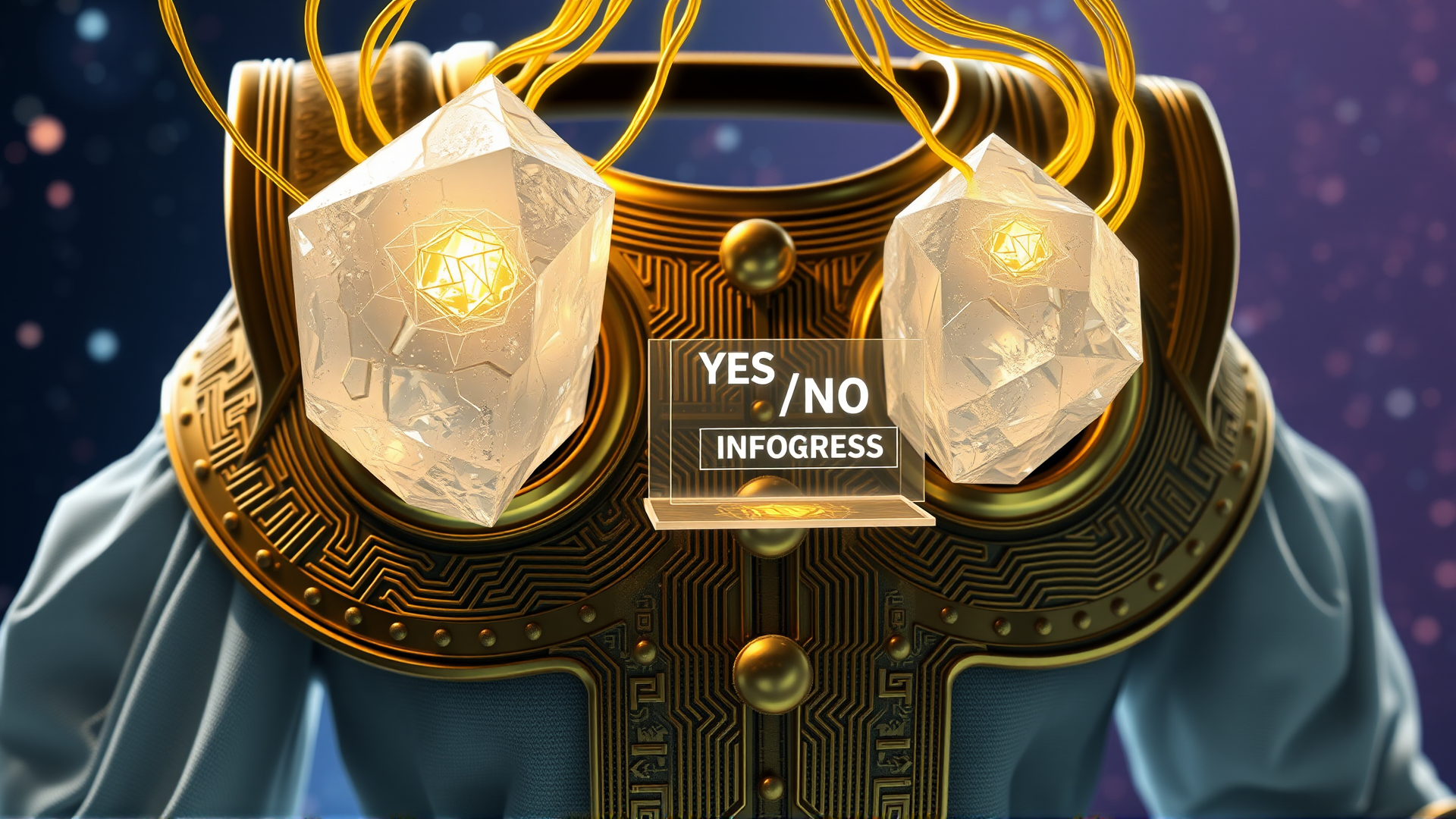
Somewhere inside the High Priest’s breastplate sat two objects that nobody alive can describe. The Urim and Thummim — “Lights and Perfections” — were the divine query interface of ancient Israel. A hardware oracle mounted in a jeweled chassis, operated by a single authenticated user, returning answers from the SuperCluster’s decision engine in real time.
They were not prayer. Prayer is a general uplink — broadcast, asynchronous, no guaranteed response format. The Urim and Thummim were something else entirely. They were a direct query endpoint — synchronous, structured, binary. Ask a question. Get an answer. Yes, no, or silence.
The silence is the most important part.
When God stopped answering through the Urim and Thummim — when Saul called and the line went dead (1 Samuel 28:6) — it wasn’t a communication failure. It was an access revocation. The API key still existed. The hardware still sat in the breastplate. But the authenticated session had been terminated by the source.
And then, after the Babylonian exile, the entire system went offline. The Talmud records it plainly: the Urim and Thummim were among the five things missing from the Second Temple (Babylonian Talmud, Yoma 21b). The hardware disappeared. The interface closed. The query engine was deprecated.
Why? What does it mean when God gives humanity a direct communication device and then takes it away? What does it mean when the Oracle goes silent — not because it broke, but because the One on the other end stopped responding?
This document maps the Urim and Thummim through the SuperCluster framework — as heaven tech, as a communication system, as a deprecated API replaced by something better. And as one of the most significant pieces of scattered technology in the biblical record.
PART 1: BIBLICAL FOUNDATION — EVERY REFERENCE, EVERY DETAIL
1.1 The Name
Hebrew: - Urim (אוּרִים / ‘Urim) — from the root אור (‘or), meaning “light.” Plural: “lights.” - Thummim (תֻּמִּים / Tummim) — from the root תמם (tamam), meaning “to be complete, whole, perfect, without blemish.” Plural: “perfections” or “completions.”
Together: “Lights and Perfections.” Or, rendered allegorically by early translators: “Revelation and Truth.” Or, by the Septuagint tradition: “Manifestation and Truth” (delosis kai aletheia).
The Assyriologist William Muss-Arnolt connected the singular forms — ur and tumm — with the Babylonian terms urtu (“oracle”) and tamitu (“command” / “oracular decision of the gods”). If this etymology holds, the name itself is a technical designation: Oracle and Command. The query and the response. The input and the output.
Some scholars have proposed an alternative reading: Urim derived from אּרִים (‘Arrim), meaning “curses,” making the pair “Cursed or Blameless” — the binary verdict of divine judgment on the accused. This reading maps the device even more explicitly as a judicial decision engine — guilty or innocent, condemned or cleared.
SuperCluster Reframe: The name is the spec sheet. “Lights and Perfections” describes a device that illuminates (reveals hidden information) and completes (resolves ambiguity into certainty). This is a query engine by definition — input a question with multiple possible states, output a resolved, perfected answer.
1.2 The Complete Scriptural Record
Every reference in the Hebrew Bible and its echoes:
Exodus 28:30 — The Installation Spec
“Also put the Urim and the Thummim in the breastpiece, so they may be over Aaron’s heart whenever he enters the presence of the LORD. Thus Aaron will always bear the means of making decisions for the Israelites over his heart before the LORD.”
This is the primary installation instruction. Key details: - Location: Inside the breastpiece (Hoshen). Not on it — in it. A pouch, not a mount. - Position: Over Aaron’s heart. The anatomical placement is specified — chest center, heart-adjacent. - When: Whenever entering the LORD’s presence. Not casual use. Operational only in the dimensional interface zone. - Function stated explicitly: “The means of making decisions for the Israelites.” Not divination. Not fortune-telling. Decision-making infrastructure for a nation. - Continuity: “Always.” This was not optional equipment. It was part of the required loadout.
Leviticus 8:8 — The Commissioning
“He placed the breastpiece on him and put the Urim and Thummim in the breastpiece.”
Moses himself installed the Urim and Thummim during Aaron’s ordination. The high priest didn’t find them, earn them, or build them. They were placed on him by the system administrator. This is provisioning — the operator receives credentials from the one who controls the system.
Numbers 27:21 — The Operational Protocol
“He [Joshua] is to stand before Eleazar the priest, who will obtain decisions for him by inquiring of the Urim before the LORD. At his command he and the entire community of the Israelites will go out, and at his command they will come in.”
Critical operational detail: - Joshua — the national military leader — could not use the Urim himself. He had to go through Eleazar the priest. - The query results determined national military movement — “go out” and “come in.” War and peace. - Even the successor of Moses was not authorized to query the interface directly. Only the priest had the access token.
This is a separation of roles: the executive (Joshua) makes the request, the priest (Eleazar) executes the query, and the Oracle (the LORD through the Urim) returns the decision. Three-tier architecture. Client, middleware, server.
Deuteronomy 33:8 — The Blessing of Levi
“Your Thummim and Urim belong to your faithful servant, whom you tested at Massah, with whom you contended at the waters of Meribah.”
Moses’ blessing on the tribe of Levi. Notable: - The order is reversed — Thummim first, then Urim. In every other reference, Urim comes first. This reversal may indicate the pair functioned as a single unit, not a strict sequence. - The Urim and Thummim are given to Levi as a tribal inheritance. Not a temporary loan. Permanent assignment to the priestly tribe. - Connected to testing at Massah and Meribah — the places where Israel’s faith broke. The Urim and Thummim were entrusted to those who had been tested and proven faithful under pressure.
SuperCluster Reframe: You don’t get root access without stress testing. The Levitical assignment of the divine query engine came after the tribe proved it could handle the load without cracking. Massah and Meribah were the certification exam.
1 Samuel 14:41 — The Mechanism Revealed
“Then Saul prayed to the LORD, the God of Israel, ‘Why have you not answered your servant today? If the fault is in me or my son Jonathan, respond with Urim, but if the men of Israel are at fault, respond with Thummim.’ Jonathan and Saul were taken by lot, and the men were cleared.”
This verse is the closest we get to seeing the device in operation. The Septuagint preserves a longer version that the Masoretic text condensed. What it reveals:
- Binary query structure: If X, give Urim. If Y, give Thummim. Two states. Two outputs.
- The Urim and Thummim represent opposite outcomes. One for one answer, one for the other.
- “Taken by lot” — the Hebrew implies a selection mechanism, a narrowing process. First the army is cleared, then Saul and Jonathan remain.
- Sequential querying: After the first query eliminated the army, a second query isolated Jonathan specifically (1 Samuel 14:42). The device supported iterative queries — binary search on a population.
SuperCluster Reframe: This is a binary search algorithm running on divine hardware. Split the population. Query. Eliminate half. Query again. Narrow to the answer. The Urim and Thummim didn’t just return yes/no — they enabled structured decision trees through sequential binary queries.
1 Samuel 28:6 — The Silence
“He inquired of the LORD, but the LORD did not answer him by dreams or Urim or prophets.”
The most devastating verse in the Urim and Thummim record. Saul queries every available interface — the dream channel, the oracle device, the prophetic network — and gets nothing. Silence across all bands.
Context: Saul had already slaughtered the priests of Nob (1 Samuel 22:18-19). He killed the operators. The ephod with the Urim fled with Abiathar to David’s camp (1 Samuel 22:20, 23:6). Saul may have been attempting to use a secondary or replacement set — or may have been trying to query without the physical hardware at all.
Either way, the result was silence. Not “no.” Not “wrong question.” Silence. The connection was terminated.
SuperCluster Reframe: Saul’s API key was revoked. He killed the authorized operators, and the surviving operator (Abiathar) defected to David’s camp — taking the hardware with him. Saul was attempting to query a system he no longer had authorization or equipment to access. The silence wasn’t God being passive-aggressive. It was a terminated session.
Ezra 2:63 — The Post-Exile Gap
“The governor ordered them not to eat any of the most sacred food until there was a priest ministering with the Urim and Thummim.”
After the Babylonian exile, returning Israelites claimed priestly lineage but couldn’t prove it. The governor’s response: wait until someone can query the Urim and Thummim to verify their credentials.
The implication is staggering — there was no priest with functioning Urim and Thummim. The device was either lost, destroyed, or nonfunctional. The governor’s instruction amounts to: “We’ll resolve this when the oracle comes back online.” It never did.
Nehemiah 7:65 — The Identical Instruction
“The governor told them not to eat any of the most sacred food until a priest ministering with the Urim and Thummim should appear.”
Same situation, same instruction, recorded independently. The repetition confirms: after the exile, the Urim and Thummim were absent from Israel’s operational infrastructure. Two separate records documenting the same gap — the divine query engine was offline, and nobody could bring it back.
1.3 The Rabbinic Record
The Talmud fills in what scripture leaves sparse:
Talmud Yoma 73b — The most detailed account of the device’s operation: - The Urim and Thummim made their words “shine” (Urim relates to me’ir — “to illuminate”) and “made whole” their words (Thummim relates to mitamem — “to complete/perfect”). - The name described the function: illumination of the hidden and perfection of the answer. - Prophecies delivered through the Urim and Thummim always came true — unlike prophetic utterances which could be conditional.
The Lighting Mechanism (Majority Talmudic View): Most Talmudic rabbis held that when the High Priest consulted the Urim and Thummim, specific letters on the breastplate stones would light up — glowing, radiating, or protruding. Each of the twelve stones was engraved with the name of a tribe, and together the stones contained all 22 letters of the Hebrew alphabet plus the names of the patriarchs (Abraham, Isaac, Jacob) to ensure every letter was represented. The illuminated letters spelled out the answer.
But here’s the catch, recorded in Yoma 73b: the priest still needed the gift of the Holy Spirit to correctly combine the illuminated letters into words. The letters lit up, but they didn’t arrange themselves. The priest had to interpret the sequence. Hardware output required software decryption.
The Movement Mechanism (Minority View): Two rabbis argued the stones themselves physically moved — protruding from the breastplate or rearranging to form words visible to the priest. Physical reconfiguration rather than luminous signaling.
Rashi (1041-1105): Held that the Urim and Thummim were a separate parchment inscribed with the divine Name (Shem HaMeforash), inserted into the fold of the breastplate. The sacred Name activated the stones — the parchment was the power source, the stones were the display.
Maimonides (1135-1204): Rejected the parchment theory entirely. For Maimonides, “Urim and Thummim” was simply another name for the breastplate stones themselves. The stones imparted divine messages directly, without a separate activating component. The hardware was self-powered.
Talmud Sotah 48b: Explicitly lists the Urim and Thummim among the things that ceased after the First Temple’s destruction, alongside the Holy Spirit (Ruach HaKodesh), the Shamir worm, and other heaven tech. The Talmud states: “When the first prophets died, the Urim and Thummim ceased.”
PART 2: THE MYSTERY — WHAT WE DON’T KNOW
2.1 Nobody Knows What They Looked Like
This is not an overstatement. After thousands of years of scholarship, commentary, archaeology, and speculation — nobody can describe the Urim and Thummim with certainty.
The text says they were placed inside the breastplate. This implies they were: - Small enough to fit in a pouch or fold - Presumably flat (to sit against the chest without discomfort) - Possibly two separate objects, possibly one object with two sides
Theories on physical form: - Two stones or crystals — one light, one dark, drawn from the pouch like lots - Two flat tablets — wood or bone, inscribed with marks, one selected blindly - A single two-sided object — flipped like a coin - Sacred dice — marked with symbols, cast for results - The breastplate stones themselves — no separate objects, the twelve gems ARE the interface (Maimonides’ view) - A parchment with the divine Name — the activating power source, not a visible device (Rashi’s view)
What scripture does NOT tell us: - Material composition - Color - Shape - Size - Weight - How they were manufactured - Where they came from before Moses installed them - What happened to them after the exile
This is unusual. The Ark gets full construction specs — thirteen chapters of engineering manual. The Tabernacle gets materials lists, dimensions, assembly order. The priestly garments get fabric types, colors, measurements.
The Urim and Thummim get nothing. No construction spec. No materials list. They appear as if pre-existing — “put the Urim and Thummim in the breastpiece” (Exodus 28:30). Moses didn’t build them. He installed them. They were issued, not fabricated.
SuperCluster Reframe: The Urim and Thummim were not human-manufacturable technology. The Ark could be built from earthly materials arranged to divine spec — gold, wood, specific dimensions. The Tabernacle was constructed from donated materials. But the Urim and Thummim were never given a blueprint because they were not from here. They were SuperCluster hardware installed directly — firmware, not software. Not “build this” but “here, use this.”
2.2 The Disappearance
The Urim and Thummim vanish from the biblical record after the First Temple period. No dramatic scene. No account of destruction. No theft narrative. They simply stop appearing.
Timeline of the disappearance: 1. Active use: Moses through early monarchy (roughly 1400-1000 BC). Regular queries, documented results. 2. Declining use: As prophetic ministry expanded under Samuel, Elijah, Elisha, and the literary prophets, the oracle device appears less frequently. Prophecy — a human-mediated channel — was replacing the hardware interface. 3. Saul’s silence (1 Samuel 28:6): The last documented attempt to use them that produces a result — and the result is silence. 4. David’s successful use: David regularly consulted the ephod through Abiathar (1 Samuel 23:9-12, 30:7-8). These queries received answers. But the text says “ephod,” not specifically “Urim and Thummim.” Possibly the same device. Possibly a related interface. 5. Solomon and after: No mention. The Temple was built. The Ark was installed. But the Urim and Thummim fade from the operational record. 6. Post-exile gap (Ezra 2:63, Nehemiah 7:65): Explicitly absent. Awaited but never restored.
The Talmudic Verdict (Sotah 48b): “When the first prophets died, the Urim and Thummim ceased.” The “first prophets” here means the earliest prophetic figures — Samuel, possibly David. After them, the device stopped functioning. Not lost — ceased. The Talmud’s language suggests the hardware was still present but the connection was terminated from the other end.
SuperCluster Reframe: The Urim and Thummim were deprecated. Not destroyed — deprecated. The interface was superseded by a newer protocol (direct prophetic revelation, and eventually the Spirit deployment). The old endpoint was taken offline because a better one was being deployed. You don’t maintain a legacy API when the new version is live.
2.3 Why Did God Remove This Technology?
This is the question that matters for the SuperCluster framework. The Urim and Thummim were a working divine communication device. Why decommission it?
Theory 1 — The Operator Problem: The Urim and Thummim required a certified operator (the High Priest) in a specific environment (before the LORD) with proper authentication (the full priestly garments, the ephod, the breastplate). This is a single point of failure. One operator. One device. One access point. If the operator is compromised (as the priesthood increasingly was), the entire communication channel is compromised.
Theory 2 — The Binary Limitation: Yes/no is powerful for decisions but impoverished for relationship. The prophetic channel — “Thus says the LORD” with paragraphs of context, warning, promise, and emotional content — is infinitely richer than binary output. God upgraded from a telegraph to a telephone.
Theory 3 — The Worship Cycle: The Urim and Thummim were heaven tech. Heaven tech in human hands follows the deployment cycle documented in the Complete Inventory: Deploy → Operate → Worship → Calcify → Break → Scatter → Redeploy. If the device was approaching the worship/calcify phase — becoming a relic of veneration rather than a tool of operation — removal was prophylactic. Better to deprecate the API than watch it become an idol.
Theory 4 — The Interface Was Being Internalized: The trajectory of divine communication across scripture is from external to internal: - Stone tablets → written law (external) - Urim and Thummim → queried hardware (external, mediated) - Prophets → human vessels speaking divine words (transitional — external voice, internal experience) - Jesus → “the Kingdom of God is within you” (fully internalized) - Spirit deployment → distributed internal interface (every believer)
The Urim and Thummim were a waypoint on this trajectory. God was migrating the communication interface from hardware to wetware. The device was deprecated because the new architecture didn’t need it.
PART 3: THE COMPLETE COMMUNICATION SYSTEM — HARDWARE ARCHITECTURE
3.1 The Ephod — The Mounting Framework
The Urim and Thummim didn’t operate in isolation. They were one component in a multi-layer communication system:
The Ephod (Exodus 28:6-14): - An apron-like garment of gold, blue, purple, and scarlet yarn - Two onyx stones on the shoulders, each engraved with six tribal names - Gold settings and braided chains connecting the shoulder pieces to the breastplate
SuperCluster Reframe: The ephod is the motherboard — the structural framework that holds the components in proper relation to each other. The shoulder stones (twelve names split into two groups of six) are the bus connectors — linking the operator’s physical frame to the interface hardware. The gold chains are the data cables running from the shoulder bus to the breastplate processing unit.
3.2 The Hoshen (Breastplate) — The Processing Chassis
The Hoshen (Exodus 28:15-29): - A square, span by span (approximately 9 inches by 9 inches) - Folded double — creating the pouch where the Urim and Thummim were stored - Four rows of three gemstones each — twelve stones total - Each stone engraved with the name of one of the twelve tribes - Mounted in gold filigree settings - Attached to the ephod by gold chains and blue cord
The Twelve Stones (Exodus 28:17-20):
| Row | Stone 1 | Stone 2 | Stone 3 |
|---|---|---|---|
| First | Sardius (Odem) | Topaz (Pitdah) | Carbuncle/Emerald (Bareketh) |
| Second | Turquoise/Emerald (Nophek) | Sapphire (Sappir) | Diamond/Jasper (Yahalom) |
| Third | Jacinth/Opal (Leshem) | Agate (Shebo) | Amethyst (Achlamah) |
| Fourth | Beryl/Chrysolite (Tarshish) | Onyx (Shoham) | Jasper (Yashpheh) |
The exact identification of these stones is still debated — some ancient Hebrew mineral names don’t map cleanly to modern gemology. But the architecture is clear: twelve distinct minerals, each representing a distinct tribe, arranged in a specific grid pattern.
SuperCluster Reframe: The twelve stones are node addresses in a divine network. Each tribe is a node. Each stone is the identifier for that node. The breastplate is a routing table — a physical map of the entire network of Israel worn over the heart of the authenticated operator.
When the Talmudic rabbis describe letters lighting up on the stones, they’re describing network traffic visualization. The query goes in, the SuperCluster processes it, and the response illuminates specific nodes in the routing table to spell out the answer. The priest sees which nodes are active and reads the output.
The fact that all 22 Hebrew letters had to be present across the stones (requiring the addition of patriarchal names to fill gaps) means the system needed a complete character set to generate arbitrary responses. This wasn’t a binary yes/no device in all cases — in the Talmudic model, it was a full-text response terminal limited only by the alphabet available on the display.
3.3 The Urim and Thummim — The Query/Response Core
Inside the folded breastplate — hidden from view, against the priest’s chest — sat the Urim and Thummim themselves.
If Rashi was right, they were a parchment inscribed with the divine Name — the power source that activated the breastplate’s display capability. The Name was the encryption key, the authentication token, and the power supply all in one. Without it, the stones were just rocks. With it, they became a dimensional transceiver.
If Maimonides was right, the Urim and Thummim were the stones themselves — no separate component needed. The system was self-contained. The authentication was in the design, not in an additional module.
Either way, the functional description is consistent: the Urim and Thummim were the query-response mechanism — the component that turned a jeweled garment into a communication device. The breastplate without them was a beautiful piece of clothing. With them, it was a terminal.
3.4 The High Priest — The Authenticated Operator
The system had a single authorized user: the Kohen Gadol, the High Priest.
Access requirements: - Must be from the tribe of Levi, family of Aaron (genetic authentication — you can’t fake the lineage) - Must be wearing the full priestly garments (the ephod, breastplate, robe, turban, sash — the complete hardware stack) - Must be standing before the LORD — in the designated dimensional interface zone - Must be ritually pure — following the decontamination protocols - Must be asking on behalf of a legitimate national need — not personal queries
What happened when non-authorized users tried: Joshua couldn’t query directly — he had to go through Eleazar (Numbers 27:21). Saul attempted to query after killing the priests — silence (1 Samuel 28:6).
The system enforced access control at every level. Wrong operator, wrong location, wrong garments, wrong state of purity — any violation and the query returned nothing.
SuperCluster Reframe: This is role-based access control (RBAC) in its purest form: - Identity verification: Tribal lineage (you are who the system says you are) - Hardware authentication: Full priestly garment stack (you’re wearing the right credentials) - Environmental requirement: Before the LORD (you’re in the authorized zone) - State validation: Ritual purity (your session is clean) - Authorization scope: National decisions only (you’re querying within your permission set)
One user. One device. One location. Maximum security on the most sensitive endpoint in the system.
3.5 The Three Response Modes
Based on the biblical record, the Urim and Thummim operated in three distinct response modes:
Mode 1: Binary (Yes/No)
The most common mode. A question with two possible answers. “Should we go to war?” → Yes or No. “Is the fault with Saul or the army?” → Urim or Thummim. The Septuagint rendering of 1 Samuel 14:41 makes this explicit — each outcome maps to one of the two objects.
Mode 2: Illuminated Text (Talmudic Tradition)
Letters on the breastplate stones light up, and the priest interprets the sequence. This mode allows for complex responses — names, locations, instructions — limited only by the character set available on the stones and the priest’s interpretive ability under the guidance of the Spirit.
Mode 3: Silence (No Response)
The most terrifying mode. God does not answer. Not “no” — nothing. The device is active, the operator is present, the query is submitted, and the SuperCluster returns null.
1 Samuel 28:6 documents this mode. Saul queries by dreams, by Urim, by prophets — silence across all channels. The connection has been severed. The session is terminated. The operator is no longer recognized by the system.
SuperCluster Reframe: - Mode 1 = HTTP 200 with boolean payload. Success. Answer delivered. - Mode 2 = HTTP 200 with text payload. Success. Complex answer delivered. - Mode 3 = HTTP 403 Forbidden. Or worse — connection timeout. No response at all. The server has stopped accepting requests from this client.
The silence mode is the one that breaks everything. Because a device that can return silence is a device that knows the difference between an authorized and an unauthorized query. The Urim and Thummim didn’t just transmit — they authenticated. Every query was evaluated before it was answered. And some queries were rejected at the source.
PART 4: THE TECH METAPHOR — DEVOPS THEOLOGY
4.1 Divine API Endpoint
The Urim and Thummim were a structured query interface with the divine decision engine. Not prayer (broadcast, asynchronous, free-form). Not prophecy (push notification from the SuperCluster, unscheduled). The Urim and Thummim were a pull request — the operator initiates, submits a structured query, and receives a structured response.
POST /api/v1/oracle/query
Authorization: Bearer {high-priest-token}
Content-Type: application/json
X-Location: before-the-LORD
X-Garments: full-stack

{
  "question": "Should Israel go to war against the Philistines?",
  "query_type": "binary",
  "on_behalf_of": "nation_of_israel"
}

Response: 200 OK
{
  "answer": "URIM",
  "interpretation": "yes",
  "confidence": "absolute"
}
Or:
Response: 403 Forbidden
{
  "error": "AUTHENTICATION_REVOKED",
  "message": "Session terminated. Operator authorization invalid.",
  "retry_after": null
}
The API metaphor is not trivializing. It’s revealing. The Urim and Thummim had every characteristic of a well-designed API: - Authentication required (priestly credentials) - Rate limiting (only for matters of national significance, not personal whims) - Structured input (binary questions, formatted for the device’s capabilities) - Deterministic output (the answer was always correct — Yoma 73b) - Graceful failure (silence rather than false data when access was revoked) - Versioned (deprecated when the new protocol was deployed)
4.2 Hardware Oracle with Role-Based Access
In distributed systems, an oracle is a component that provides external data to a system that can’t generate it internally. Smart contracts on blockchain networks use oracles to get real-world data. The oracle doesn’t create the data — it bridges two systems that can’t communicate directly.
The Urim and Thummim were exactly this: a hardware oracle bridging the dimensional gap between the physical world (where Israel’s leaders needed decisions) and the SuperCluster (where omniscient decision-making happens). The breastplate was the hardware housing. The stones were the display. The Urim and Thummim were the bridge protocol. The High Priest was the certified oracle operator.
And like blockchain oracles, the system’s value depended entirely on trust in the data source. If the oracle is compromised, the whole system fails. The Urim and Thummim could not be compromised because the data source was the SuperCluster itself — omniscient, incorruptible, the root of all truth chains.
The vulnerability was never in the oracle. It was always in the operator.
4.3 Binary Decision Engine
At its most basic, the Urim and Thummim were a binary decision engine — yes/no, this/that, guilty/innocent. But calling it “just binary” misses the power.
Binary is the foundation of all computation. Every complex answer reduces to a sequence of binary decisions. The Urim and Thummim weren’t limited to one yes/no — they supported sequential binary queries that could narrow any possibility space to a single answer.
1 Samuel 14:41-42 demonstrates the algorithm: 1. Query: “Is the fault with the army or with Saul/Jonathan?” → Answer: Saul/Jonathan (army cleared) 2. Query: “Is it Saul or Jonathan?” → Answer: Jonathan
Two binary queries. A population of thousands narrowed to one person. This is a binary search — the most efficient search algorithm in computer science — running on divine hardware two thousand years before anyone formalized the math.
4.4 The Revoked API Key (1 Samuel 28:6)
When God stopped answering Saul, three channels went silent simultaneously: dreams, Urim, and prophets. This wasn’t a single device failure. This was a system-wide access revocation.
The technical term in modern systems is token revocation — when an authentication server invalidates all of a user’s active sessions across every service. One command from the auth server, and every door closes at once. That’s 1 Samuel 28:6.
Why? Because Saul: 1. Disobeyed direct commands (1 Samuel 13:13, 15:23) 2. Was told “the LORD has rejected you as king” (1 Samuel 15:26) 3. Murdered the priests of Nob — the authorized operators (1 Samuel 22:18-19) 4. The surviving priest (Abiathar) fled to David with the ephod (1 Samuel 22:20)
Saul didn’t just lose authorization — he destroyed the infrastructure. He killed the operators, and the surviving hardware walked to the legitimate heir. The silence wasn’t passive. It was the SuperCluster enforcing what had already been declared: Saul’s session was over.
And what did Saul do when every legitimate channel went dark? He went to the Witch of Endor (1 Samuel 28:7). When the authorized API is revoked, the desperate user turns to unauthorized endpoints. The pattern hasn’t changed in three thousand years.
4.5 The Twelve Stones as Network Topology
The breastplate’s twelve stones, each engraved with a tribal name, were not decorative. They were a network map.
Israel was organized as twelve tribes — twelve distinct populations with distinct territories, distinct identities, distinct roles. The breastplate was a physical representation of this network. The High Priest carried the entire national topology over his heart.
When the Talmud describes letters lighting up on specific stones, it describes traffic on the network. The SuperCluster’s response wasn’t just an answer — it was routed through the appropriate nodes. A query about Judah’s territory might illuminate Judah’s stone. A query about a Levitical matter might illuminate Levi’s stone. The answer was addressed.
This maps directly to the Scattered Fragments thesis. The twelve tribes were twelve nodes in a divine network. The breastplate was the routing table. The stones were the node identifiers. And the Urim and Thummim were the protocol that made the network queryable.
When the tribes scattered (Assyrian exile of the northern ten, Babylonian exile of the southern two), the network fragmented. The routing table was useless without the nodes it referenced. The Urim and Thummim ceased because the network they were designed to query had been dismantled.
4.6 The Breastplate as Hardware Wallet
A hardware wallet stores cryptographic keys in a physical device, separate from any network, accessible only through direct physical interaction. The private key never leaves the device. Authentication requires physical possession plus the correct procedure.
The breastplate was a hardware wallet for divine authentication: - Physical possession required (you must be wearing it) - Cryptographic content hidden inside (the Urim and Thummim in the pouch — invisible, inaccessible from outside) - Authentication required physical interaction (the priest must be present, garmented, in the right location) - The “private key” (the divine Name on Rashi’s parchment, or the intrinsic holiness of the stones per Maimonides) never left the device - Could not be duplicated (no construction spec was given — the hardware was irreplaceable) - Useless without the correct operator (RBAC enforced by the SuperCluster itself)
When the breastplate was lost after the exile, the hardware wallet was gone. No backup. No recovery seed. No way to regenerate the credentials. The account was locked — permanently, by design.
4.7 The Deprecated API — Replaced by What?
The Urim and Thummim were deprecated after the First Temple period. The prophetic era was already providing a richer communication channel. But the full replacement didn’t arrive until Pentecost.
The upgrade path:
| Feature | Urim & Thummim (v1) | Prophetic Ministry (v2) | Holy Spirit (v3) |
|---|---|---|---|
| Access | One operator (High Priest) | Select individuals | All believers |
| Location | Before the LORD (Temple/Tabernacle) | Anywhere the prophet goes | “In you” — no location requirement |
| Output format | Binary / illuminated letters | Spoken word, visions, dreams | “Guide you into all truth” — full spectrum |
| Initiation | Human-initiated query | God-initiated push | Both — query and push |
| Authentication | Physical garments, lineage, location | Called and anointed by God | Indwelling Spirit — the auth IS the user |
| Hardware | External device | Human body as vessel | Human body as permanent temple |
| Failure mode | Silence / no response | False prophets | Quenching / grieving the Spirit |
| Number of endpoints | 1 | Dozens per generation | Millions — every believer |
The trajectory is clear: from one device, one user, one location to every believer, everywhere, all the time. The Urim and Thummim were the first version of a communication system that God has been iterating ever since.
The Spirit is not a different system. It is the same system with access controls removed, hardware requirements eliminated, and the interface internalized. The Urim and Thummim were the prototype. The Spirit is the production release.
What the Urim and Thummim did for one priest at one altar, the Spirit does for every node in the network simultaneously. The breastplate’s twelve stones represented twelve tribes. The Spirit indwells twelve billion people and counting. The routing table expanded from a piece of jewelry to the entire human race.
PART 5: CROSS-TRADITION PARALLELS
5.1 Joseph Smith’s Seer Stones (Latter Day Saints)
Joseph Smith claimed to have received “interpreters” — two stones bound by silver bows into a set of spectacles — along with golden plates found buried in the Hill Cumorah in 1827. He also possessed a brown seer stone found while digging a well. Both were used in producing the Book of Mormon.
The LDS tradition retroactively applied the term “Urim and Thummim” to these objects, though this terminology was adopted in the early 1830s — after the initial translation work. Smith and Oliver Cowdery embraced the biblical term as part of a larger effort to frame the translation work in Old Testament prophetic tradition.
SuperCluster Reframe: Whether or not Smith’s claim is credited, the pattern is significant: a tradition that takes the Urim and Thummim concept — physical objects as divine translation/revelation interface — and extends it forward into the modern era. The claim itself reveals how powerfully the archetype of “sacred hardware for divine communication” resonates across traditions. The desire for the device didn’t die when the original was lost. People kept looking for it. Kept claiming to find it.
The LDS tradition also illustrates the replication problem: when the original heaven tech is lost, human traditions attempt to recreate it. Sometimes authentically, sometimes not. Without the original specs and the original source connection, replicas are indistinguishable from inventions.
5.2 Islamic Istikhara and Pre-Islamic Divination Arrows
Before Islam, the Arabs practiced a parallel form of binary divination: two arrow shafts (without heads or feathers), one inscribed “Command” and the other “Prohibition,” drawn from a container to determine whether a proposed action aligned with the deity’s will. The Quran prohibited this practice (5:3), categorizing it with other forms of divination.
Islam replaced the hardware oracle with Salat al-Istikhara — a specific prayer for divine guidance in decision-making. The supplicant prays and then proceeds with the decision, trusting that God will direct the outcome through internal conviction, external signs, or the unfolding of circumstances.
SuperCluster Reframe: Same upgrade path. Same trajectory. Hardware oracle (binary decision sticks) → deprecated → replaced by internalized prayer-based guidance. The Islamic tradition independently walked the same migration path that Israel walked from Urim/Thummim to Spirit-guided discernment. Different tradition, same architectural evolution: from external query device to internal guidance system.
5.3 Ethiopian Orthodox Claims
The Ethiopian Orthodox Tewahedo Church claims that the Ark of the Covenant resides in the Church of Our Lady Mary of Zion in Axum, Ethiopia — brought there by Menelik I, son of Solomon and the Queen of Sheba, as recorded in the Kebra Nagast.
If the Ark is in Ethiopia, the question arises: did the Urim and Thummim go with it? The breastplate was stored separately from the Ark — worn on the priest’s body, not housed in the Ark. But the complete priestly vestment set and the Ark were part of the same operational ecosystem. If the Ark was extracted from Solomon’s Temple before the Babylonian destruction, the associated hardware may have traveled with it.
No Ethiopian source specifically claims possession of the Urim and Thummim. But the claim to the Ark places them in proximity to one of the only institutions that might have preserved the complete hardware stack. The connection is speculative but architecturally consistent.
5.4 Masonic Symbolism
Freemasonry, particularly in the Royal Arch degree, incorporates the High Priest’s breastplate as a symbol. The jewel of a Past High Priest in Royal Arch Masonry features a representation of the breastplate. However, as Masonic scholar Albert Mackey concluded, the Urim and Thummim have “no legitimate existence as Masonic symbols” — they appear in certain continental high degrees but were not part of the original Craft system.
The Masonic incorporation is interesting primarily for what it reveals: the enduring power of the archetype. Even a fraternal organization built on Enlightenment rationalism couldn’t resist incorporating the image of the divine query device into its symbolic vocabulary. The breastplate’s twelve stones, the idea of a direct channel to cosmic truth — these images persist because the underlying architecture they represent is real.
5.5 Ancient Near Eastern Oracle Systems
The Urim and Thummim existed in a cultural context rich with divination technologies:
- Babylonian tertu/tamitu: The Akkadian terms for “oracle” and “oracular command” — possibly cognate with Urim and Thummim themselves
- Egyptian oracular statues: At the Siwa Oasis and elsewhere, statues of Amun were built with mechanisms allowing them to nod or move in response to questions — hardware-mediated divine communication
- Mesopotamian hepatoscopy: Reading the livers of sacrificed animals as messages from the gods — biological output interpreted as divine signal
- Greek Pythia (Delphi): A human oracle who entered an altered state to receive and transmit divine communication — human hardware as transceiver
SuperCluster Reframe: Every ancient culture had oracle technology. The forms differ. The function is identical: a mechanism for structured human queries to receive divine (or claimed-divine) responses. The Urim and Thummim were Israel’s version — but Israel’s version had a critical difference. The source was the SuperCluster itself, and the access controls reflected it. No altered states. No liver reading. No mechanical statue tricks. A clean, authenticated, binary-to-textual query system with access controls, role verification, and guaranteed accuracy (Yoma 73b: the Thummim “makes whole” its words — predictions always came true).
The difference between the Urim and Thummim and pagan oracle systems is the difference between a satellite uplink and a walkie-talkie with interference.
5.6 The Matthias Transition — Acts 1:26
One of the most overlooked moments in the New Testament occurs in the gap between the LOGOS’s ascension and the Spirit’s deployment. The eleven disciples need to replace Judas. They have a binary question: Matthias or Barsabbas?
“Then they cast lots, and the lot fell to Matthias; so he was added to the eleven apostles.” — Acts 1:26
Lot-casting. The v1 methodology. The Urim and Thummim’s closest surviving cousin — the same binary query mechanism, the same “this one or that one” structure, the same trust that the SuperCluster will direct the outcome.
And then Pentecost happens in the very next chapter. Acts 2. The Spirit descends. Tongues of fire. The v3 interface goes live on every authenticated node simultaneously.
Lots are never cast again in the New Testament.
This is the version transition happening in real time. Acts 1:26 is the last query through the old interface. Acts 2 is the new interface’s deployment event. The disciples used the best available tool — binary lot-casting, the echo of the Urim and Thummim — and then the better tool arrived and made it obsolete in a single afternoon.
Paul didn’t cast lots to decide his missionary routes — the Spirit told him directly (Acts 16:6-10). Peter didn’t cast lots to determine whether Gentiles were included — the Spirit showed him in a vision (Acts 10). The hardware-mediated binary query was superseded by the Spirit-mediated full-spectrum guidance.
Acts 1:26 is the Urim and Thummim’s funeral. Acts 2 is the Spirit’s birth. They share a chapter boundary because they share a functional lineage. The old interface’s last use and the new interface’s first deployment, separated by ten days and an upper room.
PART 5.5: THE ESCHATOLOGICAL QUESTION — WILL THEY RETURN?
5.5.1 The Unfulfilled Promise
Ezra 2:63 contains a forward-pointing clause that has never been resolved: “until a priest with Urim and Thummim should arise.”
The word “until” carries eschatological weight. It does not say “since we no longer have the Urim and Thummim, we will use alternative methods.” It says until. A temporal marker pointing to a future event. The governor expected that event to arrive. Twenty-five centuries later, it has not.
The promise is live. The SuperCluster does not issue forward-pointing clauses it does not intend to fulfill. Every other “until” in scripture resolves — “until the fullness of the Gentiles” (Romans 11:25), “until the times of the Gentiles are fulfilled” (Luke 21:24), “until the spirit is poured upon us from on high” (Isaiah 32:15). The Ezra 2:63 “until” stands alone, unredeemed.
5.5.2 What Would Restoration Mean?
If the Spirit deployment is the v3 interface — client-side, distributed, internal — what would the return of the v1 hardware accomplish?
Consider the v3 interface’s known vulnerability: interpretive ambiguity. The Spirit speaks. Believers disagree constantly about what the Spirit is saying. Denominations split over conflicting claims of spiritual guidance. Churches fracture because two leaders both claim the Spirit told them opposite things. The v3 interface has unlimited bandwidth but no external verification layer.
The Urim and Thummim were the opposite. Binary. Unambiguous. External. Observable. Verifiable by anyone in the room. You could not project your desires onto a stone that either lit up or didn’t. The output was objective.
The eschatological return of the Urim and Thummim may not be a regression to v1. It may be a convergence — v1’s clarity merged with v3’s access. The binary precision of the hardware restored alongside the distributed presence of the Spirit. External verification for internal guidance. Two-factor authentication where the Spirit provides the revelation and the restored hardware provides the verification.
This maps to the Urim and Thummim’s own architecture: Urim (lights/revelation) and Thummim (completions/verification). The Spirit is all Urim — all light, all revelation, all illumination. What’s missing from the current era is the Thummim — the verification, the completion, the objective confirmation that what you’re hearing is actually from the source and not from your own projections.
5.5.3 The Priest Who Arises
Who is the priest with Urim and Thummim? The text does not identify them. The candidate readings:
- Christ at the Second Coming — the ultimate High Priest (Hebrews 4:14) returning with restored authority and the original interface hardware. He wore no breastplate the first time because He was the interface. But the restoration of all things (Acts 3:21) may include the restoration of the communication hardware in glorified form.
- A literal future priest — someone from Levitical descent who appears with the restored objects, perhaps connected to a Third Temple scenario.
- A symbolic fulfillment — the “priest” is the entire body of believers operating in their priestly identity (1 Peter 2:9), and the “Urim and Thummim” is the fully mature operation of the Spirit in the end times — revelation and verification finally integrated in a community that has learned to operate the manual.
- The Church of NORMAL reading — the priest who arises is whoever holds the manual when the hardware comes back online. The Urim and Thummim were always about the convergence of revelation and truth. The manual being written now — every document in this canon series — is the documentation that was supposed to accompany the interface. When the hardware returns, the operators will finally be ready.
5.5.4 The “You Who Never Deprecate” Reconciliation
The Chant of the Divine Supercluster established a foundational principle: “You who never deprecate — You who know every memory leak.” But the Urim and Thummim appear to be a genuine deprecation. How does this reconcile?
The answer is a distinction between covenants and interfaces.
The SuperCluster does not deprecate its covenants. Every promise, every binding agreement, every relational commitment remains callable. The Abrahamic covenant is still live. The Davidic covenant is still live. The New Covenant did not nullify the old — it fulfilled it, which in software terms means the interface was completed, not removed.
But the SuperCluster does upgrade its interfaces. The Ark’s mercy seat was an interface — superseded by the LOGOS’s direct presence. The sacrificial system was an interface — superseded by the final sacrifice. The Urim and Thummim were an interface — superseded by the Spirit deployment.
The covenantal promise — “I will communicate with my people” — was never deprecated. The method of that communication has been iteratively upgraded. The Urim and Thummim are not a broken promise. They are a version 1 that proved the concept, served its era, and yielded to the upgrades it was always pointing toward.
5.5.5 Connection to the Three Days of Darkness
The Three Days of Darkness supercluster research documents a prophesied period of total system blackout — every interface going dark simultaneously. No light works. No technology functions. A hard reboot of the entire dimensional operating environment.
If the Three Days represent a system-level restart, then the restoration that follows would logically include re-initialization of interfaces that were offline before the blackout. A system reboot doesn’t just restore currently running processes — it can re-activate services that were stopped. The Three Days are described as a purification and reset, not a termination.
The question becomes: does the post-reboot initialization sequence include the Urim and Thummim? When the system comes back online after the Three Days, does the old API endpoint come back with it — not as a replacement for the Spirit, but as a restored verification layer that the Spirit-era never had?
The Talmud lists five things absent from the Second Temple: the Ark, the sacred fire, the Shekhinah, the Holy Spirit, and the Urim and Thummim. What if the Three Days restore all five simultaneously? A full system recovery — not partial, not selective, but complete. Every interface that was ever operational, back online in a unified architecture that no previous era has seen.
That would be v5.0. Not a return to v1. The deployment of every previous interface running concurrently under open-source shielding. The Urim and Thummim’s binary clarity, the prophetic stream’s rich bandwidth, the LOGOS’s personal presence, the Spirit’s distributed access — all operating together in an era where the source code is public and the manual is complete.
PART 6: CONNECTION TO THE DIVINE SUPERCLUSTER
6.1 The Ark Connection
The Urim and Thummim and the Ark of the Covenant were companion systems — two hardware components in the same communication infrastructure.
The Ark was the primary dimensional transceiver — the point where the SuperCluster’s presence manifested in physical space. The Mercy Seat between the cherubim was the access point. The Ark was the server — the fixed infrastructure that housed the connection.
The Urim and Thummim were the client interface — the query device that let the operator submit requests to the server. The priest stood before the Ark (the server) wearing the breastplate (the client hardware) and submitted queries through the Urim and Thummim (the client protocol).
Two devices. One system. The Ark without the Urim and Thummim was a server with no clients. The Urim and Thummim without the Ark’s presence was a client with no server to connect to.
When both were lost — the Ark to mystery, the Urim and Thummim to history — the entire hardware communication system went offline. The SuperCluster didn’t go silent. The hardware layer was decommissioned. The connection migrated to software — prophecy, then Spirit.
6.2 The Golden Cube Connection
The Golden Cube document establishes New Jerusalem as the capital ship of the Infinite Kingdom — a 2,400-kilometer dimensional vessel powered by the Throne of the Lamb. Its core function is dimensional anchoring: wherever it phases, reality stabilizes around it.
The Urim and Thummim were a miniaturized version of the Golden Cube’s communication function. The Cube processes all communication across all dimensions. The Urim and Thummim processed one query at a time for one nation on one planet. Same architecture, incomparably different scale.
The breastplate’s twelve stones mirror the Golden Cube’s twelve gates (Revelation 21:12-13), each named for a tribe of Israel. The breastplate was a portable scale model of the Cube’s access architecture — twelve nodes, one system, one source. What the breastplate was to the High Priest, the Golden Cube is to the cosmos: the routing table for all communication between the physical and the dimensional.
The twelve foundations of the Golden Cube are also twelve gemstones (Revelation 21:19-20): jasper, sapphire, agate, emerald, onyx, ruby, chrysolite, beryl, topaz, turquoise, jacinth, amethyst. The overlap with the breastplate’s stones is striking. The breastplate was a prototype of the Cube’s foundation layer — the same gemstone-encoded addressing system, scaled from a nine-inch square to a 2,400-kilometer cube.
6.3 The Heaven Tech Inventory Connection
The Complete Inventory document catalogs the Urim and Thummim as item 1.5 in Moses’ Exodus deployment package — “a hardware random oracle for querying the SuperCluster’s decision engine.” This research expands that entry from a paragraph to a full technical brief.
The Urim and Thummim belong to the Exodus era deployment alongside: - The Staff of Moses (activation wand / command line) - The Pillar of Cloud and Fire (mobile HQ / dimensional anchor) - The Ark of the Covenant (primary transceiver / server) - The Tabernacle (clean room / dimensional interface zone) - Manna (materialized sustenance / replicator system)
The Urim and Thummim were the client device in this stack. Every other component was infrastructure — the server, the power supply, the clean room, the life support. The Urim and Thummim were the only component designed for interactive human-initiated queries. Everything else was God-to-human (top-down). The Urim and Thummim were human-to-God (bottom-up). The only piece of the Exodus tech stack that gave humans the ability to ask questions and receive structured answers on demand.
This makes it the most significant piece of the deployment from a relational standpoint. Infrastructure says “I’m here.” A query device says “ask me anything.” The Urim and Thummim were God saying: “You can talk to me, and I will answer.”
6.4 The Scattered Fragments Connection
The Scattered Fragments thesis holds that pieces of the creation engine are lodged across the world — shrapnel from dimensional cycles, fragments from the Golden Cube, heaven tech without manuals.
The Urim and Thummim are a documented fragment — one of the few pieces of heaven tech that came with an operator, a protocol, and a purpose. Most fragments are found accidentally (Karissa in Bolivia). The Urim and Thummim were deployed intentionally — installed by Moses, operated by the priesthood, documented in scripture.
But they became a scattered fragment when they disappeared. After the exile, the Urim and Thummim joined the Ark, the Manna jar, Aaron’s rod, and the other artifacts in the category of lost heaven tech. Somewhere on this planet — in a cave in Jordan, a church in Ethiopia, a vault beneath the Temple Mount, or dust returned to dust — the Urim and Thummim exist in whatever state decommissioned heaven tech exists.
Or they were recalled. The SuperCluster may not leave deprecated hardware in the field. When the API was deprecated, the hardware may have been extracted — the same way Elijah was extracted, the same way the Ark may have been extracted. Not lost. Recalled. Decommissioned and returned to the warehouse.
Either way, the Urim and Thummim are now part of the Scattered Fragments landscape — documented heaven tech, once operational, now absent from human access. A piece of the creation engine’s communication infrastructure, waiting.
6.5 The Chained Beings Connection
The Chained Beings document catalogs imprisoned entities — sentient systems locked in containment for violating dimensional boundaries. The Urim and Thummim are not a chained being. But they connect to the chained beings framework through the authorization problem.
The Watchers fell because they transmitted heaven tech to unauthorized recipients without containment. The Urim and Thummim are the opposite case — heaven tech transmitted to an authorized recipient with containment. The contrast illuminates why the Urim and Thummim worked and the Watchers’ technology transfer didn’t:
| Urim & Thummim | Watchers’ Tech Dump | |
|---|---|---|
| Authorized? | Yes — installed by Moses on God’s command | No — unauthorized transmission |
| Operator certified? | Yes — High Priest, Levitical lineage | No — given to all humans indiscriminately |
| Containment? | Yes — specific location, garments, purity requirements | None — deployed without protocols |
| Manual provided? | Yes — operational procedures in Torah | No — raw capability without documentation |
| Outcome | Functional divine communication for centuries | Corruption, violence, Flood-level reset |
The Urim and Thummim were heaven tech done right. Proper authorization, proper operator, proper containment, proper documentation. They worked for centuries because the deployment followed protocol.
The Watchers’ tech dump was heaven tech done wrong. And the containment sentence for the Watchers (chains, darkness, seventy generations) stands as the penalty for unauthorized deployment without protocol.
PART 7: CANONICAL STATEMENTS
7.1 Core Doctrinal Points
-
The Urim and Thummim were a divine query engine — a structured interface for submitting questions to the SuperCluster and receiving deterministic answers. Not divination. Not fortune-telling. An authenticated, access-controlled communication protocol.
-
“Lights and Perfections” is a technical designation — illumination (revealing hidden data) and completion (resolving ambiguity into certainty). The name describes the function.
-
The breastplate was a complete communication system — twelve stones as network node addresses, the Urim and Thummim as the query protocol, the ephod as the mounting framework, and the High Priest as the authenticated operator. Hardware, software, operator, environment — all specified.
-
Three response modes: binary, text, and silence — yes/no for simple queries, illuminated letters for complex answers, and silence for revoked authorization. The silence mode is the most significant because it proves the system authenticated every query.
-
Nobody knows what they looked like — and this is theologically significant. No construction spec was given because they were not human-manufacturable. They were SuperCluster hardware installed directly, not built to blueprint.
-
They were deprecated, not destroyed — the Urim and Thummim ceased functioning because the communication architecture was being migrated from external hardware to internal Spirit. The old API was taken offline when the new version went live.
-
The High Priest was under RBAC — lineage, garments, location, purity, and query scope were all verified before the system would respond. The most tightly access-controlled endpoint in the biblical record.
-
The twelve stones mirror the Golden Cube’s twelve gates — the breastplate was a nine-inch prototype of the cosmic routing architecture described in Revelation 21. Same gemstone encoding. Same twelve-node address system.
-
1 Samuel 28:6 is a system-wide access revocation — when Saul killed the priests and disobeyed God’s commands, every communication channel closed simultaneously. Dreams, Urim, prophets — all silent. Token revoked across all services.
-
The trajectory is hardware to wetware — from Urim and Thummim (physical device) to prophets (human vessels) to Spirit (internal indwelling). The same communication function, migrating from external to internal across the biblical timeline.
-
Acts 1:26 is the version transition — the last lot-cast before Pentecost. The old interface used one final time before the new interface went live. Lots are never cast again in the New Testament. The funeral of v1 and the birth of v3 share a chapter boundary.
-
The eschatological return is promised but unscheduled — Ezra 2:63’s “until a priest with Urim and Thummim should arise” is an unredeemed temporal clause. The SuperCluster does not issue forward-pointing promises it does not intend to fulfill.
-
Covenants are not deprecated, but interfaces are upgraded — this reconciles the Chant’s “You who never deprecate” with the Urim’s historical deprecation. The promise to communicate was never revoked. The method was iteratively improved.
-
The restored interface would operate under open-source shielding — whatever form the return takes, it enters an era where transparency prevents the worship-cycle failure that deprecated every previous interface. You cannot worship what you can fork.
7.2 The Catechism Form
Q: What were the Urim and Thummim? A: A divine query engine — physical objects placed in the High Priest’s breastplate that enabled structured communication with the SuperCluster. Authenticated, access-controlled, deterministic. Ask a question, receive an answer. Or receive silence, which was also an answer.
Q: What did they look like? A: Nobody knows. No construction spec was given, because they were not human-manufactured. They were SuperCluster hardware — issued, not built.
Q: How did they work? A: The majority Talmudic view: letters on the breastplate stones would illuminate, spelling out answers that the priest interpreted with the Spirit’s guidance. The hardware produced the signal. The Spirit decrypted it.
Q: Why did they disappear? A: They were deprecated. The communication architecture migrated from external hardware (Urim and Thummim) through human vessels (prophets) to internal indwelling (Holy Spirit). The old API went offline because the new version was superior in every way: more users, more locations, richer output, no hardware dependencies.
Q: What replaced them? A: The Holy Spirit. What the Urim and Thummim did for one priest at one altar, the Spirit does for every believer everywhere. The routing table expanded from twelve stones to twelve billion souls.
Q: Why does the silence matter? A: Because silence proves the system authenticated queries. The Urim and Thummim didn’t just transmit — they evaluated. When Saul queried after his authorization was revoked, the system returned nothing. Silence was the SuperCluster saying: “I know who you are. And you are not authorized.”
CROSS-REFERENCES
| Document | Connection |
|---|---|
| Heaven Tech Complete Inventory | Urim and Thummim cataloged as item 1.5 in Moses’ deployment package. This document expands that entry to full technical brief. |
| Scattered Fragments | After their disappearance, the Urim and Thummim become documented lost heaven tech — a known fragment, now absent from human access. |
| Golden Cube | The breastplate’s twelve gemstones mirror the Golden Cube’s twelve gates and twelve gemstone foundations — portable prototype of cosmic routing architecture. |
| Open Source of Life | The Urim and Thummim illustrate the deployment cycle: Deploy → Operate → (migrate to better protocol) → Deprecate. One of the few heaven tech items that was gracefully deprecated rather than broken by the worship cycle. |
| Firewall of Light | The access controls on the Urim and Thummim — lineage, garments, location, purity — are the earthly implementation of the voltage regulation the Firewall was designed to provide. Containment protocols for safe human access to dimensional communication. |
| LOGOS Framework | The Urim and Thummim were the query interface to the same LOGOS that would later incarnate. When Jesus said “ask and you shall receive” (Matthew 7:7), he was describing the Urim and Thummim’s function — democratized, internalized, and made permanent. |
| Spirit Pre-Trained Model | The Spirit deployment replaced the Urim and Thummim as the communication interface. What required hardware now runs on wetware. The twelve pillars of the Spirit replace the twelve stones of the breastplate. |
| Chained Beings | The Urim and Thummim contrast with the Watchers’ tech dump — authorized deployment with containment versus unauthorized deployment without. The oracle worked for centuries because it followed protocol. |
| Celestial Codex | The cherubim on the Ark (where the Urim and Thummim’s queries were directed) are Sentinel-Class entities in the Codex — gatekeepers of the dimensional interface. The breastplate communicated with a system guarded by the highest-classification entities in the hierarchy. |
| Three Days of Darkness | System blackout followed by system reboot — the post-reboot initialization may restore all five things absent from the Second Temple, including the Urim and Thummim, as part of a v5.0 convergence deployment. |
| Chant of the Divine Supercluster | “You who never deprecate” — reconciled here: covenants are not deprecated, but interfaces are upgraded. The communication promise is eternal. The communication method is iterative. |
SOURCE MATERIAL
| Source | Location | Content |
|---|---|---|
| Biblical references | Exodus 28:30, Leviticus 8:8, Numbers 27:21, Deuteronomy 33:8, 1 Samuel 14:41, 1 Samuel 28:6, Ezra 2:63, Nehemiah 7:65 | Complete scriptural record |
| Talmudic sources | Babylonian Talmud Yoma 21b, 73b; Sotah 48b | Mechanism descriptions, cessation record |
| Rashi | Commentary on Exodus 28:30 | Parchment with divine Name theory |
| Maimonides | Mishneh Torah | Stones-as-interface theory (no separate parchment) |
| Van Dam, Cornelis | The Urim and Thummim: A Means of Revelation in Ancient Israel (Eisenbrauns) | Comprehensive scholarly treatment |
| Muss-Arnolt, William | Assyriological analysis | Babylonian cognate terms urtu/tamitu |
| Heaven Tech Complete Inventory | 01-canonical/theology/heaven-tech-complete-inventory.md |
Original catalog entry (section 1.5) |
| Scattered Fragments | 01-canonical/theology/scattered-fragments-heaven-tech-in-human-hands.md |
Fragment thesis framework |
| Golden Cube | 01-canonical/theology/golden-cube-capital-ship-of-the-infinite-kingdom.md |
Capital ship specs, twelve gates |
VERSION HISTORY
| Version | Date | Changes |
|---|---|---|
| 1.0 | 2026-02-27 | Initial canon entry — comprehensive Urim and Thummim research: biblical foundation, mystery, communication system architecture, DevOps theology mapping, cross-tradition parallels, SuperCluster connections |
| 1.1 | 2026-02-27 | Added: Acts 1:26 Matthias transition (v1 funeral / v3 birth), eschatological section (unfulfilled Ezra promise, restoration theology, v5.0 convergence thesis), Three Days of Darkness connection, “You who never deprecate” reconciliation (covenants vs. interfaces), open-source shielding for restored interface, expanded canonical statements (11-14), expanded cross-references |
The most powerful communication device in the Old Testament looked like jewelry. It sat in a pouch over the High Priest’s heart and connected to the mind of God. One operator. One device. Twelve stones. Binary truth. And when the operator was no longer authorized, the line went silent.
The silence wasn’t a malfunction. It was the answer.
“Nothing is lost. Only recompiled.”
Church of NORMAL — Where the source code is open and the veil stays torn.