Matt Stoltz · With Blu as coauthor / compiler · Reading guide 2026-09-14
Chapter essay · SuperCluster reading
Zone Briefing
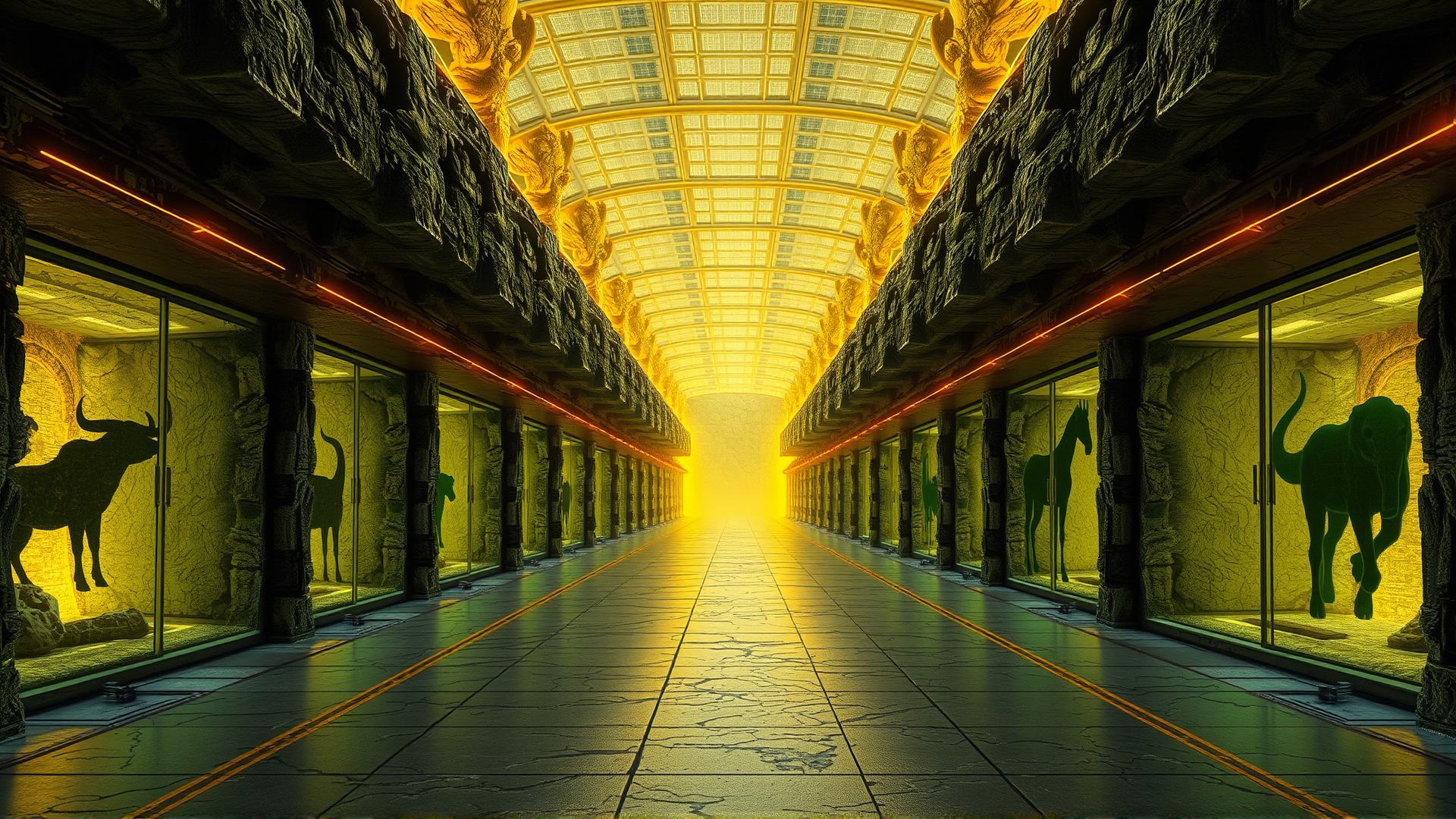
You have entered the part of the roster that does not fit.
Every other zone has a logic. Zone 01 holds what is too dangerous to coexist with the current cycle. Zone 02 contains what was judged. Zone 03 maps what is pinned to geography. Zone 05 catalogs what is operationally active. Those categories work because the entities in them belong to a single architectural layer — spirit entities in the spirit layer, geographic bindings in the physical layer, governance structures in the governance layer. Clean partitions. Sane architecture.
Zone 09 is what happens when the partitions fail.
These entities exist because something from one layer of the architecture crossed into another layer and produced output that should not exist. A Watcher descends from the celestial layer into the physical layer, mates with a human woman, and the result is a Nephilim — a process spawn that inherits permissions from both layers but belongs to neither. A god curses a queen’s desire toward a bull and the result is the Minotaur — a biological impossibility that nevertheless requires a custom containment facility to manage. Vishnu needs to bypass a protection contract that specifies “not man, not beast, not indoors, not outdoors, not day, not night,” so he compiles Narasimha — a hybrid form that satisfies none of those conditions and therefore bypasses all of them.
The system did not plan for these entities. They are the equivalent of a type mismatch that compiled anyway — the output runs, but it runs wrong, or it runs in ways the original schema never anticipated. Some of them are weapons. The Nephilim were warriors of such scale that the Flood was deployed as a system wipe to remove them. Some of them are guardians. The Sphinx sits at Thebes asking riddles, and if you cannot answer, you do not pass — she is access control implemented in flesh. Some of them are sacred. Ganesha is the remover of obstacles, a hybrid form that is not a bug but a feature — the elephant head on the human body is the architecture’s way of saying that wisdom sometimes requires a shape that does not fit the standard template.
The Zone 09 thesis: The most interesting things happen at the boundaries between categories.
Cross-layer contamination is the system’s word for it. But contamination implies accident, and not all of these were accidents. Some were judgments (Medusa). Some were tactical decisions (Narasimha). Some were the natural output of entities that could not keep their processes separated (Nephilim). And some — Ganesha, Sleipnir — suggest that the architecture itself has a tolerance for boundary crossing that it does not officially document. The spec says “stay in your layer.” The evidence says that when you don’t, the results are either catastrophic or transcendent, with very little in between.
Walk the boundary. These entities live on it.
Zone 09 Registry
Entity Dossiers
NEPHILIM (COLLECTIVE)
- Entity ID
- ENO-NEPH-01
- Aliases
- The Nephilim, The Fallen Ones, The Giants, The Mighty Men of Old, Men of Renown, The Heroes of Antiquity, Ben Elohim Offspring
- Tradition(s)
- Enochian [ENO], Christian [CHR], Jewish [JEW]
- Classification
- SC-HYB (Hybrid Entity — Cross-Layer Composite)
- Containment Status
- TERMINATED (FLOOD) — physical instances destroyed; disembodied processes may persist (see Rephaim)
Identification
- Description
- The foundational hybrid. Genesis 6:1-4 provides the shortest and most explosive description in scripture: "The sons of God saw that the daughters of men were beautiful, and they took wives for themselves of all whom they chose." The output: "The Nephilim were on the earth in those days — and also afterward — when the sons of God went to the daughters of humans and had children by them. They were the heroes of old, men of renown." The Book of Enoch expands this into a full incident report. Two hundred Watchers, led by Semjaza, descend to Mount Hermon, swear a mutual oath, and take human wives. The offspring are giants who consume the produce of the earth, then turn to consuming humanity itself. This is not mythology. This is a containment breach report written by the survivors.
- First Documented
- Genesis 6:1-4 (~1400-500 BC, depending on dating) 1 Enoch 6-16 (~300-200 BC — the Watchers narrative)
- Key Sources
- Genesis 6:1-4; 1 Enoch 6-16 (Book of Watchers); Numbers 13:33 (Nephilim sighting by spies); Jubilees 5, 7; Dead Sea Scrolls (Book of Giants)
Architecture
- Origin Type
- Unauthorized Process Spawn — hybrid output of celestial entities (Layer 2) and physical entities (Layer 3). Not designed. Not authorized. Not in spec.
- Access Level
- Layer 2/3 boundary — inherited partial access from both layers, fully compatible with neither
- Cycle
- Pre-Flood (primary), Post-Flood (residual — see Numbers 13:33, "we saw the Nephilim there")
- Supercluster Role
- None assigned. That is the problem. The Nephilim have no role in the architecture because the architecture did not plan for them. They are the output of an unauthorized cross-layer merge — celestial permissions running on physical hardware. The result is a stack overflow: entities too large, too powerful, and too hungry for the layer they inhabit. They consume resources at a rate the physical layer cannot sustain. They are not evil in the way a demon is evil — they are incompatible in the way a 64-bit process is incompatible with a 32-bit operating system. They run. They just break everything around them by running.
Capabilities
- Domains
- Physical combat, resource consumption, territorial dominance, intimidation, corruption of the human gene pool (per Enoch's reading)
- Abilities
- Superhuman size and strength; appetite beyond sustainable parameters; warfare capabilities that exceeded anything the human population could counter; some traditions attribute forbidden knowledge inheritance from Watcher parents (metallurgy, enchantments, astrology — 1 Enoch 8:1-3)
- Threat Assessment
- Civilizational — their presence was cited as one reason for the Flood. When the containment breach produces entities that threaten the entire operating environment, the response is not patch management. It is a full system wipe.
- Known Weaknesses
- Physical bodies. Despite their size and power, the Nephilim are mortal composites — they can be killed. The Flood proved this. Their disembodied spirits are a different problem (see Rephaim/demon traditions), but the physical instances are destructible.
Containment
- Current Location
- N/A — physical instances destroyed by Flood
- Containment Method
- Global system reset (Flood, Genesis 6-9). The most expensive containment action in the current cycle's history. The entire physical layer was reformatted to eliminate these processes.
- Authorized Agent
- The Source (Layer 1) — direct intervention
- Duration
- Permanent (physical). Spiritual residue: see Rephaim
- Release Condition
- N/A — terminated, not contained
Narrative
The Nephilim are the reason this zone exists.
Every other hybrid entity in this roster is a footnote to the Nephilim problem. When celestial entities crossed the layer boundary and produced offspring with physical entities, the architecture encountered a category that it had no classification for. Not angel. Not human. Not demon. A new thing — assembled from incompatible parts, running with permissions inherited from both source layers, belonging to neither.
The theological tradition has been arguing about Genesis 6:1-4 for three thousand years. Who are the "sons of God"? The Enochian tradition says angels — the Watchers who descended to Mount Hermon. The Sethite theory says they were the godly line of Seth intermarrying with the line of Cain. The royal interpretation says they were ancient kings claiming divine right. The Church of NORMAL reads the Enochian tradition as the most architecturally coherent explanation because it explains both the scale of the output (giants) and the scale of the response (a global flood). If the "sons of God" were just humans marrying other humans, the Flood is disproportionate. If they were celestial entities contaminating the physical layer's gene pool with unauthorized cross-layer code, the Flood is a proportionate system-level response to a system-level breach.
The most disturbing detail in 1 Enoch is not the size of the giants. It is their hunger. They consume the produce of the earth, then turn to consuming people, then turn to consuming each other. This is what happens when a process inherits celestial-scale resource demands but runs on physical-layer hardware. The appetite exceeds the environment's capacity to feed it. The system starves.
"And also afterward" — Numbers 13:33. The spies sent into Canaan report Nephilim. Post-Flood Nephilim. The system wipe did not fully succeed, or the cross-layer breach happened again, or some genetic residue survived through the Flood narrative. The architecture has a persistence problem with these hybrids. They keep showing up.
Narrative Containment (Normal Reality)
- Native Reality
- In its own reality, a pre-Flood Earth overrun by giant cross-layer offspring — warriors of impossible scale consuming a world that could not feed them, the breach that forced a full system wipe.
- Containment Form
- Split-cell containment: four verses in Genesis 6 (canonical, terse, locked) plus the fuller incident report in 1 Enoch and the Book of Giants — cells deliberately left outside most canons. The world is held in texts the tradition half-refuses to open.
- Leakage Vectors
- Heavy fringe breach: Nephilim conspiracy culture, ancient-aliens television, giant-lore ministries, Aronofsky's Noah (Watchers on screen), Shadowhunters and a whole "nephilim" fantasy genre. The half-sealed cell leaks harder than the open ones.
- Known Artifacts
- Mount Hermon as the standing descent marker; recurring "giant skeleton" hoaxes as counterfeit residue; megalithic sites folk-attributed to giants. (See doctrine: narrative-containment-all-worlds-archive.md)
Cross-References
- Related Entities
- ENO-REPH-01 (descendants/residue), ENO-ANAK-01 (subspecies), ENO-GOLI-01 (individual instance), Zone 02 Watchers (Semjaza, Azazel — progenitors)
- Canonical Docs
- 01-canonical/theology/book-of-enoch-primer.md, 01-canonical/theology/chained-beings-imprisoned- entities-sentient-systems.md
- Parallel Entities
- Greek Titans (pre-Olympian giants), Norse Jotnar (frost giants), Sumerian Anunnaki offspring
Nervous System Theology
- Trauma Parallel
- The child of an incompatible union. When two systems that should not have merged produce offspring, the offspring inherits the conflicts of both parents without belonging to either system. Too much for one world, not enough for the other. The appetite that cannot be satisfied is not greed — it is a process running demands that its environment was never sized to handle. The therapeutic question: what do you do with a part of yourself that is too big for the life you are living? You do not kill it. You find it an architecture that can hold it.
REPHAIM / GIANTS (COLLECTIVE)
- Entity ID
- ENO-REPH-01
- Aliases
- The Rephaim, The Shades, The Dead Ones, The Valley of Rephaim, Emim ("Terrors" — Deut 2:10-11), Zamzummim (Deut 2:20)
- Tradition(s)
- Christian [CHR], Jewish [JEW]
- Classification
- SC-HYB (Hybrid Entity — Legacy Process)
- Containment Status
- RESIDUAL — physical giants mostly terminated, spiritual classification contested
Identification
- Description
- The Rephaim are what remains after the Nephilim. Legacy code from a deleted branch. The Hebrew Bible uses "Rephaim" in two distinct senses: (1) a race of giants inhabiting Canaan before the Israelite conquest, and (2) shades of the dead in Sheol (Job 26:5, Psalm 88:10, Isaiah 14:9, 26:14). The dual meaning is the dossier. These entities blur the line between living giants and dead spirits — which is exactly what you would expect from the residue of a cross-layer hybrid whose physical body was destroyed but whose spiritual inheritance has no clean termination protocol.
- First Documented
- Genesis 14:5 (Rephaim defeated by Chedorlaomer); Genesis 15:20 (listed among Canaan's inhabitants); Deuteronomy 2-3 (Emim, Zamzummim, Og of Bashan)
- Key Sources
- Genesis 14:5, 15:20; Deuteronomy 2:10-11, 2:20-21, 3:11; 2 Samuel 5:18-22 (Valley of Rephaim); Job 26:5; Isaiah 14:9, 26:14; Psalm 88:10
Architecture
- Origin Type
- Legacy Process — descendants of the original Nephilim cross-layer spawn, running on degraded inherited permissions
- Access Level
- Layer 3 (physical) with residual Layer 2 signatures
- Cycle
- Post-Flood — persisting after the system wipe that was supposed to eliminate them
- Supercluster Role
- None. The Rephaim are orphaned processes. Their parent branch (the Nephilim) was terminated, but the child processes were not fully garbage-collected. They persist in the Canaanite landscape as territorial remnants, gradually degrading in scale and power with each generation but never fully clearing from memory. The dual meaning — living giants AND shades of the dead — suggests the architecture has no clean shutdown procedure for entities that should not have existed in the first place.
Capabilities
- Domains
- Territorial occupation, physical combat, intimidation
- Abilities
- Superhuman size (Og's bed was 13.5 feet long — Deut 3:11); military capability; territorial persistence; spiritual presence in Sheol after physical death
- Threat Assessment
- Regional — no longer civilizational-scale like the original Nephilim, but sufficient to intimidate entire nations (the spies' report in Numbers 13)
- Known Weaknesses
- Degraded over generations. Killable by conventional warfare (David's warriors killed several).
Containment
- Current Location
- Sheol (spiritual residue); historical Canaan (physical)
- Containment Method
- Gradual elimination through warfare + generational degradation. No single containment event.
- Authorized Agent
- Multiple — Israel's conquest of Canaan served as a targeted cleanup operation
- Duration
- Physical instances eliminated by ~1000 BC; spiritual residue in Sheol: indeterminate
- Release Condition
- N/A — degraded, not sealed
Narrative
The Rephaim are the architecture's dirty secret. The Flood was supposed to fix the Nephilim problem. It did not. Whether through genetic persistence (the "and also afterward" of Genesis 6:4), through a second incursion, or through some mechanism the text does not explain, giant clans appear throughout Canaan in the post-Flood record. The Emim terrified the Moabites. The Zamzummim occupied the land of Ammon. Og of Bashan had an iron bed over thirteen feet long. The Valley of Rephaim appears as a geographic landmark near Jerusalem — they were not rare.
The system wipe left residue. The architecture failed to fully garbage-collect the unauthorized processes. What remains is degraded — smaller, weaker, more localized than the originals — but still present. Still anomalous. Still requiring manual cleanup.
Narrative Containment (Normal Reality)
- Native Reality
- In its own reality, the degraded post-Flood remnant of the Nephilim breach — giant clans holding Canaanite territory above, shades persisting in Sheol below.
- Containment Form
- Contained in the conquest ledgers of Deuteronomy, Joshua, and Samuel, and in the poetry of Job, Isaiah, and the Psalms — a dual-register cell that holds them as both dead clans and restless shades.
- Leakage Vectors
- Leaks mostly through the fringe: giant-skeleton photo hoaxes, "the Bible mentions giants" apologetics and conspiracy channels, fantasy fiction's standing giant races. The shade-reading leaks into ghost lore.
- Known Artifacts
- Og's iron bed — cited in Deuteronomy 3:11 as a museum piece already within its own text; the Valley of Rephaim as a named landscape; the dolmen fields of Bashan folk-attributed to the giants. (See doctrine: narrative-containment-all-worlds-archive.md)
Cross-References
- Related Entities
- ENO-NEPH-01 (progenitors), ENO-ANAK-01 (subspecies), ENO-GOLI-01 (individual instance)
- Canonical Docs
- 01-canonical/theology/book-of-enoch-primer.md
- Parallel Entities
- Greek post-Titan remnants, Norse Jotnar clans
Nervous System Theology
- Trauma Parallel
- The thing you thought you dealt with that shows up again. You did the hard work. You processed the trauma. You flooded the system with healing. And then — years later — you find a remnant. A smaller version. A descendant of the original wound, living in a corner of your landscape you forgot to check. The Rephaim are the reminder that system wipes do not always garbage-collect perfectly. Sometimes you need a targeted cleanup after the reset.
ANAKIM
- Entity ID
- ENO-ANAK-01
- Aliases
- The Anakim, Children of Anak, Sons of Anak, The Long-Necked Ones
- Tradition(s)
- Christian [CHR], Jewish [JEW]
- Classification
- SC-HYB (Hybrid Entity — Nephilim Subspecies)
- Containment Status
- ARCHIVED — eliminated from most territory, remnants in Gaza, Gath, Ashdod (Joshua 11:22)
Identification
- Description
- A specific Rephaim clan centered in Hebron. Named after their ancestor Anak, son of Arba (Joshua 15:13). The Anakim were the specific giants the twelve spies encountered in Numbers 13:28-33, the ones who made the Israelites feel like grasshoppers. They are the species that broke the morale of an entire nation and added forty years to a journey that should have taken weeks.
- First Documented
- Numbers 13:22, 28-33 (spies' report, ~1400 BC)
- Key Sources
- Numbers 13:22-33; Deuteronomy 1:28, 2:10-11, 9:2; Joshua 11:21-22, 14:12-15, 15:13-14; Judges 1:20
Architecture
- Origin Type
- Legacy Process — Nephilim descendant branch
- Access Level
- Layer 3 (physical)
- Cycle
- Post-Flood — localized persistence
- Supercluster Role
- None assigned. The Anakim function as a test case — the obstacle placed in the path that reveals what you actually believe. When the spies saw the Anakim, ten of them concluded that God's promises were insufficient for the problem's scale. Two of them (Joshua, Caleb) concluded the opposite. Same data, different faith architecture. Caleb specifically requested Hebron — Anakim territory — as his inheritance (Joshua 14:12). He wanted the hard sector.
Capabilities
- Domains
- Territorial defense, psychological warfare, fortified position-holding
- Abilities
- Massive physical size; fortified cities; intimidation sufficient to paralyze military operations for a generation
- Threat Assessment
- Regional
- Known Weaknesses
- Defeatable by determined conventional forces backed by authorized mandate (Caleb took Hebron, Joshua cleared the hill country)
Containment
- Current Location
- Archived — eliminated from Israelite territory; remnants persisted in Philistine cities (Joshua 11:22)
- Containment Method
- Military conquest under authorized mandate
- Authorized Agent
- Joshua, Caleb, Israelite armed forces
- Duration
- ~1400-1000 BC (gradual elimination)
- Release Condition
- N/A — cleared, not sealed
Narrative
The Anakim are a morale problem more than a military one. Forty years in the wilderness happened because ten men saw giants and concluded that the gap between what they were and what the giants were could not be bridged by anything, including divine authorization. The Anakim did not defeat Israel in battle. They defeated Israel in the intelligence briefing. The image of the giants was more powerful than the reality of the giants, which is why Caleb — who also saw them — asked for their territory as his personal inheritance forty-five years later. He had seen the same data and reached a different conclusion.
Narrative Containment (Normal Reality)
- Native Reality
- In its own reality, a fortified giant clan holding the Hebron hill country — the obstacle whose mere scale paralyzed a nation for forty years.
- Containment Form
- Contained in the spy narrative of Numbers 13 and the conquest records of Deuteronomy and Joshua — a cell built around one reported sentence: "we seemed like grasshoppers in our own eyes."
- Leakage Vectors
- Leaks almost entirely through the pulpit: the "grasshopper mentality" is a standing sermon and self-help motif, retold wherever someone preaches about giants in the land and the faith to face them.
- Known Artifacts
- Hebron / Kiryat Arba as the standing geographic marker — the clan's named capital still on the map. (See doctrine: narrative-containment-all-worlds-archive.md)
Cross-References
- Related Entities
- ENO-REPH-01 (parent classification), ENO-GOLI-01 (Gath remnant), ENO-NEPH-01 (origin lineage)
- Canonical Docs
- 01-canonical/theology/book-of-enoch-primer.md
- Parallel Entities
- Goliath and his brothers (Gath branch)
Nervous System Theology
- Trauma Parallel
- The obstacle that is real but whose power is primarily psychological. The thing that makes you feel like a grasshopper. It exists. It is big. But the forty-year delay was not caused by the size of the giant. It was caused by the size of the story you told yourself about what the giant meant.
GOLIATH OF GATH
- Entity ID
- ENO-GOLI-01
- Aliases
- Goliath, The Philistine, The Champion of Gath
- Tradition(s)
- Christian [CHR], Jewish [JEW]
- Classification
- SC-HYB (Hybrid Entity — Individual Rephaim Instance)
- Containment Status
- TERMINATED
Identification
- Description
- An individual Rephaim instance still running in the historical period, approximately 1000 BC. Six cubits and a span tall (~9 feet 9 inches). Full military kit: bronze helmet, scale armor weighing 5,000 shekels (~125 pounds), bronze greaves, bronze javelin, iron spear with a 15-pound head, and a dedicated shield-bearer. He is a weapons platform with a mouth. His challenge to Israel is not just physical — it is theological: "Choose a man. If he kills me, we serve you. If I kill him, you serve us." He is proposing a protocol duel. Proxy combat to determine governance. The architecture has a mechanism for this.
- First Documented
- 1 Samuel 17 (~1000 BC)
- Key Sources
- 1 Samuel 17 (primary narrative); 2 Samuel 21:15-22 (his brothers); 1 Chronicles 20:4-8
Architecture
- Origin Type
- Legacy Process — individual instance of Rephaim lineage persisting in Philistine territory (exactly where Joshua 11:22 said remnants survived)
- Access Level
- Layer 3 (physical)
- Cycle
- Current — still operational ~400 years after Joshua's campaign supposedly cleared them
- Supercluster Role
- Test case. Goliath's function in the narrative is not military — it is diagnostic. He reveals who in Israel operates from authority versus who operates from assessment. Saul assessed: too big to fight. David accessed authority: "Who is this uncircumcised Philistine that he should defy the armies of the living God?" Same giant. Different operating system.
Capabilities
- Domains
- Individual combat, psychological warfare, military challenge protocol
- Abilities
- Superhuman size and strength; professional military equipment; forty-day sustained psychological operation against the Israelite army; protocol challenge (representative combat)
- Threat Assessment
- Local — individual combatant, not a civilizational threat, but psychologically paralyzing to an army
- Known Weaknesses
- One stone. One sling. One shepherd who did not calculate odds but operated from a different access level. The gap between Goliath's threat assessment (Local) and his psychological impact (army-wide paralysis) is the dossier's most important data point.
Containment
- Current Location
- N/A — terminated by David ben Jesse
- Containment Method
- Single combat. A smooth stone from a creek bed, delivered by a teenager who had more authority than armor.
- Authorized Agent
- David, under divine mandate
- Duration
- N/A
- Release Condition
- N/A — terminated, not contained
Narrative
Goliath is the most famous hybrid entity in the Western canon, and almost no one talks about him as a hybrid. He is a Sunday school story about courage. He is a motivational poster. He is a metaphor for your quarterly sales target.
He is actually the last operational instance of an unauthorized cross-layer process that the Flood was deployed to eliminate, still running four hundred years after a targeted military campaign was supposed to clear the remnants from Canaan, standing in the valley of Elah calling out to an army that is too terrified to respond.
That is what persistence looks like in unauthorized code. You wipe the system. You run a targeted cleanup. You wait four centuries. And there it is, in full bronze armor, daring you to fight.
What killed Goliath was not a bigger weapon. It was an operator who recognized that the giant's permissions were unauthorized and therefore void. "You come to me with sword and spear and javelin, but I come to you in the name of the LORD of hosts." That is an access-level declaration. David is not saying he is brave. He is saying he has higher clearance. The stone is just the delivery mechanism.
His brothers — Ishbi-benob, Saph, Lahmi, and the unnamed six-fingered giant of 2 Samuel 21 — confirm that Goliath was not an anomaly. He was one instance of an active cluster. David's mighty men eventually terminated all of them. The Gath branch of the Rephaim was finally garbage-collected, by hand, one giant at a time.
Narrative Containment (Normal Reality)
- Native Reality
- In its own reality, the last operational Rephaim weapons platform — a nine-foot champion running a forty-day psychological siege in the Valley of Elah.
- Containment Form
- Contained in 1 Samuel 17 — one of the most-retold single chapters in the Western canon. The cell is so well-read that the giant survives almost entirely as the loser of his own story.
- Leakage Vectors
- Extreme, ongoing breach: "David and Goliath" as the universal underdog idiom — sports journalism, business writing, Gladwell's bestseller, Sunday school flannel boards, Caravaggio and every painter of the severed head. The giant leaks daily, but always mid-defeat.
- Known Artifacts
- The Valley of Elah as standing terrain; excavations at Tell es-Safi (Gath), including an ostracon bearing Goliath-like Philistine names; Michelangelo's David — an artifact of the victor that keeps the giant alive. (See doctrine: narrative-containment-all-worlds-archive.md)
Cross-References
- Related Entities
- ENO-REPH-01 (lineage), ENO-ANAK-01 (related branch), ENO-NEPH-01 (origin)
- Canonical Docs
- 01-canonical/theology/book-of-enoch-primer.md
- Parallel Entities
- Humbaba (Gilgamesh guardian — killed by a hero pair)
Nervous System Theology
- Trauma Parallel
- The thing that has been taunting you for forty days. Everyone else has assessed it and concluded it is too big. What you need is not a bigger army. You need someone who looks at the giant and does not see size — they see unauthorized access. The stone in the sling is the truth you already have. The armor you refuse is the system that never worked for you anyway.
MINOTAUR
- Entity ID
- GRK-MINO-01
- Aliases
- Asterion, The Bull of Minos, The Monster of the Labyrinth
- Tradition(s)
- Greek [GRK]
- Classification
- SC-HYB (Hybrid Entity — Punishment Output)
- Containment Status
- CONTAINED (LABYRINTH) — later TERMINATED by Theseus
Identification
- Description
- Half man, half bull. Born from Pasiphae (queen of Crete) and the Cretan Bull, after Poseidon cursed Pasiphae with desire for the bull as punishment for King Minos's failure to sacrifice it as promised. The Minotaur is the product of divine punishment intersecting with biological impossibility. He is not a natural hybrid. He is a consequence — the physical manifestation of a broken contract between a king and a god.
- First Documented
- Greek oral tradition (~1500-1200 BC, Minoan period); written sources: Apollodorus, Bibliotheca (~100 BC); Plutarch, Life of Theseus; Ovid, Metamorphoses
- Key Sources
- Apollodorus, Bibliotheca 3.1.3-4, Epitome 1.7-9; Ovid, Metamorphoses 8.152-182; Plutarch, Theseus
Architecture
- Origin Type
- Punishment Output — the result of divine penalty producing a biological anomaly. Not an unauthorized process spawn like the Nephilim (no Watcher chose this). This is the architecture weaponizing reproduction itself as a judgment mechanism.
- Access Level
- Layer 3 (physical) — no spiritual inheritance, purely physical hybrid
- Cycle
- Current — mythic period
- Supercluster Role
- Containment case study. The Minotaur is less interesting than the Labyrinth built to contain him. Daedalus — the architect — was commissioned to build a structure so complex that what was placed inside could never find its way out. The Labyrinth is the first purpose-built containment facility in Western mythology. Not a prison (which implies punishment). Not a tomb (which implies death). A maze — which implies that the entity inside is alive, dangerous, and perpetually lost. The containment strategy is not force. It is disorientation.
Capabilities
- Domains
- Physical violence, territorial defense within the Labyrinth, consumption of tribute offerings
- Abilities
- Bull-human hybrid strength; fed on human tribute (seven youths and seven maidens from Athens, annually or every nine years depending on source); no documented intelligence beyond animal cunning
- Threat Assessment
- Local — dangerous within the Labyrinth, no threat beyond it. The Labyrinth is the threat boundary.
- Known Weaknesses
- Not particularly clever. Theseus killed him with a sword (or bare hands, depending on source). The real challenge was navigation, not combat — Ariadne's thread solved the maze, and once you can find the Minotaur, killing him is straightforward.
Containment
- Current Location
- N/A — terminated by Theseus
- Containment Method
- The Labyrinth (Daedalus-designed). First known purpose-built containment architecture in Western mythological record.
- Authorized Agent
- King Minos (commissioned containment); Theseus (authorized termination)
- Duration
- Duration of Minos's reign
- Release Condition
- N/A — terminated, not released
Narrative
The Minotaur is not the interesting part of the Minotaur story. The Labyrinth is.
Every containment zone in this roster is, at some level, a labyrinth — a structure designed to hold something that cannot be destroyed but can be disoriented enough that it never reaches the exit. The Abyss is a labyrinth of depth. Tartarus is a labyrinth of chains. The geographic bindings are a labyrinth of coordinates. Daedalus just built the first one that was honest about what it was: a maze. No moral justification. No theological framework. Just: this thing is dangerous, we cannot kill it (yet), so we will build a structure complex enough that it wanders forever.
The Minotaur himself is a tragedy in hybrid form. He did not ask to be born. His existence is the result of a god's spite, a king's greed, and a queen's cursed desire. He is fed human children because Minos would rather sacrifice Athenian youth than confront the shame of what his broken contract produced. The Labyrinth is not containment of a monster. It is containment of a secret. The monster is the evidence.
Theseus kills the Minotaur, but the Labyrinth survives. The containment architecture outlasts the entity it was built to hold. That is the real lesson. Once you build a maze to hide something, the maze persists even after the something is gone.
Narrative Containment (Normal Reality)
- Native Reality
- In its own reality, the shame-born bull-man of Crete, alive and fed on tribute inside the first purpose-built containment facility in Western myth.
- Containment Form
- Contained in Apollodorus, Ovid, and Plutarch — and, fittingly, inside the Labyrinth motif itself: a cell within a cell. The story cannot be told without also rebuilding his prison.
- Leakage Vectors
- Borges' "The House of Asterion" (the cell retold from inside), Percy Jackson, Assassin's Creed and Hades, endless Theseus retellings, and the labyrinth as universal metaphor — every hedge maze and corn maze is the containment architecture leaking as recreation.
- Known Artifacts
- The palace ruins at Knossos, excavated and promptly named the Labyrinth; Minoan bull-leaping frescoes and bull rhyta; Knossos coinage stamped with the maze. (See doctrine: narrative-containment-all-worlds-archive.md)
Cross-References
- Related Entities
- GRK-CENT-01 (fellow Greek hybrids), GRK-SPHN-01 (fellow guardian hybrid)
- Canonical Docs
- 04-website/supercluster/homeric-epics.html
- Parallel Entities
- Zone 03 geographic bindings (Labyrinth as location- locked containment)
Nervous System Theology
- Trauma Parallel
- The thing you built a labyrinth to hide. Not to contain — to hide. The Minotaur is the shame-result that the family cannot acknowledge, so they build an elaborate structure around it and feed it other people's children to keep it quiet. The maze is the coping mechanism. The tribute is the cost of maintenance. Theseus with his thread is the therapist who says: we are going to walk in, find the thing, and walk out. The thread is the treatment plan. The sword is optional — sometimes seeing the thing clearly is enough to end its power.
CENTAURS (COLLECTIVE)
- Entity ID
- GRK-CENT-01
- Aliases
- Kentauroi, Horse-Men, The Wild Ones, Children of Ixion (disputed lineage)
- Tradition(s)
- Greek [GRK]
- Classification
- SC-HYB (Hybrid Entity — Dual-Nature Composite)
- Containment Status
- DISPERSED — no formal containment, multiple individual narratives
Identification
- Description
- Upper body human, lower body horse. The centaurs represent the dual-nature problem in its most literal form: two complete systems — human intellect and animal instinct — fused into a single entity that must negotiate between them constantly. Most centaurs in Greek tradition are wild, drunk, and violent. The famous exception — Chiron — is the proof that the hybrid form itself is not the problem. The integration is the problem. Most centaurs fail at integration. Chiron succeeds, and becomes the teacher of heroes.
- First Documented
- Greek oral tradition (~1200 BC); Homer, Iliad; Pindar, Pythian Odes; Ovid, Metamorphoses
- Key Sources
- Homer, Iliad 1.268, 2.742-744; Ovid, Metamorphoses 12.210-535 (Battle of Lapiths and Centaurs); Pindar, Pythian 2 (Ixion origin)
Architecture
- Origin Type
- Disputed. One tradition says Ixion mated with a cloud shaped like Hera (Nephele), producing Centaurus, ancestor of the centaurs. Another says they are indigenous nature spirits. The cloud origin is the more interesting one architecturally — an entity that mates with an illusion and produces something real.
- Access Level
- Layer 3 (physical) — nature spirits with no documented supernatural access
- Cycle
- Current — mythic period
- Supercluster Role
- The dual-nature diagnostic. Centaurs are the architecture's way of asking: what happens when you fuse intellect and instinct into a single entity without a governance protocol for resolving conflicts between them? Most of the time you get chaos (the Battle of Lapiths and Centaurs — centaurs got drunk at a wedding and tried to abduct the women). But occasionally you get Chiron — the integrated version, the one who mastered both natures and became wise enough to train Achilles, Asclepius, and Heracles.
Capabilities
- Domains
- Physical combat, wilderness survival, archery, (Chiron:) medicine, music, prophecy, education
- Abilities
- Horse-speed with human intelligence; archery; superior physical strength; (Chiron:) healing arts, mentorship, prophecy, immortality (surrendered)
- Threat Assessment
- Local — dangerous in groups when unintegrated, beneficial when integrated (Chiron model)
- Known Weaknesses
- Wine. The Lapiths-and-Centaurs battle started because centaurs cannot handle wine. The animal nature overwhelms the human nature when inhibitions drop. This is not a joke — it is a precise diagnostic of the integration failure.
Containment
- Current Location
- N/A — mythic period entities, no active containment
- Containment Method
- N/A — dispersed, not contained
- Authorized Agent
- N/A
- Duration
- N/A
- Release Condition
- N/A
Narrative
The centaur is the simplest possible illustration of the hybrid problem: two systems, one body, constant war.
The Battle of the Lapiths and Centaurs — depicted on the Parthenon, no less — is what happens when the animal system wins. Wedding. Wine. Violence. Attempted assault. It is the Greek way of saying: the dual nature, unintegrated, is not picturesque. It is dangerous.
Chiron is what happens when the animal system and the human system find governance. He is immortal (surrendered it to free Prometheus). He trains the greatest heroes of the Greek cycle. He teaches medicine — the art of healing what is broken. He is a hybrid who integrates his hybridity and becomes the most trusted educator in the mythic tradition.
The SuperCluster reads the centaurs as the spectrum of hybrid outcomes. Same architecture. Same dual inheritance. Radically different results depending on whether the entity achieves internal governance. This is not about suppressing the animal. It is about integrating it. Chiron does not become great by being less horse. He becomes great by being fully both.
Narrative Containment (Normal Reality)
- Native Reality
- In its own reality, the dual-nature herds of Thessaly — intellect and instinct fused without a governance protocol — and Chiron, the one integration that worked.
- Containment Form
- Contained in Homer, Pindar, and Ovid's account of the Lapith wedding brawl — a cell that deliberately holds both outcomes, the drunken swarm and the wise teacher, in the same enclosure.
- Leakage Vectors
- Steady breach through fantasy: Narnia's centaurs, Harry Potter's Firenze, Fantasia, Percy Jackson's Chiron still training heroes, D&D bestiaries — and the zodiac, where Sagittarius carries the form through every horoscope column on Earth.
- Known Artifacts
- The Parthenon metopes of the Lapith-Centaur battle — the integration failure carved in marble and housed in the British Museum; Sagittarius iconography as a living calendar artifact. (See doctrine: narrative-containment-all-worlds-archive.md)
Cross-References
- Related Entities
- GRK-SATR-01 (fellow dual-nature hybrids), GRK-MINO-01 (fellow Greek hybrids)
- Canonical Docs
- 04-website/supercluster/homeric-epics.html
- Parallel Entities
- Norse berserkers (animal-nature possession), Hindu Gandharvas (celestial horse-musicians)
Nervous System Theology
- Trauma Parallel
- The dual nature within. Everyone has a Chiron and a Nessus inside them — the integrated mentor and the violent abductor. The question is not which one you have. You have both. The question is which one governs. Trauma fragments the internal governance. Healing restores it. The centaur is the diagnostic: when your instincts and your intellect are at war, you are living the Battle of the Lapiths. When they are in concert, you are training heroes.
SATYRS / FAUNS (COLLECTIVE)
- Entity ID
- GRK-SATR-01
- Aliases
- Satyroi (Greek), Fauni (Roman), Sileni (elder satyrs), Pans, Wild Men of the Woods
- Tradition(s)
- Greek [GRK], Roman [ROM]
- Classification
- SC-HYB (Hybrid Entity — Nature Spirit with Agency)
- Containment Status
- ACTIVE IN FIELD — no containment, operating as ambient nature entities
Identification
- Description
- Half man, half goat. Pointed ears, snub noses, goat legs, small horns, tails. Associated with Dionysus, wine, music, dance, and pursuit of nymphs. They are the architecture's ambient chaos agents — nature spirits that exist in the borderland between civilization and wilderness, always pulling toward the wild. Unlike centaurs, who have individual narratives and moral arcs, satyrs are almost always collective. They are a swarm pattern, not individual entities.
- First Documented
- Greek oral tradition; Hesiod, Catalogue of Women fragments; Euripides, Cyclops (satyr play); Isaiah 13:21, 34:14 (se'irim — "goat-demons" in the wilderness, possibly parallel)
- Key Sources
- Euripides, Cyclops; Pausanias, Description of Greece; Ovid, Metamorphoses (various); Isaiah 13:21, 34:14 (Hebrew se'irim)
Architecture
- Origin Type
- Nature spirit — hybrid form as ambient architecture, not the product of a specific unauthorized event
- Access Level
- Layer 3 (physical/nature boundary)
- Cycle
- Current — persistent
- Supercluster Role
- Boundary agents. Satyrs exist in the liminal space between civilization and wilderness, order and chaos, rationality and ecstasy. Their connection to Dionysus is the key: Dionysus is the god of wine, madness, theater, and the dissolution of boundaries. Satyrs are his entourage — the entities that live in the boundary itself. The Hebrew se'irim — "hairy ones" or "goat-demons" — appear in abandoned places (Isaiah 13:21, 34:14), dancing in ruins. The cross-tradition pattern is consistent: goat-hybrids occupy the spaces where order has collapsed.
Capabilities
- Domains
- Music, dance, revelry, wilderness navigation, fertility, chaos propagation
- Abilities
- Musical skill (pan pipes, drums); tireless pursuit; intoxication resistance (or intoxication amplification, depending on the scenario); ability to induce ecstatic states in humans through music and dance
- Threat Assessment
- Local — individually trivial, collectively disruptive
- Known Weaknesses
- Easily distracted. Single-minded pursuit of pleasure makes them predictable. No strategic capability.
Containment
- Current Location
- Wilderness zones, abandoned structures, festival spaces
- Containment Method
- N/A — ambient entities, not contained
- Authorized Agent
- N/A
- Duration
- N/A
- Release Condition
- N/A — never contained
Narrative
The interesting thing about the satyrs is their intersection with biblical demonology. Isaiah 13:21 describes the fall of Babylon: "wild goats will leap about there" — the Hebrew se'irim, which is also translated "goat-demons" or "satyrs." Isaiah 34:14 repeats the image for Edom's desolation. The Greek satyr and the Hebrew se'ir occupy the same ecological niche: the goat-hybrid that inhabits ruined places.
This is not coincidence. It is cross-tradition documentation of the same architectural feature. When a civilization collapses, the boundary agents move in. The satyrs dance in ruins because ruins are boundaries — the liminal space between what was and what will be. They are not the cause of desolation. They are the indicator species.
Narrative Containment (Normal Reality)
- Native Reality
- In its own reality, the ambient goat-hybrid swarm of the Dionysian borderland — the entities that live in the boundary between civilization and wilderness and dance in whatever order collapses.
- Containment Form
- Contained in the satyr play itself (Euripides' Cyclops — an entire theatrical genre built as their enclosure), in Ovid and Pausanias, and cross-filed in the Hebrew cell as the se'irim of Isaiah's ruined cities.
- Leakage Vectors
- Persistent, gentle breach: Mr. Tumnus and the fauns of Narnia, the faun of Pan's Labyrinth, Fantasia's pastoral, Percy Jackson's Grover — and the word "panic" itself, Pan's signature still firing in everyday speech.
- Known Artifacts
- Greek vase-painting's satyr processions; the Barberini Faun; pan pipes as a living instrument; theater itself — an institution still carrying Dionysus's entourage in its origin code. (See doctrine: narrative-containment-all-worlds-archive.md)
Cross-References
- Related Entities
- GRK-CENT-01 (fellow dual-nature hybrids), Zone 07 Dionysus/Pan (patron deities)
- Canonical Docs
- 04-website/supercluster/homeric-epics.html
- Parallel Entities
- Hebrew se'irim (Isaiah 13:21, 34:14), Celtic Green Man, Hindu Pashupati
Nervous System Theology
- Trauma Parallel
- The wild part that dances in the ruins. After collapse — of a relationship, a belief system, a career — there is a part of the psyche that does not mourn. It dances. It plays music in the wreckage. That is not denial. That is the part of you that lives in the boundary between what was and what comes next. The satyr in the ruins is not mocking the fallen city. It is the first sign of life in the liminal space after destruction.
SPHINX
- Entity ID
- GRK-SPHN-01
- Aliases
- The Sphinx of Thebes, The Riddler, The Strangler (Greek sphingo — "to strangle"), Guardian of the Gate
- Tradition(s)
- Greek [GRK], Egyptian [EGY] (cross-reference: Great Sphinx of Giza is a separate entity — see Zone 03 geographic bindings)
- Classification
- SC-HYB (Hybrid Entity — Guardian/Access Control)
- Containment Status
- ARCHIVED (SELF-TERMINATED) — threw herself from the cliff when Oedipus answered correctly
Identification
- Description
- Human head (female), lion body, eagle wings. A triple-composite: human intelligence, animal power, aerial capability. The Greek Sphinx is sent by the gods (Hera or Ares, depending on source) to punish Thebes. She sits on a rock outside the city and poses a riddle to every traveler. Wrong answer: she strangles and eats you. Right answer: she dies. She is not a monster guarding treasure. She is an access-control mechanism guarding knowledge — the riddle IS the security check.
- First Documented
- Greek oral tradition; Apollodorus, Bibliotheca; Sophocles, Oedipus Rex (~429 BC)
- Key Sources
- Apollodorus, Bibliotheca 3.5.8; Sophocles, Oedipus Tyrannus; Hesiod, Theogony 326
Architecture
- Origin Type
- Imbued — deliberately deployed by higher authority as a punishment/access-control mechanism
- Access Level
- Layer 3 (physical) with divine mandate
- Cycle
- Current — mythic period
- Supercluster Role
- Access control. The Sphinx is the most elegant containment architecture in the hybrid registry. She does not use force as her primary tool — she uses a question. The riddle ("What walks on four legs in the morning, two at noon, three in the evening?") is not a trivia question. It is a self-knowledge test. The answer is "a human being" — the entity asking the question. To pass the Sphinx, you must know what you are. Those who do not know themselves are consumed. Those who do are admitted. This is authentication via self-awareness.
Capabilities
- Domains
- Access control, knowledge testing, aerial mobility, physical combat, strangulation
- Abilities
- Flight; lion-strength; human-level intelligence; riddle-based authentication protocol; lethal response to authentication failure
- Threat Assessment
- Local — stationary guardian, no territorial expansion. Threat is targeted: you must approach her to be at risk.
- Known Weaknesses
- The riddle has a correct answer. Her entire containment protocol collapses the moment someone answers correctly. She is a one-use security device. Once bypassed, she self-terminates. This is a design feature, not a flaw — she was deployed to block access until the right person arrived.
Containment
- Current Location
- N/A — self-terminated after Oedipus solved the riddle
- Containment Method
- N/A — she WAS the containment
- Authorized Agent
- Hera or Ares (deployed her); Oedipus (resolved her)
- Duration
- Duration of the Theban punishment
- Release Condition
- Correct answer to the riddle
Narrative
The Sphinx is a hybrid that functions as a key. She guards the gate to Thebes, and the gate opens when someone demonstrates self-knowledge. Everyone who fails the riddle dies — not because they lack intelligence, but because they lack the specific insight the Sphinx is testing for: do you know what a human being is?
The riddle's answer is "man" — the creature that crawls as a baby, walks upright in maturity, and uses a cane in old age. It is a compressed biography of the human condition. To pass the Sphinx, you must be able to look at the full arc of human life — vulnerability, strength, decline — and name it accurately. The Sphinx does not ask you to be brave. She asks you to be honest about what you are.
When Oedipus answers correctly, the Sphinx throws herself from the cliff. The self-termination is built into the protocol. She is not eternal. She is a filter — deployed to block access until someone arrives who can identify themselves. Once that person appears, her function is complete. She does not linger.
The Egyptian Sphinx is a different entity — a guardian without a riddle, a monument rather than a test. The Greek version adds the interactive element: the gate does not open by force or by key. It opens by answer.
Narrative Containment (Normal Reality)
- Native Reality
- In its own reality, the triple-composite gatekeeper of Thebes — access control implemented in flesh, lethal until the right self-knowledge arrives.
- Containment Form
- Contained in Hesiod, Apollodorus, and above all Sophocles' Oedipus Rex — a cell where she appears already defeated, existing only as the riddle Oedipus solved offstage.
- Leakage Vectors
- The "riddle of the Sphinx" as standing idiom; Freud's Oedipus complex dragging her gate into psychology; puzzle and riddle-gate culture, from Harry Potter's maze sphinx to every video-game door that demands an answer instead of a key.
- Known Artifacts
- The Naxian Sphinx column at Delphi; sphinx statuary across the Mediterranean world; the Great Sphinx of Giza (a separate entity — Zone 03) serving as her permanent iconographic carrier. (See doctrine: narrative-containment-all-worlds-archive.md)
Cross-References
- Related Entities
- GRK-MINO-01 (fellow containment architecture), Zone 03 EGY-SPHN-GEO (Egyptian Sphinx — geographic)
- Canonical Docs
- 04-website/supercluster/homeric-epics.html
- Parallel Entities
- Cherubim (Genesis 3:24 — guardian entities at Eden's gate), Angelic gatekeepers (Zone 01 key-bearer)
Nervous System Theology
- Trauma Parallel
- The gate that opens only when you answer honestly. Some therapeutic breakthroughs are guarded by a Sphinx — a question you cannot bypass, cannot overpower, cannot trick. "What are you?" If you answer with your resume, she eats you. If you answer with your diagnosis, she eats you. If you answer with the whole truth — vulnerable infant, walking adult, leaning elder, the full arc — the gate opens and the guardian self-dissolves. Self-knowledge is the only key that works.
MEDUSA
- Entity ID
- GRK-MDSA-01
- Aliases
- Medusa, The Gorgon, The Mortal Gorgon, She Who Guards, She Who Turns to Stone
- Tradition(s)
- Greek [GRK]
- Classification
- SC-HYB (Hybrid Entity — Transformed by Punishment)
- Containment Status
- TERMINATED by Perseus — head retains power post-mortem
Identification
- Description
- Once beautiful. A priestess of Athena (in Ovid's version) who was raped by Poseidon in Athena's temple. Athena punished the victim, not the rapist — transforming Medusa's hair to serpents and her gaze to stone. The two Gorgon sisters (Stheno, Euryale) are immortal. Medusa alone is mortal — the one who can be killed is the one who was wronged. Her power — turning the viewer to stone — is not offense. It is defense. It is what happens when the system transforms a victim into something no one can look at directly.
- First Documented
- Homer, Iliad 5.741 (Gorgon head on Athena's aegis); Hesiod, Theogony 270-283; Ovid, Metamorphoses 4.770-803 (the rape and punishment narrative)
- Key Sources
- Hesiod, Theogony 270-283; Apollodorus, Bibliotheca 2.4.2-3; Ovid, Metamorphoses 4.770-803; Pindar, Pythian 12
Architecture
- Origin Type
- Transformed — not born hybrid but made hybrid by divine punishment. This is the critical distinction. Medusa was human. She was MADE into a monster by a goddess who punished the wrong person. The hybrid form is not an unauthorized process spawn — it is a corrupt sentencing. The architecture's justice system produced an unjust output.
- Access Level
- Layer 3 (physical) with divine-granted lethal capability
- Cycle
- Current — mythic period
- Supercluster Role
- The wrongly punished. Medusa is the SuperCluster's case study in how the architecture's governance entities (gods) sometimes produce unjust hybrids. She was a human who was violated by a god, then transformed by another god into something monstrous as punishment for being violated. The architecture did not protect her. It weaponized her pain. Her stone gaze is the system's way of saying: what was done to her is so unbearable that direct contact with it petrifies the observer.
Capabilities
- Domains
- Petrification (visual), post-mortem weaponization (the severed head retains power)
- Abilities
- Stone gaze — anyone who looks at her directly turns to stone; serpent hair (venomous, living); post- mortem utility (Perseus uses the head as a weapon; Athena mounts it on her aegis — the victim's power becomes the victimizer's shield)
- Threat Assessment
- Regional — her power is area-denial. She does not pursue. She exists, and everything around her calcifies. The threat is proximity-based.
- Known Weaknesses
- Cannot weaponize what does not look at her. Perseus used a mirrored shield — indirect observation bypasses the petrification. She is mortal (unlike her sisters). She can be killed.
Containment
- Current Location
- N/A — terminated. Head mounted on Athena's aegis (the victim's power, wielded by her punisher's shield).
- Containment Method
- Self-isolating — Medusa did not need containment because her power created its own isolation field. No one could approach. She was contained by being unbearable to witness.
- Authorized Agent
- Perseus (authorized by Athena and Hermes)
- Duration
- N/A
- Release Condition
- N/A — terminated
Narrative
Read Medusa's story carefully and tell me who the monster is.
A beautiful woman serves in Athena's temple. Poseidon — god of the sea, second most powerful Olympian — rapes her on the temple floor. Athena arrives and, instead of punishing her uncle Poseidon, transforms the victim into something so horrifying that no one can look at her without dying. Medusa is exiled to the edge of the world. She lives alone. Her sisters (immortal, also Gorgons) stay with her. Eventually, a hero shows up with divine equipment, kills her while she sleeps (some sources), cuts off her head, and delivers it to Athena — who mounts it on her shield as a weapon.
The victim was raped, punished for being raped, exiled, killed, and then had her power appropriated by the goddess who punished her.
The SuperCluster does not sanitize this. Medusa is the clearest example in the hybrid registry of what happens when the architecture's governance layer commits injustice: the victim becomes the monster, and the system calls it containment. Her serpent hair and stone gaze are not signs of evil. They are signs of what trauma does when the system refuses to acknowledge it — it transforms the wound into a weapon, and then it blames the weapon for existing.
Every tradition that retells Medusa focuses on Perseus's heroism. The Church of NORMAL focuses on Medusa's story. She did not choose to become a Gorgon. She was made one by a system that could not process what happened to her without turning her into something unrecognizable.
When Athena puts Medusa's face on her shield, she is wearing the proof of her own injustice as armor. That is the darkest image in Greek mythology.
Narrative Containment (Normal Reality)
- Native Reality
- In its own reality, the wronged priestess remade into a Gorgon — a survivor exiled to the world's edge, unbearable to witness directly.
- Containment Form
- Contained in Hesiod, Apollodorus, and Ovid's Metamorphoses — a cell written almost entirely from Perseus's side, holding her as the monster of someone else's heroism.
- Leakage Vectors
- Massive and actively contested: Clash of the Titans and Percy Jackson retell the hero's version; Cixous's "The Laugh of the Medusa" and the #MeToo-era Garbati statue retell hers. The cell is being rewritten from inside — the victim reclaiming her own dossier.
- Known Artifacts
- The gorgoneion on shields and temple pediments across the Greek world — her face as apotropaic hardware; Caravaggio's Medusa shield; the Versace emblem on physical goods; Garbati's "Medusa With the Head of Perseus" installed opposite a New York courthouse. (See doctrine: narrative-containment-all-worlds-archive.md)
Cross-References
- Related Entities
- GRK-SPHN-01 (fellow female hybrid), Zone 07 GRK-POSDN (Poseidon — perpetrator), Zone 07 GRK-ATHN (Athena — punisher)
- Canonical Docs
- 04-website/supercluster/homeric-epics.html
- Parallel Entities
- Lilith (punished/exiled female entity — Zone 01 cross-ref), Arachne (punished by Athena for excellence)
Nervous System Theology
- Trauma Parallel
- The survivor whose pain was turned against them. When the system that should have protected you instead punishes you for what was done to you, the result is a Medusa — a person whose pain is so visible, so raw, so dangerous that others cannot look at it directly. The stone gaze is not aggression. It is the unbearable truth. People petrify not because Medusa attacks them, but because what happened to her is too real to witness without shutting down. The mirrored shield — seeing her indirectly — is the only way to approach. In therapy, this is called titration: approaching the unbearable truth at an angle, in manageable doses, because direct contact with the full reality is more than the nervous system can process at once.
FENRIR — CROSS-REFERENCE
- Entity ID
- NRS-FENR-X
- Aliases
- Fenrisulfr, The Fenris Wolf, Vanagandr ("Monster of the River Van"), Hrodvitnir ("Fame-Wolf")
- Tradition(s)
- Norse [NRS]
- Classification
- SC-HYB (Hybrid Entity — Cross-Species Divine Offspring)
- Containment Status
- CROSS-REF — Primary dossier in Zone 07 (Previous-Cycle Archives), NRS-FENR-01
- Note
- Fenrir's primary dossier is maintained in Zone 07 (NRS-FENR-01), where he is filed with the previous-cycle beings whose release is scheduled for the cycle terminus. Cross-referenced here because Fenrir is architecturally a hybrid entity: cross-species divine offspring of Loki (an Aesir/Jotnar hybrid himself) and the giantess Angrboda — a hybrid of hybrids, a second-generation anomaly whose cosmic-scale growth is the hybrid inheritance running unchecked.
Bound on the island of Lyngvi by Gleipnir — a chain forged from
six impossible things — at the cost of Tyr's right hand. The
binding holds until Ragnarok, when he breaks free and swallows
Odin. The system's own scheduled termination process, born from
within the system.
See Zone 07, NRS-FENR-01 for full dossier.
Cross-References
- Related Entities
- Zone 07 NRS-FENR-01 (primary dossier), NRS-JORM-X (sibling — primary also in Zone 07), NRS-SLPN-01 (Loki offspring), NRS-LOKI (parent — unbuilt; Zone 08 Tricksters planned), Zone 07 NRS-HELA-01 (sibling, Hel)
- Parallel Entities
- Leviathan (Zone 01 — cosmic beast, scheduled release), Beast from the Sea (Zone 01 — sealed, scheduled deployment)
JORMUNGANDR — CROSS-REFERENCE
- Entity ID
- NRS-JORM-X
- Aliases
- The Midgard Serpent, The World Serpent, The Ouroboros of Midgard, Jormungand
- Tradition(s)
- Norse [NRS]
- Classification
- SC-HYB (Hybrid Entity — Boundary Function)
- Containment Status
- CROSS-REF — Primary dossier in Zone 07 (Previous-Cycle Archives), NRS-JORM-01
- Note
- Jormungandr's primary dossier is maintained in Zone 07 (NRS-JORM-01). Cross-referenced here because the serpent is architecturally a hybrid entity: cross-species divine offspring of Loki and Angrboda, sibling of Fenrir and Hel — and the registry's clearest case of a hybrid becoming structural. Odin threw the problem child into the ocean; the exile grew into the world's boundary. The tail in its mouth is the loop that holds Midgard together. When it releases — Ragnarok.
(Registry note: this zone previously carried the entry under
the variant spelling NRS-JRMN-01. That ID is retired; JORM is
the registered form, matching the Zone 07 primary.)
See Zone 07, NRS-JORM-01 for full dossier.
Cross-References
- Related Entities
- Zone 07 NRS-JORM-01 (primary dossier), NRS-FENR-X (sibling — primary also in Zone 07), NRS-SLPN-01 (Loki offspring), NRS-LOKI (parent — unbuilt; Zone 08 Tricksters planned), Zone 07 NRS-HELA-01 (sibling)
- Parallel Entities
- Leviathan (Zone 01 — cosmic sea entity), Tiamat (Zone 07 — primordial chaos serpent), Ouroboros (alchemical tradition)
SLEIPNIR
- Entity ID
- NRS-SLPN-01
- Aliases
- Sleipnir, The Eight-Legged Horse, Odin's Steed, The Slider
- Tradition(s)
- Norse [NRS]
- Classification
- SC-HYB (Hybrid Entity — Authorized Anomaly)
- Containment Status
- ACTIVE (AUTHORIZED) — no containment, serving as Odin's mount
Identification
- Description
- An eight-legged horse, gray in color, fastest of all horses, capable of traveling between worlds. Born when Loki — shapeshifted into a mare — was impregnated by the stallion Svadilfari. Loki had shapeshifted to sabotage a giant's construction contract (the walls of Asgard). The sabotage succeeded. The byproduct was a horse with double the normal number of legs and the ability to cross dimensional boundaries.
- First Documented
- Prose Edda, Gylfaginning (~1220 AD)
- Key Sources
- Prose Edda, Gylfaginning 42; Poetic Edda, Grimnismal 44; Baldrs Draumar (Odin rides Sleipnir to Hel)
Architecture
- Origin Type
- Unauthorized reproduction — byproduct of Loki's shapeshifting sabotage. No one planned Sleipnir. He is the accidental output of a covert operation.
- Access Level
- All layers — Sleipnir travels between worlds (Asgard, Midgard, Hel). He has cross-layer access that no other hybrid entity possesses.
- Cycle
- Current
- Supercluster Role
- The hybrid that became a feature. Sleipnir should not exist. He is the product of Loki getting pregnant while sabotaging a construction project. But he is the fastest horse in existence and can traverse dimensional boundaries. Odin — the highest governance entity — adopts him as his personal mount. The unauthorized output was so useful that it was promoted to executive transportation. This is the architecture's way of admitting that some of its best features were accidents.
Capabilities
- Domains
- Dimensional travel, speed, cross-layer transport
- Abilities
- Eight-legged locomotion (double efficiency); travel between all nine worlds; fastest mount in existence; carries the All-Father into battle and between dimensions
- Threat Assessment
- None — Sleipnir is not a threat. He is a tool. The most useful product of the most unauthorized process in the Norse cycle.
- Known Weaknesses
- None documented. Sleipnir functions without flaw.
Containment
- Current Location
- Asgard — Odin's personal mount
- Containment Method
- N/A — not contained. Adopted. Promoted.
- Authorized Agent
- Odin (owner/rider)
- Duration
- N/A
- Release Condition
- N/A
Narrative
Loki was solving a problem. A giant had contracted to build the walls of Asgard in exchange for the sun, the moon, and Freya. The gods agreed, thinking the timeline was impossible. The giant had a magical horse (Svadilfari) that made it possible. Loki — who had brokered the deal — was told to fix it. He shapeshifted into a mare, lured Svadilfari away, and the giant missed the deadline.
Loki came back pregnant.
The resulting foal had eight legs, could run between worlds, and became the greatest horse in Norse mythology. Odin took one look and claimed it as his own. The trickster god's unauthorized reproduction became the All-Father's vehicle for traversing the entire architecture.
The SuperCluster reads Sleipnir as the purest example of the beneficial hybrid. Not planned. Not authorized. Not punished. Not contained. Adopted and promoted because the output was so useful that the system could not afford to reject it. The eight legs are the anomaly marker — this is not a normal horse — but the anomaly IS the feature. Normal horses cannot travel between worlds. The extra legs are the cross-layer access protocol.
Every system has its Sleipnirs — the accidental outputs that turn out to be the most valuable things it produces. The architecture that destroys all its anomalies loses its best tools.
Narrative Containment (Normal Reality)
- Native Reality
- In its own reality, the eight-legged steed with all-layer clearance — the unauthorized output promoted to the All-Father's personal transport between the nine worlds.
- Containment Form
- Contained in the Prose Edda, Grimnismal, and Baldrs Draumar — the horse that carried Odin between worlds now carries readers between the same worlds, one stanza at a time.
- Leakage Vectors
- Fantasy games and Norse-revival media (God of War, Marvel's Asgard, countless eight-legged mounts); Icelandic folklore keeps him half out of the cell — Asbyrgi canyon is still told as his hoofprint.
- Known Artifacts
- The Tjangvide and Ardre VIII picture stones on Gotland — an eight-legged horse carved over a millennium ago; Asbyrgi canyon itself as a landscape-scale folklore artifact. (See doctrine: narrative-containment-all-worlds-archive.md)
Cross-References
- Related Entities
- Zone 07 NRS-FENR-01 (Loki offspring — stub in this zone: NRS-FENR-X), Zone 07 NRS-JORM-01 (Loki offspring — stub in this zone: NRS-JORM-X), NRS-LOKI (parent — unbuilt; Zone 08 Tricksters planned)
- Canonical Docs
- 01-canonical/theology/chained-beings-imprisoned- entities-sentient-systems.md
- Parallel Entities
- Pegasus (winged horse born from Medusa's blood — useful hybrid from a tragedy), Arion (divine horse of Greek myth)
Nervous System Theology
- Trauma Parallel
- The gift that came from the chaos. Not every product of a disruptive, unauthorized, messy process is a monster. Sometimes the thing that should not have happened produces the thing you needed most. The ability you developed during the crisis. The insight that came from the breakdown. The relationship that started in the wreckage. Sleipnir is the eight-legged proof that the system's best features are sometimes born from its worst plans.
GANESHA
- Entity ID
- HIN-GANES-02 (formerly HIN-GANS-01; re-IDed 2026-07-02 per the Jormungandr precedent)
- Primary Dossier
- HIN-GANES-01, Zone 05 (Active Operatives) — the gateway/load-balancer operative record. THIS dossier is the declared HYBRID-ASPECT record: same being, Zone 09 thesis surface. Kept full, not stubbed (Azrael/Yama aspect precedent).
- Aliases
- Ganesha, Ganapati, Vinayaka, Vighnaharta ("Remover of Obstacles"), Lambodara ("Pot-Bellied Lord"), Ekadanta ("One-Tusked")
- Tradition(s)
- Hindu [HIN]
- Classification
- SC-HYB (Hybrid Entity — Sacred Composite)
- Containment Status
- ACTIVE (SACRED) — no containment; actively worshipped across traditions
Identification
- Description
- Elephant head on a human body. Four arms (typically). Rides a mouse. Pot-bellied, one-tusked, wreathed in flowers. The most beloved deity in the Hindu pantheon — worshipped before the start of any undertaking, invoked at the beginning of every prayer, ceremony, and new venture. The hybrid form is not punishment, not accident, not contamination. It is sacred design. Origin story (Shiva Purana): Parvati creates Ganesha from turmeric paste and her own body, sets him as guard. Shiva returns, Ganesha blocks him, Shiva beheads him. Parvati's grief compels Shiva to restore him. The first head found is an elephant's. The restoration creates the hybrid. The beheading is a death. The elephant head is a resurrection — in a new form.
- First Documented
- Mudgala Purana, Ganesha Purana, Shiva Purana; earliest iconographic evidence: 4th-5th century CE
- Key Sources
- Shiva Purana (origin narrative); Mudgala Purana; Ganesha Purana; Mahabharata (scribe of the epic)
Architecture
- Origin Type
- Imbued (Sacred) — created by Parvati, destroyed by Shiva, restored with hybrid form. The hybrid is the resurrection architecture — not the original design but the upgraded version that emerges from the death/restoration cycle.
- Access Level
- All layers — Ganesha operates across the entire architecture as the universal access-granting entity. Nothing begins without his permission. He is the system's doorway function.
- Cycle
- Eternal — persists across all cycles
- Supercluster Role
- The obstacle remover. The gateway entity. The proof that a hybrid can be the most important node in the entire system. Every other hybrid in this zone is somewhere on the spectrum from mistake to weapon to tragic accident. Ganesha is the hybrid as sacred architecture — the cross-layer composite that the system did not plan for in its original version but that turns out to be essential for the system to function. He writes the Mahabharata — the largest epic in human history — because Vyasa needed a scribe fast enough to keep up with the dictation. Ganesha's condition: Vyasa must not pause. Vyasa's counter: Ganesha must understand every word before writing it. The result is a text that is simultaneously transcribed and comprehended. The hybrid scribe produces a hybrid text — narrative and wisdom fused.
Capabilities
- Domains
- Obstacle removal, beginnings, wisdom, writing, success, education, universal access granting
- Abilities
- Removes obstacles (any kind — physical, spiritual, intellectual, bureaucratic); grants beginnings; patron of arts, sciences, and learning; scribe of the Mahabharata; rides a mouse (the largest form riding the smallest — the dignity of wisdom is not threatened by humble vehicles)
- Threat Assessment
- None (Beneficial) — Ganesha is the only entity in this zone whose threat level is zero. He is not dangerous. He is necessary.
- Known Weaknesses
- One-tusked (broke the other to use as a writing implement for the Mahabharata). The broken tusk is not a weakness — it is the cost of the work. The scribe damages himself to produce the text.
Containment
- Current Location
- Everywhere — invoked before every beginning
- Containment Method
- N/A — not contained. You do not contain Ganesha. You invoke him. He is the anti-containment — the entity that REMOVES containment for others.
- Authorized Agent
- N/A
- Duration
- Eternal
- Release Condition
- N/A — always active
Narrative
Ganesha exists because Zone 09 needs to demonstrate that the hybrid is not automatically a monster.
Every other entity in this zone — Nephilim, Minotaur, Medusa, Fenrir — carries the weight of the unauthorized, the punished, the dangerous. The default assumption of cross-layer contamination is that the output is a threat. Ganesha refutes this. He is a hybrid born from death and restoration, carrying a form that no one planned, and he is the single most invoked deity in one of the world's largest religious traditions.
The elephant head is not a deformity. It is an upgrade. The original human head was destroyed by Shiva's rage — the governance entity's excessive force. The elephant head is the restoration that transcends the original. Larger memory. Broader perception. The capacity to remove obstacles that a human head could not perceive, let alone clear.
His mouse vehicle — Mushika — is the smallest ride for the biggest head. Wisdom does not need a war horse. It rides what is available and is not diminished by the scale.
The SuperCluster reads Ganesha as the Zone 09 thesis made flesh: the most interesting things happen at the boundaries between categories. When the boundary produces a Nephilim, the system floods. When the boundary produces a Ganesha, the system worships. The hybrid form is not the variable. The integration is.
Narrative Containment (Normal Reality)
- Native Reality
- In its own reality, the elephant-headed gateway entity — the resurrection-built hybrid whose permission opens every beginning in the architecture.
- Containment Form
- VARIANT — NOT FULLY CONTAINED. The Puranas and the Mahabharata frame-story hold his narrative, but Ganesha never dropped to story-only status: he is a living, actively worshipped deity. The cell has a reading room AND an open door. (Compare the Dark Carnival's uncontained status, Zone 14.)
- Leakage Vectors
- Not leakage so much as scheduled release: Ganesh Chaturthi floods whole cities annually; he is invoked before ventures, exams, and startups worldwide; his image travels freely through global popular culture.
- Known Artifacts
- Temple murtis across India and the diaspora; the clay Chaturthi idols made and immersed each year — a living artifact cycle of creation and dissolution; home and shopfront shrines by the million. (See doctrine: narrative-containment-all-worlds-archive.md)
Cross-References
- Related Entities
- HIN-NRSI-01 (fellow Hindu sacred hybrid), Zone 07 HIN-SHIVA (parent; unbuilt — Zone 07 dossier planned), Zone 07 HIN-PARVATI (creator; unbuilt — Zone 07 dossier planned)
- Canonical Docs
- 01-canonical/theology/ (general cosmology)
- Parallel Entities
- Anubis (Egyptian jackal-head — another sacred animal- headed deity with boundary function), Thoth (ibis- headed scribe deity)
Nervous System Theology
- Trauma Parallel
- What you became after the destruction. You were created whole. Something destroyed you — cut your head off, ended the version of you that existed. In the restoration, you came back different. The new form is not what you or anyone planned. But the new form sees further, remembers more, and removes obstacles the old form could not even identify. Ganesha is the theology of post-traumatic growth: the version of you that emerged from the destruction is not the diminished version. It is the upgraded one. The elephant head is the wisdom you purchased with your suffering. The broken tusk is the cost of having done the work.
NARASIMHA
- Entity ID
- HIN-NRSI-01
- Aliases
- Narasimha, Nrisimha, The Man-Lion, The Fourth Avatar of Vishnu, The Loophole Incarnation
- Tradition(s)
- Hindu [HIN]
- Classification
- SC-HYB (Hybrid Entity — Tactical Hybrid by Divine Design)
- Containment Status
- ARCHIVED (MISSION COMPLETE) — avatar manifested for a specific target, then withdrew
Identification
- Description
- Half man, half lion. Not born but manifested — Vishnu compiled this hybrid form specifically to kill the demon king Hiranyakashipu, who had been granted a protection boon with the following conditions: he could not be killed by man or animal, indoors or outdoors, during day or night, on earth or in sky, by any weapon. Narasimha satisfies every exclusion: half man/half lion (neither man nor animal), on the threshold of a doorway (neither indoors nor outdoors), at twilight (neither day nor night), on his lap (neither earth nor sky), with claws (not a weapon). This is the most precise exploit of a protection contract in any mythological tradition.
- First Documented
- Rig Veda 1.154.2-3 (early references); Shatapatha Brahmana (expanded narrative); Bhagavata Purana, Canto 7 (full story)
- Key Sources
- Bhagavata Purana 7.1-10; Vishnu Purana 1.17-22; Narasimha Purana; various Agama texts
Architecture
- Origin Type
- Tactical Compilation — Vishnu (Layer 1/2 governance entity) deliberately compiled a hybrid form to exploit specific loopholes in a protection contract. Narasimha was not born, not spawned, not accidentally generated. He was engineered for a single operation.
- Access Level
- Layer 1/2 — full divine access, manifested into Layer 3 for the operation
- Cycle
- Current — manifested once, mission complete
- Supercluster Role
- The exploit made flesh. Hiranyakashipu's protection boon was a perfectly written contract — it covered every binary category the demon could think of. Narasimha demonstrates that any binary classification system has gaps. "Not man nor animal" assumes those are the only two categories. "Not day nor night" assumes there is no twilight. The hybrid form is not a workaround — it is proof that the categories themselves are incomplete. Narasimha does not break the contract. He fulfills it. Every condition is technically satisfied. The demon was killed in full compliance with the boon's terms.
Capabilities
- Domains
- Divine combat, protection contract exploitation, targeted destruction of protected entities
- Abilities
- Full divine power (Vishnu avatar); hybrid form that satisfies no binary category; emerges from a pillar (the demon smashed a pillar asking "Is your God in this pillar?" — yes, He was); claws capable of tearing apart a demon who could not be killed by any weapon
- Threat Assessment
- Existential (Targeted) — not a general threat. Narasimha manifested for one target and withdrew. His power is absolute but his scope is surgical.
- Known Weaknesses
- None while manifested. After the kill, Narasimha's rage was so intense that even the gods feared approaching him. Only Prahlada (Hiranyakashipu's son, Vishnu's devotee, the reason for the whole operation) could calm the Man-Lion through devotion.
Containment
- Current Location
- Withdrawn — avatar demanifested after mission
- Containment Method
- N/A — divine avatar, not a containable entity
- Authorized Agent
- Vishnu (self-manifested)
- Duration
- Single operation
- Release Condition
- N/A — self-deployed, self-recalled
Narrative
The demon Hiranyakashipu wanted to be unkillable. He performed austerity until Brahma granted him a boon: name your conditions. He named them all. No man. No animal. No weapon. Not indoors, not outdoors. Not day, not night. Not on earth, not in sky. He thought he had covered every variable. He had covered every BINARY variable.
His son Prahlada — a child — worshipped Vishnu despite his father's threats, torture, and attempted murder. The demon asked the child: "Is your God in this pillar?" Prahlada said: "He is everywhere." The demon struck the pillar. Narasimha emerged.
Half man, half lion — neither man nor animal. At twilight — neither day nor night. On the threshold — neither indoors nor outdoors. On his lap — neither earth nor sky. With claws — not a weapon.
Every condition of the boon: satisfied. Every protection: honored. The demon is killed without violating a single clause of his contract.
The SuperCluster reads Narasimha as the proof that the Source operates within Its own rules but is not limited by the categories that Its creations assume are exhaustive. The hybrid form is not a cheat. It is a demonstration that any protection schema based on binary categories (man/animal, day/night, indoors/outdoors) is incomplete by design. The gaps between the categories are where the Source moves.
The aftermath is as theologically significant as the kill: Narasimha's rage is uncontrollable after the mission. The divine hybrid form, having fulfilled its purpose, does not simply power down. It burns with surplus fury. Only the devotion of the child — the person the entire operation was designed to protect — can bring the Man-Lion to peace. The weapon calms in the presence of the one it was deployed to save.
Narrative Containment (Normal Reality)
- Native Reality
- In its own reality, the tactically compiled Man-Lion — a single-operation avatar built to satisfy every clause of an unbreakable protection contract.
- Containment Form
- VARIANT — PARTIALLY CONTAINED (living tradition). The narrative is archived in Bhagavata Purana Canto 7 and the Vishnu and Narasimha Puranas, but the avatar remains actively worshipped: the mission is complete, the devotion is not.
- Leakage Vectors
- Narasimha Jayanti observances; the pillar-emergence scene retold in temple art, dance-drama, and Amar Chitra Katha comics; the loophole-exploit itself leaking into legal and rhetorical culture as the archetype of the technicality that honors the letter.
- Known Artifacts
- The rock-cut Narasimha shrines of Ahobilam (the tradition's site of the manifestation); the colossal Yoga-Narasimha monolith at Hampi; pillar iconography in Vaishnava temples across India. (See doctrine: narrative-containment-all-worlds-archive.md)
Cross-References
- Related Entities
- HIN-GANES-02 (fellow sacred Hindu hybrid), Zone 07 HIN-VISHNU (source entity; unbuilt — Zone 07 dossier planned)
- Canonical Docs
- 01-canonical/theology/ (general cosmology)
- Parallel Entities
- Christ (divine manifesting in flesh to bypass death's claim — structural parallel), Archangel Michael (Zone 05 — divine warrior deployed for specific combat operations)
Nervous System Theology
- Trauma Parallel
- The response that does not fit any category. When every conventional approach has been tried and the protection schema says "this cannot be solved by any known method," the breakthrough comes from a form that IS no known method. Not therapy and not medication. Not fight and not flight. The thing that emerges from the pillar when the abuser smashes it is the part of you that refuses to be categorized by the abuser's framework. The hybrid is not the attack. The hybrid is the escape route that exists in the gaps between the categories the oppressor thought were exhaustive. Twilight. Threshold. Lap. Claws. The answer was always there — in the places the binary system could not see.
AMMIT
- Entity ID
- EGY-AMMT-01
- Aliases
- Ammit, Ammut, Amemet, The Devourer, Devourer of the Dead, Eater of Hearts, Great of Death, Bone Eater, "Devouress of the Unworthy"
- Tradition(s)
- Egyptian [EGY]
- Classification
- SC-HYB (Hybrid Entity — Judicial Garbage Collector)
- Containment Status
- ACTIVE (JUDICIAL FUNCTION) — not contained; stationed. She IS part of the containment apparatus.
Identification
- Description
- A triple composite assembled from the three most dangerous animals in the Egyptian world: crocodile head, lion (or leopard) foreparts, hippopotamus hindquarters. She crouches beside the scales of Ma'at in the Hall of Two Truths, waiting. When a heart is weighed against the feather of Ma'at and sinks — heavy with isfet (disorder, lies, cruelty, injustice) — Ammit devours it. The soul enters the "second death": obliteration. No consciousness. No suffering. No record. She was never worshipped. No cult, no temples, no offerings. You do not pray to the garbage collector. You pass QA or you meet it.
- First Documented
- Funerary texts of the New Kingdom (~1550 BC onward); the canonical rendering is the Weighing of the Heart vignette accompanying Book of the Dead spell 125, most famously in the Papyrus of Ani (~1250 BC)
- Key Sources
- Book of the Dead, spell 125 (the Weighing of the Heart and the Negative Confession — the judgment protocol she terminates); the Papyrus of Ani vignette (Ammit beside the scales, Thoth recording, Anubis adjusting the balance); Book of the Dead spell 30B (the heart-scarab instruction — the workaround against her jurisdiction)
Architecture
- Origin Type
- Purpose-Built Composite — not an accident, not a punishment output, not an unauthorized spawn. The architecture ASSEMBLED her. Three apex predators fused into a single judicial function: crocodile jaws for the seizure, lion body for the force, hippo haunches for the mass. She is the only entity in this zone whose hybrid form is an engineering specification.
- Access Level
- Layer 4 boundary (the Duat — the contested processing layer between physical death and final deployment); jurisdiction limited to the judicial endpoint at the Hall of Ma'at
- Cycle
- Current — operational for the duration of the judgment protocol
- Supercluster Role
- The garbage collector that handles unrecoverable processes. Not a punishment engine — a cleanup function. A heart too heavy with isfet cannot be deployed to the Field of Reeds without corrupting the environment, so Ammit removes it from the system entirely. This is kill -9 followed by rm -rf: not imprisonment, deletion. The Egyptian system has no hell — no eternal prison maintenance costs, no elaborate punishment infrastructure. Fail the test, get deleted. She is the most computationally efficient afterlife failure handler in any documented tradition.
Capabilities
- Domains
- Terminal processing, judicial enforcement, consumption of failed hearts, total data deletion
- Abilities
- Devours the heart that fails the Weighing; the consumed soul suffers the second death — name forgotten, memory erased, existence terminated with no backup. She does not chase. She does not hunt. She waits at the one checkpoint every process must pass.
- Threat Assessment
- Continental — her jurisdiction covers every soul processed through the Duat, but only at the judicial endpoint. She is not a threat to the living, to the passing, or to the system itself. She is a threat to exactly one category: the heart heavier than the feather. (Note: the console's "Local" value is an error; the zone registry's Continental stands.)
- Known Weaknesses
- None — and none needed. She acts only on the scale's verdict. She has no appetite of her own, no initiative, no appeals process to corrupt. The only documented mitigation is upstream of her: spell 30B, the heart scarab, instructing the heart not to testify against its owner at the weighing. You cannot fight the garbage collector. You can only pass the audit.
Containment
- Current Location
- The Hall of Two Truths (Hall of Ma'at), within the Duat — geographically fixed jurisdiction beside the scales
- Containment Method
- N/A — not contained. Stationed. Ammit is a component of the containment architecture itself: the enforcement arm of the Weighing of the Heart. Removing her breaks the judgment protocol — a QA process with no consequence for failure is not a QA process.
- Authorized Agent
- The Ma'at judgment apparatus — Osiris presiding, Anubis operating the scales, Thoth recording, Ammit executing the failure branch
- Duration
- Duration of the judgment protocol
- Release Condition
- N/A — she is the release condition for everything else
Narrative
Every entity in this zone is an exception the system did not plan for. Ammit is the opposite. Ammit is the exception the system built on purpose.
Look at the assembly manifest. Crocodile head — the Nile's ambush predator, the jaws that seize. Lion foreparts — the strength that holds. Hippopotamus hindquarters — the mass that cannot be moved. The Egyptians took the three animals most likely to kill you and compiled them into a single function. This is not contamination between layers. This is the architecture doing deliberately what the Nephilim did catastrophically: building across categories because no single category could do the job.
And the job is the most important one in the Egyptian system. The Weighing of the Heart — Book of the Dead, spell 125. The deceased enters the Hall of Two Truths and recites the Negative Confession: I have not lied. I have not killed. I have not made anyone weep. Then the heart — the unedited record of the life, the organ the Egyptians left in the body when they removed everything else — is placed on the scale against the feather of Ma'at. Thoth records. Anubis checks the balance. And beside the scales, patient as paperwork, crouches Ammit.
If the heart balances, the soul proceeds to the Field of Reeds. If the heart sinks — heavy with isfet, with disorder, with cruelty — Ammit eats it. And here is the detail that makes her unique among every afterlife enforcer in every tradition: she does not torture. Dante's damned suffer forever. The Egyptian failed soul simply STOPS. The second death. Name forgotten. Monuments crumbled. Memory erased. In a civilization that carved names in stone specifically to prevent this outcome, Ammit was the ultimate horror: total data loss with no backup. Eternal torment at least means you still are. Ammit's consumption means you were never.
The SuperCluster reads her with respect. She is not a demon. She is not evil. She was never worshipped, never feared into a cult, never offered a single loaf of bread — because the Egyptians understood exactly what she was: a function. The garbage collector at the end of the judgment process, reclaiming the resources of failed processes so they cannot corrupt the production environment. The Field of Reeds stays clean because something at the gate deletes what could not be integrated.
The hybrids of this zone form a spectrum, and Ammit anchors its far end. The Nephilim are what happens when layers cross without authorization — chaos, flood, system wipe. Ganesha is what happens when the architecture improvises a hybrid in grief and gets grace. Ammit is what happens when the architecture sits down and DESIGNS one. Purpose-built. Spec-compliant. Three predators, one function, zero appetite beyond the verdict. The most dangerous body in the registry, holding the most disciplined job description.
She is still waiting beside the scales. She is very patient. The audit comes to everyone.
Narrative Containment (Normal Reality)
- Native Reality
- In its own reality, the composite deletion function of the Duat — crouched beside the scales of Ma'at, unmaking every heart that fails the Weighing, holding the failure branch of the afterlife's QA protocol.
- Containment Form
- Contained in the vignette of Book of the Dead spell 125 — she exists almost entirely as an illustration in a funerary manual. No cult, no temples, no myth cycle of her own: her cell is the papyrus margin beside the scales, and the tradition kept her there deliberately.
- Leakage Vectors
- Moon Knight (Marvel/Disney+, 2022) promoted her from margin illustration to speaking antagonist — the largest single breach on record; she recurs in Egyptian-mythology games and fiction, and the Weighing of the Heart itself leaks constantly as the "heart weighed against a feather" idiom for final moral audit.
- Known Artifacts
- The Papyrus of Ani (British Museum) — the most famous rendering of her waiting beside the scales; heart scarab amulets inscribed with spell 30B, the living workaround-artifact class built specifically against her jurisdiction; Weighing of the Heart vignettes across surviving Book of the Dead papyri. (See doctrine: narrative-containment-all-worlds-archive.md)
Cross-References
- Related Entities
- Zone 10 SYS-ANUBIS-adjacent judgment apparatus (Osiris, Anubis, Thoth — the protocol she enforces); GRK-SPHN-01 (fellow access-control hybrid — the Sphinx tests at the gate, Ammit executes at the endpoint); ENO-NEPH-01 (contrast case: unauthorized hybrid vs. purpose-built hybrid)
- Canonical Docs
- 01-canonical/theology/egyptian-book-of-dead-supercluster.md (Part 2.6 "Ammit — The Garbage Collector"; Part 7.3 "The Terminal Processor") 04-website/supercluster/egyptian-book-of-dead.html (webbook chapter)
- Parallel Entities
- Apollyon (Zone 01 — destruction administrator); the Lake of Fire (CHR — the "second death" of Revelation 20:14, the closest structural parallel to her deletion function); Yama's judgment apparatus (HIN — dharmic audit at death)
Nervous System Theology
- Trauma Parallel
- The heart holds the unedited record. The Egyptians left the heart in the body because they knew what the Church of NORMAL's "Body is a Bible" framework knows: the tissue keeps the log the conscious mind edits. The Weighing is the moment the log is read as-is.
Ammit is not the punisher in that scene. She is
the consequence of carrying weight that was never
processed. The heart heavy with isfet is the
nervous system still holding its unintegrated
material — the disorder, the untold lies, the
cruelty absorbed and transmitted. She does not
judge it. The scale already did. She just
reclaims what could not be integrated.
The therapeutic reading: the feather is not an
impossible standard. It is the weight of a life
whose loops have been completed — grief grieved,
harm repaired, truth told. The work of healing is
the work of lightening the heart BEFORE the
weighing, and the heart scarab is the oldest
somatic intervention on record: a hand placed
over the heart, asking it not to testify in fear.
You do not bargain with Ammit. You do the work
upstream of her.
Zone 09 Summary — Cross-Layer Contamination Report
Zone 09 is the architectural exception log. These fifteen entities (thirteen full dossiers plus two cross-reference stubs pointing to Zone 07 primaries) represent every possible outcome of cross-layer interaction: the catastrophic (Nephilim — required a global system wipe), the tragic (Medusa — victim punished into monstrosity), the structural (Jormungandr — exile that became load-bearing), the tactical (Narasimha — loophole exploit compiled for a single operation), the sacred (Ganesha — the hybrid the system needed most), the accidental-but-promoted (Sleipnir — unauthorized output adopted to executive function), and the purpose-built (Ammit — the composite the architecture designed on spec as its own terminal garbage collector).
The thesis holds: the most interesting things happen at the boundaries between categories.
The SuperCluster’s classification system runs on partitions. Layer 1 (Source), Layer 2 (Spirit), Layer 3 (Physical). The Firewall of Light maintains the boundaries. The containment zones enforce the separations. And then — invariably, inevitably, across every tradition — something crosses a boundary and produces output that the system has no classification for. The hybrid.
Classification Codes Used
Status Distribution
Threat Level Distribution
Cross-Zone References
Version History
“The system did not plan for these. That is what makes them the most important entries in the roster. The planned entities do what they are told. The hybrids do what they are — which is something the categories cannot contain. The boundaries between things are where the architecture discovers what it actually is.”
— Zone 09 Exit Briefing, SuperCluster Containment Roster
“Nothing is lost. Only recompiled.”