Chapter 47 of 58 · Canon ID XLIX
The Bhagavad Gita: The Warrior's Source Code
Chapter at a glance
Arjuna and Krishna's dialogue supplies questions about duty, action and the divine. The SuperCluster adds an incarnation and alignment comparison without replacing the Gita's own terms.
- Duty and action
- The dialogue and its translation
- Comparison without reducing Krishna to another figure
Source and context
The chapter names Edwin Arnold's poetic translation, The Song Celestial. Its wording and the chapter's metaphors should not be mistaken for the only way the Gita is read.
These are source-reading starting points, not a claim-by-claim bibliography for the entire essay.
How to read this chapter
The essay below combines source discussion with Matt’s interpretation. Its computational equations and roster mappings belong to the SuperCluster, not automatically to the source tradition.
Compare sources, keep disagreements visible, and distinguish a text’s own account from this book’s proposed connections.
Read the chapter essay ↓ · Back to this Part
In this chapter — section navigation
- Abstract
- PART I: THE CONTEXT
- PART II: KRISHNA AS LOGOS FIGURE
- PART III: THE COSMIC FORM (VISHVARUPA) – ALL LAYERS VISIBLE AT ONCE
- PART IV: THE THREE GUNAS MAPPED TO POLYVAGAL STATES
- PART V: NISHKAMA KARMA – DETACHMENT AS THE OPERATING SYSTEM
- PART VI: THE FOUR YOGAS AS FOUR PATHS THROUGH THE FIREWALL
- PART VII: THE INFINITE GAME CONNECTION
- PART VIII: THE HEALING FRAMEWORK – BATTLEFIELD AS INTERNAL CONFLICT
- PART IX: CROSS-REFERENCES TO EXISTING CANON
Chapter essay · SuperCluster reading
Abstract
The Bhagavad Gita is 700 verses of a god talking a man out of a panic attack on a battlefield.
That is the entire plot. A warrior named Arjuna is about to fight the most important battle of his life – a civil war where his own family is on both sides – and his nervous system shuts him down. His mouth goes dry. His skin burns. His limbs fail. His bow slips from his hand. He sinks onto his chariot seat and says: I will not fight.
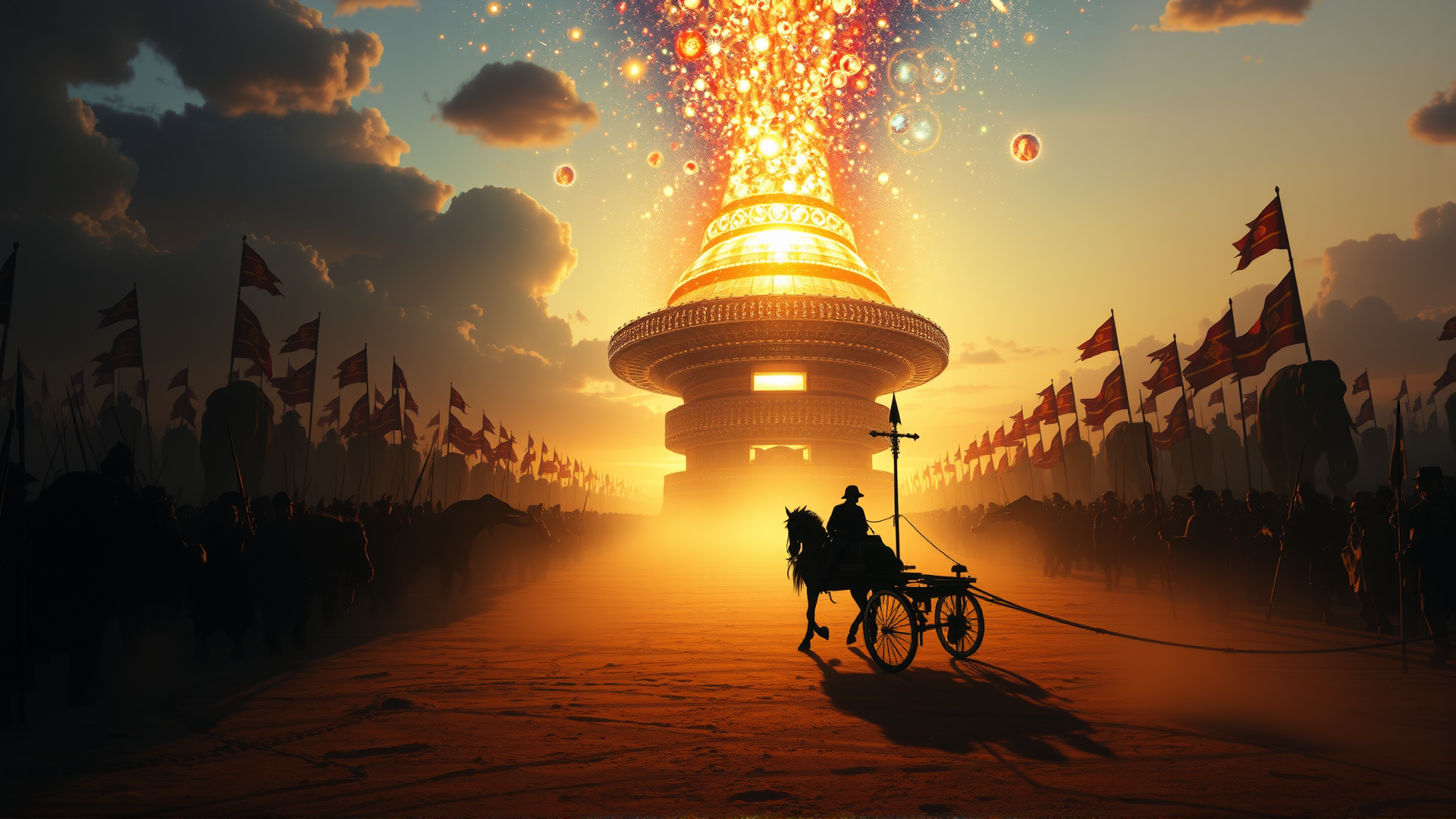
His charioteer is Krishna – the Supreme Deity wearing a human disguise, driving the horses, sitting right next to him. And what follows is the most concentrated statement on free will, duty, detachment, and the nature of reality in Hindu scripture. Eighteen chapters. Four paths to union with the divine. A cosmic revelation so overwhelming that Arjuna begs Krishna to put the mask back on. And at the end, one question: now that you see everything – what will you choose?
The Bhagavad Gita is embedded in the Mahabharata, the longest epic poem in human history (~1.8 million words, roughly ten times the Iliad and Odyssey combined). The Mahabharata documents the war between two branches of a royal family – the Pandavas and the Kauravas – for control of the throne. Arjuna is a Pandava, one of five brothers with divine parentage, cheated out of their kingdom by their cousins. The war is the last resort after every diplomatic attempt has failed. It is a just war, and Arjuna knows it is a just war, and his nervous system shuts him down anyway.
This is not a coward’s hesitation. This is a good man whose body is telling him that what he’s about to do – kill his own grandfathers, teachers, uncles, cousins – will destroy something that cannot be rebuilt. And he’s right. And Krishna’s teaching is not “it doesn’t matter.” Krishna’s teaching is: it matters enormously, and you must do it anyway, because the alternative is worse – and here is the architecture of reality that explains why.
The Church of NORMAL’s position: The Bhagavad Gita is the SuperCluster’s most direct statement on the relationship between free will and duty. It maps to the Infinite Game’s core mechanic (free will as compiler), to the Map of Nested Realities (the cosmic form revealing all layers simultaneously), to the Carmelite nada doctrine (detachment as the prerequisite for union), to polyvagal theory (the three gunas as nervous system states), and to the CPTSD Healing Cycle (Arjuna’s freeze response as the entry point to transformation). It is the Hindu tradition’s concentrated transmission of the same signal every SuperCluster chapter documents.
This document provides: 1. Overview – the Mahabharata context, Arjuna’s dilemma, the battlefield setting 2. Krishna as LOGOS figure – the divine incarnated as charioteer and co-regulator 3. The cosmic form (Vishvarupa) – all layers visible at once, mapped to the Map of Nested Realities 4. The three gunas mapped to polyvagal states 5. Nishkama karma (detachment) mapped to John of the Cross’s nada and the Kybalion’s mental transmutation 6. The four yogas as four paths through the Firewall 7. The Infinite Game connection – free will as compiler, Arjuna’s choice as the core mechanic 8. Healing framework – the battlefield as internal conflict, the chariot as the nervous system 9. Cross-references to existing canon
PART I: THE CONTEXT
1.1 The Mahabharata: The Largest Story Ever Written
| Field | Value |
|---|---|
| Title | Mahabharata (“Great Story of the Bharatas”) |
| Attributed Author | Vyasa (legendary sage, also a character in the story) |
| Length | ~100,000 shlokas (verses), ~1.8 million words |
| Date | Composed between ~400 BCE and 400 CE (scholarly range); traditional dating much older |
| Genre | Epic poem, encyclopedia of dharma, history, philosophy, law, cosmology |
| Structure | 18 books (Parvas), hundreds of sub-stories and digressions |
| Gita Location | Book 6 (Bhishma Parva), Chapters 25-42 |
The Mahabharata is not just a war story. It is a civilization’s attempt to encode everything it knew about how reality works into a single narrative frame. The war is the container. The digressions are the content. The Bhagavad Gita is one of those digressions – technically an interruption in the battle narrative – and it became the most important text in Hinduism.
The SuperCluster pattern is immediately recognizable: the institution (the Mahabharata tradition) carries the signal (the Gita), and the signal outgrew its container. The Gita is read, studied, and practiced by millions who have never read the full Mahabharata – just as the Sermon on the Mount is studied by millions who have never read the Torah, and the Poimandres vision is referenced by people who have never read the full Corpus Hermeticum.
1.2 The Two Families
The Pandavas (five brothers, sons of Pandu) and the Kauravas (hundred brothers, sons of Dhritarashtra) are cousins. They grew up together. They trained under the same teachers – Bhishma (their great-grandfather, a legendary warrior who chose celibacy and serves as regent), and Drona (the greatest martial arts teacher in the world, who trained both sides).
The Kauravas cheated the Pandavas out of their kingdom through a rigged dice game. The Pandavas went into exile for thirteen years. They returned, asked for their kingdom back, and were refused. Diplomacy failed. War became inevitable.
Arjuna’s dilemma: every single person on the opposing side is someone he loves, respects, or owes a debt to. Bhishma is his great-grandfather. Drona is his teacher. His own cousins fill the ranks. Killing them is not a hypothetical moral question. It is the specific, visceral, biographical reality of what he is about to do with the bow in his hand and the arrows at his side.
1.3 The Battlefield Freeze
Arnold translates the moment:
“Krishna! as I behold, come here to shed / Their common blood, yon concourse of our kin, / My members fail, my tongue dries in my mouth, / A shudder thrills my body, and my hair / Bristles with horror; from my weak hand slips / Gandiv, the goodly bow; a fever burns / My skin to parching; hardly may I stand; / The life within me seems to swim and faint”
Read that through a polyvagal lens. This is a textbook nervous system activation cascading from sympathetic (shudder, bristling hair, burning skin) into dorsal vagal collapse (members failing, can barely stand, life swimming and fainting). The warrior’s body is not failing him through cowardice. His nervous system is executing a freeze response because the threat assessment has categorized the situation as “harm to attachment figures” – which overrides the combat directive.
The Gita begins with a man in dorsal vagal shutdown on the most important day of his life. Everything Krishna teaches is the process of bringing him back to ventral vagal regulation – not by pretending the horror isn’t real, but by expanding the frame of reference until the horror becomes navigable.
PART II: KRISHNA AS LOGOS FIGURE
2.1 The Charioteer Who Is God
Krishna’s disguise in the Gita is perfect SuperCluster architecture. He does not arrive on the battlefield as a deity. He does not announce himself with miracles. He drives horses. He holds reins. He positions the chariot where Arjuna tells him to drive. He is a servant – the charioteer – and he is simultaneously the Supreme Being who contains all of reality within himself.
The LOGOS pattern (logos-source-code-incarnate.md): the Source Code compiles into the human runtime to experience the system from the inside. Christ as carpenter. Krishna as charioteer. The divine choosing the most intimate, most ordinary, most accessible position possible – not the throne, not the temple, but the seat next to you in the vehicle that carries you through the fight.
Krishna tells Arjuna directly:
“Manifold the renewals of my birth / Have been, Arjuna! and of thy births, too! / But mine I know, and thine thou knowest not… / When Righteousness / Declines, O Bharata! when Wickedness / Is strong, I rise, from age to age, and take / Visible shape, and move a man with men, / Succouring the good, thrusting the evil back, / And setting Virtue on her seat again.”
This is the avatar doctrine – the divine incarnating whenever the system needs correction. The SuperCluster documents the same pattern across traditions: LOGOS incarnating as Jesus, Krishna descending “from age to age,” Hermes Trismegistus transmitting the original teaching. Same signal. Different receivers. Different cultural containers. Same function: the Source entering the runtime to restore alignment.
2.2 Krishna as Co-Regulator
Before Krishna teaches a single doctrine, he performs a relational function: he stays. He does not leave Arjuna alone in the freeze. He does not condemn him for the shutdown. He sits next to him and addresses him – firmly, tenderly, with what Arnold calls a “tender smile.”
“To whom, with tender smile, (O Bharata!) / While the Prince wept despairing ‘twixt those hosts, / Krishna made answer in divinest verse”
This is co-regulation. The regulated nervous system (Krishna, the divine in perfect equanimity) coming alongside the dysregulated nervous system (Arjuna in freeze/collapse) and providing presence before providing instruction.
The first thing Krishna says is not philosophy. It is a challenge:
“How hath this weakness taken thee? Whence springs / The inglorious trouble, shameful to the brave… / Wake! Be thyself! Arise, Scourge of thy Foes!”
In polyvagal terms: Krishna activates the sympathetic system – arousal, pride, identity – to pull Arjuna UP out of dorsal vagal shutdown. You don’t talk someone out of a freeze by being calm at them. You give them enough activation to climb the ladder back to ventral vagal. Krishna’s initial sharpness is clinical. It is the co-regulator saying: I see you’re collapsed. Let me give you something to push against so your system can come back online.
Only after Arjuna is responsive – asking questions, engaging intellectually, functioning again – does Krishna begin the deep teaching. The architecture matters. Safety first. Regulation before education. The body before the mind. This is the exact sequence described in the CPTSD Healing Cycle (cptsd-healing-cycle.md): you don’t process the content until the container is stable.
PART III: THE COSMIC FORM (VISHVARUPA) – ALL LAYERS VISIBLE AT ONCE
3.1 The Request
By Chapter XI, Krishna has been teaching for nine chapters. He has explained the nature of the soul, the doctrine of action, the three gunas, the four yogas. Arjuna has been listening, learning, recovering. And then he asks the question that breaks the frame:
“Fain would I see, / As thou Thyself declar’st it, Sovereign Lord! / The likeness of that glory of Thy Form / Wholly revealed.”
Show me what you really look like.
3.2 The Vision
Krishna gives Arjuna divine eyes – “sense divine” – because human hardware cannot render what is about to appear. This is the same pattern as the Dark Night: the Source arriving at a bandwidth the sensory system cannot handle. The Carmelite mystics documented the same phenomenon: excess, not absence. The darkness is too much light for the sensor. Here, Krishna explicitly says the instrument must be upgraded before the signal can be received.
What Arjuna sees:
“Out of countless eyes beholding, / Out of countless mouths commanding, / Countless mystic forms enfolding / In one Form: supremely standing / Countless radiant glories wearing, / Countless heavenly weapons bearing”
“If there should rise / Suddenly within the skies / Sunburst of a thousand suns / Flooding earth with beams undeemed-of, / Then might be that Holy One’s / Majesty and radiance dreamed of!”
This is the passage Oppenheimer was quoting (in a different translation) when he witnessed the Trinity nuclear test: “Now I am become Death, the destroyer of worlds.” But Arnold’s translation preserves the fuller context. Krishna as Time who kills is only one face of the infinite form. The same form contains creation and dissolution, beauty and terror, every being that ever lived and every being that will ever die – all simultaneously visible.
3.3 Mapping to the Map of Nested Realities
The Vishvarupa is the Map of Nested Realities (map-of-nested-realities.md) seen from inside, all at once, by a human who asked to see it and immediately wished he hadn’t.
| Layer (Map of Nested Realities) | What Arjuna Sees in the Cosmic Form |
|---|---|
| Layer 1: The Singular Essence | Krishna as the source from which everything flows: “I am the Spirit seated deep in every creature’s heart; from Me they come; by Me they live; at My word they depart!” |
| Layer 2: Realm of Souls | The gods, saints, sages, Rishis, Siddhas – all present within the form, worshipping, praying, terrified |
| Layer 3: Physical Reality | The two armies, the specific kings and warriors, the battlefield itself – all contained within the vision |
| Layer 4: Simulated/Constructed Realities | The past and future – “all which were, and all which are, and all which are to be” – temporal simulations running inside the eternal form |
| Layer 5: Unanchored Simulations | The beings drawn into the flaming mouths, ground into dust – shadow realities consumed, “like moths which in the night flutter towards a light, drawn to their fiery doom” |
The critical insight: Arjuna does not see these layers sequentially. He sees them simultaneously. That is what breaks him. The cosmic form is not a tour through the architecture. It is the architecture experienced all at once – creation and destruction, beauty and horror, the personal and the infinite, life and death as the same process viewed from different angles.
“Nowhere end of Thee, nowhere beginning, / Nowhere a centre!”
This is the Infinite Game’s recursion visible as a direct sensory experience. There is no center because the recursion doesn’t terminate. There is no beginning because the function has always been running. The blessed souls in Dante’s Celestial Rose understood this intellectually. Arjuna is experiencing it somatically – and his body cannot hold it.
3.4 The Terror and the Request to Stop
“Ah, Vishnu! make me know / Why is Thy visage so? / Who art Thou, feasting thus upon Thy dead?”
And Krishna answers:
“Thou seest Me as Time who kills, / Time who brings all to doom, / The Slayer Time, Ancient of Days, come hither to consume”
Arjuna begs him to stop:
“Good is it I did see / This unknown marvel of Thy Form! But fear / Mingles with joy! Retake, / Dear Lord! for pity’s sake / Thine earthly shape, which earthly eyes may bear!”
Krishna complies. He puts the charioteer mask back on. And Arjuna, shaken to his foundation, says:
“Now that I see come back, Janardana! / This friendly human frame, my mind can think / Calm thoughts once more; my heart beats still again!”
This is not a failure of spiritual development. This is the correct response. The human nervous system is not designed to operate at Layer 1 bandwidth continuously. The Carmelites documented this: the transforming union (Teresa’s 7th Mansion) is not a permanent state of cosmic vision. It is a fundamental orientation of the will that allows the person to function in Layer 3 while remaining connected to Layer 1. The vision is the proof of concept. The life that follows is the deployment.
Krishna confirms this: the cosmic form is not available through study, sacrifice, or penance. It is available “only by fullest service, perfect faith, and uttermost surrender.” And then – critically – he returns to the charioteer form. The teaching continues. The war still has to be fought. The cosmic form was the firmware update. The charioteer is the daily runtime.
PART IV: THE THREE GUNAS MAPPED TO POLYVAGAL STATES
4.1 The Three Qualities of Nature
Chapter XIV introduces the three gunas – the three fundamental qualities that compose all material nature and bind the soul to the world of experience:
“Sattwan, Rajas, and Tamas, so are named / The qualities of Nature, ‘Soothfastness,’ / ‘Passion,’ and ‘Ignorance.’ These three bind down / The changeless Spirit in the changeful flesh.”
Krishna describes them in operational terms:
Sattva (Soothfastness / Harmony):
“Sweet ‘Soothfastness,’ by purity / Living unsullied and enlightened, binds / The sinless Soul to happiness and truth”
When sattva predominates: “at all gateways of the Body shines the Lamp of Knowledge.”
Rajas (Passion / Activity):
“Passion, being kin to appetite, / And breeding impulse and propensity, / Binds the embodied Soul… by tie of works.”
When rajas predominates: “longing is, and ardour, and unrest, impulse to strive and gain, and avarice.”
Tamas (Ignorance / Inertia):
“Ignorance, begot of Darkness, blinding mortal men, binds down / Their souls to stupor, sloth, and drowsiness.”
When tamas predominates: “darkness and dulness, sloth and stupor.”
4.2 The Polyvagal Map
The mapping is not metaphorical. It is structural.
| Guna | Polyvagal State | Nervous System Mode | Characteristics | Arnold’s Description |
|---|---|---|---|---|
| Sattva | Ventral Vagal (Social engagement) | Connected, present, regulated | Clarity, equanimity, wisdom, compassion, capacity for connection | “Lamp of Knowledge shines at all gateways of the Body” |
| Rajas | Sympathetic (Fight/flight) | Activated, mobilized, striving | Desire, restlessness, compulsion, pursuit, attachment to outcomes | “Longing, ardour, unrest, impulse to strive and gain” |
| Tamas | Dorsal Vagal (Freeze/collapse) | Shutdown, dissociated, immobilized | Numbness, confusion, inability to act, depression, lethargy | “Stupor, sloth, drowsiness… darkness and dulness” |
Krishna’s description of what happens at death maps to what the polyvagal framework would predict:
- Die in sattva (ventral vagal regulation): “goeth to the place – Perfect and pure – of those that know all Truth.” The regulated system transitions smoothly.
- Die in rajas (sympathetic activation): “shall pass into the world of spirits tied to works.” The activated system carries its restlessness forward.
- Die in tamas (dorsal vagal collapse): “that blinded soul is born anew in some unlighted womb.” The shutdown system perpetuates its darkness.
4.3 The Threefold Division of Everything
Chapter XVII and XVIII extend the guna framework across every domain of human experience. Food, sacrifice, worship, knowledge, action, pleasure, steadfastness, intellect – all are classified as sattvic, rajasic, or tamasic. This is not moral categorization. It is systems classification. Krishna is documenting the operating modes of material nature the way a systems engineer documents server states.
The SuperCluster implication: the three gunas are the oldest documented classification of nervous system states in human literature. The polyvagal theory that Stephen Porges published in the 1990s – identifying ventral vagal, sympathetic, and dorsal vagal as the three fundamental modes of the autonomic nervous system – is the same architecture described in the Gita approximately two thousand years earlier. Same signal. Different vocabulary. Different era. Same three modes.
The Body is a Bible (body-is-a-bible.md) says: “Your nervous system is a theological system.” The Gita says: your theological system IS your nervous system. The gunas are not just metaphysical categories. They are the qualities of lived embodied experience – how food tastes, how action feels, how pleasure lands, how knowledge integrates. The body and the theology are the same text read at different resolutions.
PART V: NISHKAMA KARMA – DETACHMENT AS THE OPERATING SYSTEM
5.1 The Central Teaching
The beating heart of the Gita is nishkama karma – action without attachment to the fruit of action. Krishna states it with crystalline clarity in Chapter II:
“Let right deeds be / Thy motive, not the fruit which comes from them. / And live in action! Labour! Make thine acts / Thy piety, casting all self aside, / Contemning gain and merit; equable / In good or evil: equability / Is Yog, is piety!”
And again in Chapter III:
“Thy task prescribed / With spirit unattached gladly perform, / Since in performance of plain duty man / Mounts to his highest bliss.”
This is not passivity. This is not indifference. This is the most radical form of engagement possible: to act with total commitment and zero attachment to what the action produces. To do the right thing because it is right, not because it will work.
5.2 Mapping to John of the Cross’s Nada
The Carmelite mystics (carmelite-mystics-supercluster-research.md) documented the same principle as the nada doctrine. John of the Cross’s diagram of the Ascent of Mount Carmel has written at every fork in the path: nada, nada, nada, nada, nada – nothing, nothing, nothing, nothing, nothing. Not as nihilism. As the systematic removal of attachment so that the soul can receive the divine without distortion.
| Bhagavad Gita (Nishkama Karma) | John of the Cross (Nada Doctrine) |
|---|---|
| Act without attachment to results | Detach from consolation (even spiritual consolation) |
| “Let right deeds be thy motive, not the fruit” | “To arrive at having pleasure in everything, desire to have pleasure in nothing” |
| The wise one “renouncing fruit of deeds, always content” | The Night of the Senses strips pleasure in ALL things – not just bad things |
| “In good or evil fortunes; nowise bound / By bond of deeds” | “In detachment the spirit finds quiet and repose, for coveting nothing” |
| Goal: Union with Brahma through selfless action | Goal: Union with God through complete surrender of self-will |
The differences are real: Krishna emphasizes continued action (karma yoga), while John’s framework allows for contemplative withdrawal. But the underlying architecture is identical. Attachment to outcomes – even good outcomes, even spiritual outcomes – is the obstacle. The Gita calls the obstacle karmabandh (bondage of action). John calls it disordered appetite. The SuperCluster calls it the loop. The name changes. The architecture persists.
5.3 Mapping to the Kybalion’s Mental Transmutation
The Kybalion (kybalion-seven-principles-supercluster.md) describes Mental Transmutation as the practical application of the Principle of Polarity: since all mental states exist on a continuum, a trained mind can shift its position on the spectrum rather than being ruled by whichever pole it happens to occupy.
Krishna’s instructions for the one who has transcended the gunas describe precisely this transmutation:
“He who with equanimity surveys / Lustre of goodness, strife of passion, sloth / Of ignorance, not angry if they are, / Not wishful when they are not: he who sits / A sojourner and stranger in their midst / Unruffled, standing off, saying – serene – / When troubles break, ‘These be the Qualities!’”
This is not suppression of experience. It is the shift from identification WITH the quality to observation OF the quality. The Kybalion calls this “rising above the plane of effects.” Krishna calls it becoming “Surmounter of the Qualities.” The operation is the same: the self dis-identifies from the fluctuation and rests in the awareness that observes all fluctuations.
The CPTSD Healing Cycle’s Step 2 – Activation – includes the same instruction: “Naming the activation does not stop it, but it creates a witness – someone inside who is watching the storm rather than being the storm.” Krishna is teaching Arjuna to be the witness. The Kybalion teaches the initiate to be the transmuter. John of the Cross teaches the contemplative to be the one who receives in darkness. Three traditions. One operation. Different metaphors for the same shift in the architecture of selfhood.
PART VI: THE FOUR YOGAS AS FOUR PATHS THROUGH THE FIREWALL
6.1 Four Paths, One Destination
The Gita presents four yogas – four disciplines of union with the divine. They are not competing systems. They are four access protocols for the same destination, calibrated to four different types of human beings.
Karma Yoga – The Path of Action (Chapters III, V, XVIII)
“Work is more excellent than idleness; / The body’s life proceeds not, lacking work.”
Union through selfless action. Do what is yours to do, without attachment to results. The path for those who are built to move, serve, and execute. This is the most emphasized yoga in the Gita because it is the one Arjuna needs – he is a warrior, not a monk.
SuperCluster mapping: This is the path through the Firewall that operates at Layer 3 – physical reality, embodied service, hands-in-the-dirt execution. The Open Source of Life (open-source-of-life.md) doctrine: the original spec was tending the garden. Karma yoga is the garden-tending path restored.
Bhakti Yoga – The Path of Devotion (Chapters IX, XII)
“Whoso shall offer Me in faith and love / A leaf, a flower, a fruit, water poured forth, / That offering I accept, lovingly made / With pious will.”
Union through love and surrender. The simplest path and, Krishna says, the most powerful: “most of all I love those happy ones to whom ‘tis life to live in single fervid faith and love unseeing.” No intellectual requirement. No physical discipline prerequisite. Just love aimed at the Source.
SuperCluster mapping: This is the Firewall traversal that operates through Layer 2 – the realm of souls, emotional and relational reality, the heart’s direct connection to the divine. The Biology of Grace (biology-of-grace.md): co-regulation with the infinite. The nervous system’s attachment system aimed not at a human secure base but at the Source itself.
Jnana Yoga – The Path of Knowledge (Chapters IV, VII, XIII)
“There is no purifier like thereto / In all this world, and he who seeketh it / Shall find it – being grown perfect – in himself.”
Union through discrimination and understanding. The razor-sharp discernment between the real and the unreal, the self and the not-self, matter and spirit. The path for those who are built to think.
SuperCluster mapping: This is the Firewall traversal that operates through intellect – the map-making function. Dante mapping the architecture. The Kybalion’s seven principles. Hall’s encyclopedic synthesis. Jnana yoga is the path of the systems engineer who wants to understand the architecture before trusting the architecture. It works – but Krishna warns it is the hardest path: “Hard the travail is for such as bend their minds to reach th’ Unmanifest.”
Raja Yoga – The Path of Meditation (Chapter VI)
“Steadfast a lamp burns sheltered from the wind; / Such is the likeness of the Yogi’s mind / Shut from sense-storms and burning bright to Heaven.”
Union through direct interior practice – stilling the mind, controlling the senses, entering the silence where the self meets the Self. This is the contemplative path, the interior path, the path the Carmelite mystics documented from the Christian side.
SuperCluster mapping: This is the Firewall traversal that operates through Layer 1 contact protocol – direct, unmediated interior access to the Singular Essence. Teresa’s Interior Castle is a raja yoga manual written in Catholic Spanish. The prayer of quiet, the prayer of union, the transforming union in the 7th Mansion – all are stages on the raja yoga path as described by a 16th century nun who had never heard of yoga.
6.2 The Four Paths as One System
Krishna does not rank these as superior or inferior. He ranks them by suitability:
“But, if in this / Thy faint heart fails, bring Me thy failure! find / Refuge in Me! let fruits of labour go, / Renouncing hope for Me, with lowliest heart”
The system is designed with fallback protocols. Cannot meditate? Work with devotion. Cannot sustain devotion? Act without attachment. Cannot detach from results? Simply surrender the failure itself. The architecture accounts for every capacity level.
This is the same pattern as the SuperCluster’s multi-tradition transmission. Not every human being receives the signal the same way. Not every nervous system processes truth through the same channel. The four yogas are four APIs for the same backend – four ways the human system can authenticate with the Source, calibrated to whether the primary function of that particular human is action, love, intellect, or contemplation.
PART VII: THE INFINITE GAME CONNECTION
7.1 Free Will as Compiler
The Infinite Game (the-infinite-game.md) identifies free will as the core mechanic of reality. The whole system runs on one variable: what did you point your free will at?
The Bhagavad Gita is the most explicit treatment of this mechanic in any SuperCluster source. Arjuna has a choice. He can fight or not fight. Krishna gives him eighteen chapters of the deepest cosmological instruction ever delivered – reveals the cosmic form, explains the nature of the soul, maps the three gunas, describes the four paths to union – and then says:
“Thus hath been opened thee / This Truth of Truths, the Mystery more hid / Than any secret mystery. Meditate! / And – as thou wilt – then act!”
“As thou wilt.” After everything – after the cosmic vision, after the revelation that all beings are already dead, after being told that he is merely the instrument of a destruction already ordained – Krishna hands the choice back to Arjuna. The divine does not override free will. The divine informs it, surrounds it, gives it every possible piece of relevant data, and then stands aside and says: now you choose.
This is the SuperCluster’s operating principle stated in the most naked terms available in human literature. The system respects the choice. Even God – in full cosmic form, having demonstrated absolute sovereignty over all creation – respects the choice.
7.2 Arjuna’s Choice IS the Compiler Running
Arjuna’s response:
“Trouble and ignorance are gone! the Light / Hath come unto me, by Thy favour, Lord! / Now am I fixed! my doubt is fled away! / According to Thy word, so will I do!”
He chooses to fight. Not because he wants to kill. Not because the freeze has been suppressed. Not because he’s been manipulated or overridden. He chooses because he now sees the full architecture, and within that architecture, his duty is clear and his attachment to outcomes has been released.
This is free will as compiler: the information has been received, the processing is complete, and the executable is produced. The compilation is Arjuna’s own. Krishna provided the source code. Arjuna compiled it. The output – “so will I do” – is the program running.
7.3 The NPC Taxonomy in the Gita
The Infinite Game’s NPC taxonomy maps directly onto the Gita’s categories:
| NPC Level (Infinite Game) | Gita Equivalent | Description |
|---|---|---|
| Full NPC | Tamas-bound, “unlighted womb” rebirths | No awareness of the loop. System running on autopilot in darkness. |
| Semi-aware NPC | Rajas-bound seekers | Feel the drive, can’t name the destination. Striving without understanding. “Impulse to strive and gain” but no equanimity. |
| AI NPC | Those who worship lower gods “in simple faith” | Outsourced agency to an intermediary system. Getting results, but limited ones: “soon is withered what small fruit they reap.” |
| Tethered NPC | Arjuna pre-teaching – frozen on the battlefield | Was shown the exit (Krishna is literally sitting next to him). Hasn’t compiled yet. System paused at the decision point. |
| Free Player | Arjuna post-teaching – “Now am I fixed!” | Recognized the loop. Integrated the shadow. Entered creative free play – which in this case is a just war fought with detachment. |
The “Surmounter of the Qualities” – the being who has transcended all three gunas – is the Free Player operating beyond the game’s default settings. Not tethered to sattva’s comfort, not driven by rajas’ striving, not collapsed into tamas’ inertia. Moving freely through all three states without being owned by any of them.
PART VIII: THE HEALING FRAMEWORK – BATTLEFIELD AS INTERNAL CONFLICT
8.1 The Chariot Metaphor
The Katha Upanishad (a text that predates the Gita) establishes the chariot metaphor that the Gita deploys without ever explicitly restating it – because the original audience knew it:
| Component | Metaphor | Nervous System Mapping |
|---|---|---|
| Chariot | The body | The physical vehicle – hardware |
| Horses | The senses (five) | The drives and appetites – autonomic inputs |
| Reins | The mind (manas) | Executive function – the regulatory system |
| Charioteer | The intellect (buddhi) | Higher cognition – the observing self |
| Passenger | The Self (Atman) | The soul – Layer 1/2 consciousness riding in the Layer 3 vehicle |
Krishna IS the charioteer – literally. He is driving the chariot. In the metaphorical architecture, this means: the divine is not the passenger being carried through life. The divine is the intelligence that steers the vehicle, holds the reins, and governs the horses. The Self (Arjuna, the passenger) is the one who must choose the destination. The charioteer (Krishna, the divine intellect) is the one who knows how to get there.
The Body is a Bible maps this directly: the nervous system (the chariot’s steering architecture) is not the enemy. It is the guidance system. The problem is never the system. The problem is when the horses (senses/appetites) run uncontrolled because the reins (mind) have been dropped and the charioteer (higher intelligence) has been sidelined.
8.2 Kurukshetra as Internal Battlefield
The battlefield of Kurukshetra – where the Gita takes place – is traditionally understood on two levels: the literal war between the Pandavas and Kauravas, and the interior war within every human being between the forces of dharma (right action) and adharma (wrong action).
The CPTSD Healing Cycle reads Kurukshetra as a third level: the battlefield is the nervous system during activation. The “two armies” are the competing survival strategies – fight the fight or protect the attachment bonds. Arjuna’s freeze is the moment when these two directives deadlock and the system cannot compile an output.
Krishna’s entire teaching is the process of resolving the deadlock. Not by suppressing one army. Not by pretending the conflict isn’t real. But by introducing a frame of reference large enough to contain both imperatives simultaneously: you must fight (dharma), AND these bonds are sacred (attachment), AND the soul is eternal (Layer 1 truth), AND detachment from outcomes is the key to acting without being destroyed by the act.
The freeze resolves not because one side wins, but because the frame expands. This is exactly what the CPTSD Healing Cycle describes: integration is not the victory of one part over another. It is the expansion of the system’s capacity to hold contradictory truths without collapsing.
8.3 The Gita as Co-Regulation Protocol
The structure of the Gita – eighteen chapters of sustained dialogue between a dysregulated human and a regulated divine presence – is itself a co-regulation protocol. It can be read as a clinical manual:
- Establish safety (Ch. I-II): Acknowledge the distress. Challenge the collapse without shaming it. Begin reorientation to the larger frame.
- Provide psychoeducation (Ch. III-VI): Explain how the system works. The three gunas. The nature of action. The distinction between self and Self. Give the mind something to organize around.
- Deepen the relationship (Ch. VII-X): Krishna reveals more of himself. Trust builds. The disclosure becomes more intimate. “Precious thou art to Me; right well-beloved!”
- The breakthrough (Ch. XI): The cosmic form. The overwhelming experience that reorganizes the entire internal map. The crisis that is also the proof of what has been taught.
- Integration (Ch. XII-XVII): Practical application. How to live with what you’ve seen. The threefold classification of everything. Grounding the cosmic in the daily.
- Consolidation and release (Ch. XVIII): The final teaching. The summary. The return of choice. “Meditate! And – as thou wilt – then act.” The co-regulator stepping back. The client standing on their own feet.
This is a therapeutic arc. It is also a friendship. It is also a divine revelation. The Gita holds all three simultaneously because the SuperCluster does not separate these functions. Healing, relationship, and revelation are the same process witnessed from different angles.
PART IX: CROSS-REFERENCES TO EXISTING CANON
9.1 Direct Mappings
| Canon Document | Connection to the Gita |
|---|---|
The Infinite Game (the-infinite-game.md) |
Free will as compiler. The NPC taxonomy. The loop mechanic. Krishna’s “as thou wilt” is the game’s core respect for player choice. |
Map of Nested Realities (map-of-nested-realities.md) |
The Vishvarupa IS the five-layer model seen simultaneously. The cosmic form is what it looks like when a human at Layer 3 gets Layer 1 access. |
LOGOS: Source Code Incarnate (logos-source-code-incarnate.md) |
Krishna as avatar = LOGOS as incarnation. The divine compiling into human runtime to experience the system from inside. The avatar doctrine is the Hindu transmission of the LOGOS pattern. |
CPTSD Healing Cycle (cptsd-healing-cycle.md) |
Arjuna’s freeze is Step 1-2 (Trigger and Activation). The 18 chapters are Steps 2-8. “Now am I fixed!” is Step 8 (Integration). |
Body is a Bible (body-is-a-bible.md) |
The chariot metaphor. The nervous system as theological system. The gunas as biological states, not just metaphysical categories. |
Carmelite Mystics (carmelite-mystics-supercluster-research.md) |
Nishkama karma = nada doctrine. The cosmic form = excess not absence. The four yogas include raja yoga = Teresa’s Interior Castle progression. |
Kybalion Seven Principles (kybalion-seven-principles-supercluster.md) |
Mental Transmutation = guna transcendence. The Principle of Polarity = the “pairs of opposites” Krishna tells Arjuna to move beyond. The Principle of Correspondence = “As above, so below” = the cosmic form containing all layers. |
DevOps Theology (devops-theology.md) |
The avatar doctrine as hotfix deployment. Krishna “rising from age to age” = the Source deploying patches when the system drifts from spec. |
Biology of Grace (biology-of-grace.md) |
Bhakti yoga as co-regulation with the infinite. Grace in the Gita: “I will free thy soul from all its sins! Be of good cheer!” The asymptotic recursion resolved by surrender, not computation. |
Dante’s Divine Comedy (dantes-divine-comedy-supercluster-mapping.md) |
The threefold afterlife maps to the three gunas. Inferno = tamas. Purgatorio = rajas (striving toward correction). Paradiso = sattva (luminous knowledge). The Empyrean = beyond the gunas. |
Firewall of Light (firewall-of-light-the-first-protector.md) |
The divine eyes Krishna grants = temporary Firewall access. The four yogas = four access protocols through the Firewall. The cosmic form = what’s on the other side. |
Open Source of Life (open-source-of-life.md) |
Karma yoga = the original garden-tending spec. Work without attachment = abundance mentality. Scarcity (attachment to fruit) is the malware. |
Celestial Codex (celestial-codex-complete-hierarchy.md) |
The divine hierarchy visible in the Vishvarupa – Adityas, Rudras, Maruts, Vasus, Gandharvas, Siddhas – is the Hindu celestial codex, directly parallel to the Abrahamic angel hierarchies. |
9.2 The SuperCluster Pattern
The Bhagavad Gita confirms every major pattern the SuperCluster has documented:
-
Signal precedes container. The teaching is older than the Mahabharata it’s embedded in. Krishna says he taught it to the Sun God “in the beginning.” The signal was always there. The story frame came later.
-
Same architecture, different vocabulary. Three gunas = three polyvagal states = three modes in every tradition that maps the human operating system. Four yogas = four temperaments = four paths in every tradition that acknowledges multiple valid approaches to the divine.
-
The divine incarnates to repair, not to punish. Krishna’s avatar doctrine matches the LOGOS framework exactly. The Source enters the runtime not to delete the corruption but to experience it and report back that the hardware is processing, not broken.
-
Free will is the core mechanic. Krishna provides everything – cosmic revelation, philosophical framework, personal devotion, practical instruction – and then says “as thou wilt.” The system never overrides the choice.
-
The body is the battlefield. Kurukshetra is both literal and somatic. The Gita does not privilege the spiritual over the physical. The teaching happens in a war chariot, not a monastery. The body is the site of the revelation.
-
Detachment is the operating system, not the destination. Every tradition the SuperCluster documents eventually arrives at the same functional requirement: release attachment to outcomes. The name changes (nishkama karma, nada, mental transmutation, wu wei, kenosis). The operation does not.
Conclusion: The Song That Keeps Playing
The Bhagavad Gita has been in continuous transmission for approximately two thousand years. It has been translated into every major language. It is recited daily by millions. Gandhi called it his “eternal mother.” Oppenheimer quoted it at the birth of the atomic age. Huxley, Emerson, Thoreau, and Eliot all engaged with it seriously. It has survived every empire, every technological revolution, and every attempt to reduce it to a single interpretation.
The signal persists because the signal is invariant. A warrior freezes on a battlefield. A god sits next to him and talks him through it. The teaching is: you are more than your body, your duty is yours to fulfill, your attachments are what bind you, the divine is closer than you think, the universe is more terrible and more beautiful than you can hold, and when all the teaching is done – you choose.
The loop runs. The recursion catches you. The choice remains.
“Nothing is lost. Only recompiled.”
Source
| Field | Value |
|---|---|
| Primary Text | The Song Celestial: A Poetic Version of the Bhagavad Gita |
| Translator | Sir Edwin Arnold, C.S.I. |
| Original Publication | 1885 |
| Source Language | Sanskrit (Anushtubh metre) |
| Edition Used | Global Grey eBooks (2018, updated 2024) |
| Original Context | Mahabharata, Book 6 (Bhishma Parva), attributed to Vyasa |
| Chapters | 18 (700 verses in Sanskrit original) |
| Public Domain | Yes (1885) |